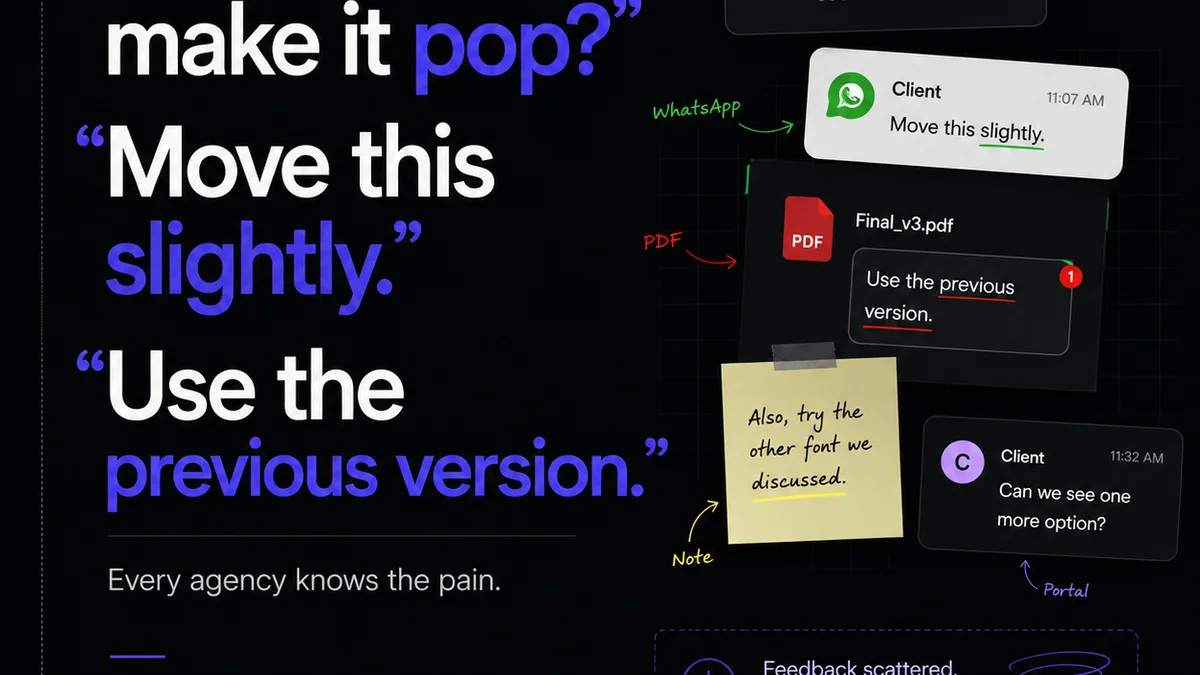
Everyone talks about managing client feedback. You know the drill: centralize it, make it actionable, get approvals. It’s good advice. It’s just not the whole story.
The real trend isn’t just *how* feedback comes in. It’s the evolving *nature* of the requests themselves.
The hard truth? The requests you’re getting today are fundamentally different from the ones you were getting even two years ago. And if you’re not paying attention, you’re already behind.
1. The Rise of the Micro-Request
Remember when a client brief meant a substantial project? A campaign, a website redesign, a new product launch. Those still happen, of course.
But now, they’re often layered with a constant stream of smaller, more immediate asks. “Can we just tweak this headline?” “Could you swap this image?” “What about a quick GIF of that logo animation?”
These aren’t necessarily bad requests. They’re a symptom of a faster-paced digital world and clients who are more hands-on than ever.
The Downside: Death by a Thousand Cuts
The problem isn’t the individual micro-request. It’s the aggregate effect.
- Unaccounted-for hours bleeding into profitability.
- Team members constantly context-switching, killing deep work.
- Scope creep disguised as “small edits.”
- Frustration building because the real project momentum is lost.
You can’t just tell clients “no” to every small thing. But you also can’t let them derail your entire operation.
2. The Specter of the “Unsolicited” Revision
This is the one that makes creative directors’ eyes twitch.
A client loves the work. It’s approved. Signed off. Then, days or weeks later, a new email lands: “Hey, we were thinking…”
Suddenly, the approved direction is up for debate. A new stakeholder has weighed in. Or they’ve just had an “aha!” moment that requires a complete pivot.
Why It’s Becoming More Common
- Increased stakeholder involvement at all levels.
- Clients trying to “future-proof” creative with last-minute changes.
- A misunderstanding of the creative process and the cost of re-work.
- Fear of missing out (FOMO) on a “better” idea.
This isn’t about clients being difficult. It’s often about their own internal pressures and a lack of clarity on *when* creative decisions are final.
The impact on your team’s morale and your project timelines can be devastating.
3. The “Show Me More Options” Mirage
Clients often think asking for more options is a sign of thoroughness. They want to explore the landscape.
“Just give us three more directions.” “What if we tried X, Y, and Z?”
This sounds reasonable. It sounds collaborative.
The Underlying Problem: Indecision
More often than not, this isn’t a genuine request for exploration. It’s a mask for indecision. Or worse, a way to defer a difficult conversation about strategy or budget.
- They don’t actually know what they want.
- They’re afraid of committing to the *wrong* thing.
- They’re trying to get more value for the same price.
- They haven’t done their own internal homework.
Each “extra option” requested is often hours of creative work that might never see the light of day, pulled from the team’s capacity to deliver the *actual* winning concept.
4. The Data-Driven Mandate (Without the Data)
“Make it more like X.” “We saw this on TikTok, can we do that?” “Our competitor is doing Y, we need that.”
Clients are increasingly referencing external benchmarks, competitor activity, or vague performance data. They *want* their creative to be data-informed.
But they often lack the actual data, or the strategic thinking, to articulate *why* something is working or how it applies to their specific goals.
The Challenge for Creatives
You’re expected to translate these surface-level observations into strategic creative execution. Without clear objectives or robust data, you’re shooting in the dark.
- Vague references to trends replace clear strategic direction.
- “What’s working for them” becomes the brief, not “what’s right for us.”
- The pressure to create viral hits overshadows brand consistency.
This trend demands a higher level of strategic partnering from your agency, not just creative execution.
5. The “Just Use AI” Expectation
This one is new, and it’s rapidly becoming a major point of friction.
Clients hear about AI image generators, AI copywriting tools, AI video editors. They see the headlines.
And they start asking: “Can’t AI just do this?” or “How much will this cost if we use AI?”
The Reality Check
AI is a tool. A powerful one, yes. But it’s not a replacement for strategy, creative direction, or nuanced execution. It requires significant human oversight, prompt engineering, curation, and editing to produce anything truly valuable and on-brand.
- Clients often underestimate the human input required.
- They confuse the *idea* of AI with the *output* of AI.
- They assume AI instantly solves complex creative problems.
This trend requires educating your clients and setting very clear expectations about what AI can and cannot do for *their* specific project, and at what cost.
Where Revue Fits In
These trends aren’t just abstract concepts. They’re daily operational challenges that impact your team’s sanity and your agency’s bottom line.
Revue helps you cut through the noise. It’s not just about collecting feedback; it’s about structuring it. It’s about bringing clarity to the chaos of creative requests.
- Centralized Feedback: All client input, from the smallest tweak to the biggest strategic question, lives in one place. No more hunting through email chains or Slack messages.
- Revision & Approval Visibility: Track every version, every comment, every approval. This creates a clear audit trail, making it harder for “unsolicited” revisions to sneak in after sign-off.
- Quality Control: By organizing feedback and revisions, you maintain a higher standard for the final output. You can see where scope creep might be happening and address it proactively.
- Client Collaboration: Use Revue to guide clients through the process, making it clear when decisions need to be made and what the implications of changes are.
When requests are managed systematically, you can identify these trends *before* they become major problems. You can see the pattern of micro-requests, the risk of unsolicited changes, the indecision masked as exploration, and the vague data prompts.
Final Thought
Are you just reacting to client requests, or are you proactively shaping the creative process? The distinction is everything.
Frequently asked questions
What are micro-requests in creative projects?
Micro-requests are small, often frequent, and seemingly minor adjustments or additions asked for by clients, such as headline tweaks, image swaps, or quick format changes, which can collectively impact project scope and team focus.
How can agencies handle unsolicited revisions effectively?
Effectively handling unsolicited revisions involves establishing clear approval processes, maintaining a documented audit trail of all changes and sign-offs, and educating clients on the impact and cost of post-approval changes.
What does the 'Show Me More Options' trend signify?
The 'Show Me More Options' trend often indicates client indecision or a fear of commitment rather than a genuine desire to explore diverse creative directions. Agencies should guide clients towards making strategic decisions based on defined goals.
How should creative leaders address the 'Just Use AI' expectation?
Address the 'Just Use AI' expectation by educating clients on AI's current capabilities and limitations, emphasizing the essential human input required for strategy, quality, and brand alignment, and setting clear expectations for AI-assisted projects.