Everyone talks about ROI. Return on Investment. It’s the bedrock of business decisions, the metric that separates dreams from dollars. And when it comes to creative work, the assumption is that it’s too fuzzy, too subjective, too *artistic* to measure. That it lives in a separate universe from hard numbers.
None of that is wrong. But it’s incomplete.
The hard truth is that creative work is measurable. Not just in terms of likes and shares, but in its direct impact on your agency’s bottom line and your clients’ business objectives. The real challenge isn’t *if* you can measure creative ROI, but *how* you do it effectively, consistently, and in a way that actually drives better decisions.
This isn't about turning creativity into a spreadsheet. It's about building a framework to understand its impact, justify its value, and optimize its performance.
1. Defining Creative ROI: What We're Actually Measuring
Let’s cut through the noise. Creative ROI isn’t just about proving that a campaign *worked*. It’s about understanding how much it worked relative to the resources invested. This means moving beyond anecdotal evidence and vanity metrics.
Vanity metrics are those shiny numbers that look good but don’t necessarily translate to business success. Think follower counts, raw impressions, or even engagement rates if they don’t lead to conversions.
The Real Drivers of Value
True creative ROI links directly to tangible business outcomes. For an agency, this could mean:
- Increased client retention and lifetime value.
- Attracting higher-paying clients who value strategic creative.
- Improved project profitability through efficient workflows and clear approvals.
- Reduced internal churn due to clear project goals and recognized impact.
For your clients, it’s even more direct:
- Lead generation and conversion rates.
- Sales growth and revenue increases.
- Brand awareness and market share shifts.
- Customer acquisition cost (CAC) reduction.
- Customer lifetime value (CLV) enhancement.
The key is to define these outcomes before the creative work begins. What does success look like, and how will we know we’ve achieved it? Without clear objectives, you’re flying blind.
2. The Inputs: What Goes into Creative Investment
Understanding the 'investment' side of the ROI equation is crucial. This isn't just about the hours billed. It’s the total cost of bringing creative ideas to life.
Think broadly about all the resources consumed.
Direct Costs
- Labor: Salaries, contractor fees, freelance costs for designers, copywriters, strategists, project managers, account managers.
- Tools & Software: Subscription fees for design software, project management tools, stock imagery, video editing suites, analytics platforms.
- Production: Printing, media buys, video production, photography, event costs.
Indirect Costs
These are often overlooked but can significantly impact profitability.
- Overhead: Rent, utilities, administrative staff, insurance.
- Rework & Revisions: Time spent on revisions due to unclear briefs, scope creep, or delayed feedback. This is a major profit killer.
- Opportunity Cost: What else could your team have been working on? The time spent on one project is time lost on another potential revenue-generating opportunity.
- Client Management: Time spent in meetings, managing expectations, and chasing feedback.
Accurately tracking these inputs is the first step to understanding the true cost of creative output. Without this data, any ROI calculation is just a guess.
3. Measuring the Outputs: Connecting Creative to Business Results
This is where many agencies falter. They deliver great creative, but struggle to articulate its business impact. The 'output' isn't just the final design file; it's the business result that creative drove.
Attribution Models: The Holy Grail (and the Headache)
Attributing a specific business outcome to a single piece of creative work can be complex. Customers interact with brands across multiple touchpoints. Was it the social media ad, the email campaign, or the website landing page that finally closed the deal?
This is where understanding attribution models comes in. Common models include:
- First-Touch Attribution: Gives all credit to the first interaction a customer has with your brand. Simple, but often inaccurate.
- Last-Touch Attribution: Gives all credit to the final interaction before conversion. Also simple, but ignores the customer journey.
- Linear Attribution: Distributes credit equally across all touchpoints. Better, but still lacks nuance.
- Time-Decay Attribution: Gives more credit to touchpoints closer to the conversion.
- Position-Based (U-Shaped) Attribution: Credits the first and last touchpoints most, with remaining credit distributed among middle touches.
- Data-Driven Attribution: Uses machine learning to assign credit based on actual performance data. The most sophisticated, but requires robust data.
The 'best' model depends on your client’s sales cycle and marketing strategy. The crucial point is to agree on a model and track consistently.
Beyond Digital: Measuring Offline Impact
Don't forget the power of offline creative. How do you measure the ROI of a billboard, a direct mail piece, or a brand experience event?
- Unique promo codes or landing pages for offline campaigns.
- Post-event surveys and lead capture.
- Brand lift studies (though these can be costly).
- Tracking overall sales trends in the geographic area of an offline campaign.
It requires creativity in measurement, just as much as in the creative itself.
4. Calculating Creative ROI: The Formula and Its Nuances
At its simplest, the ROI formula is:
ROI = (Net Profit from Creative - Cost of Creative Investment) / Cost of Creative Investment * 100
Let’s break that down:
- Net Profit from Creative: This is the revenue directly attributable to the creative work, minus the direct costs associated with generating that revenue (e.g., cost of goods sold).
- Cost of Creative Investment: This is the total cost of producing and executing the creative, including all direct and indirect costs mentioned earlier.
Example:
An agency runs a targeted social media ad campaign for a client.
- Cost of Investment: $5,000 (ad spend + design/copywriting time + agency management time).
- Revenue Generated (Attributed): $50,000 in sales.
- Cost of Goods Sold (for those sales): $20,000.
- Net Profit from Creative: $50,000 - $20,000 = $30,000.
- ROI: ($30,000 - $5,000) / $5,000 * 100 = 500%.
This looks great. But ROI isn't just a single number. It’s a lens through which to view performance.
Nuances and Considerations
- Time Horizon: Is this short-term campaign ROI or long-term brand-building ROI? The measurement differs.
- Risk Adjustment: Higher potential rewards often come with higher risk. How do you factor that in?
- Strategic Goals: Sometimes, the 'ROI' isn't purely financial. It might be increased brand perception, market entry, or customer loyalty, which have future financial implications.
- Benchmarking: How does this ROI compare to other marketing efforts or previous creative campaigns?
Don't let the complexity paralyze you. Start with a simple, agreed-upon method and refine it over time.
5. Where Revue Fits In
Measuring creative ROI effectively hinges on streamlined workflows, clear communication, and centralized project data. This is where tools like Revue become indispensable.
Think about the common friction points that kill creative ROI:
- Endless revision cycles due to unclear feedback.
- Missed deadlines because project status is a mystery.
- Scope creep that balloons costs without adding value.
- Difficulty proving the value of creative work to clients (or internal stakeholders).
Revue tackles these head-on by providing a single source of truth for creative projects.
Centralized Feedback & Approvals
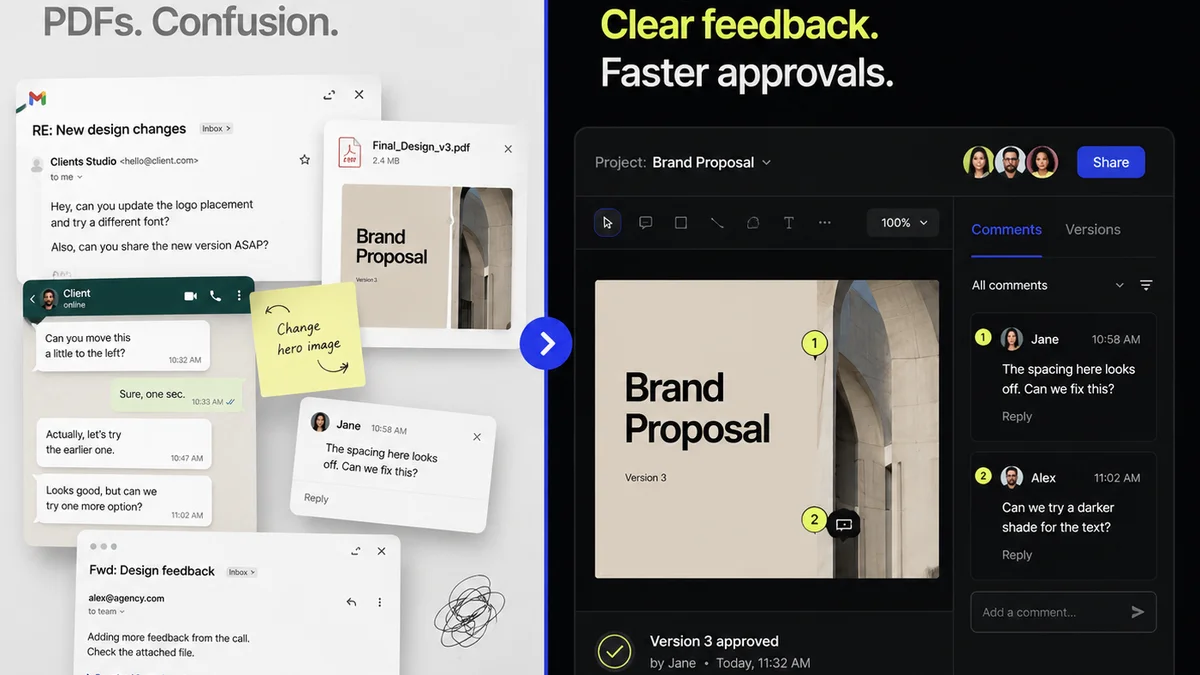
Instead of wading through scattered emails and Slack threads, all client feedback lives directly on the asset within Revue. This means:
- Clear, actionable comments tied to specific versions.
- Reduced back-and-forth, saving valuable hours.
- A documented history of decisions, crucial for tracking scope and justifying costs.
Revision & Approval Visibility
Project managers and clients gain clear visibility into the revision and approval process. Everyone knows what’s been reviewed, what’s pending, and what’s approved. This transparency:
- Minimizes delays caused by lost feedback or unclear status.
- Ensures everyone is working from the latest approved version.
- Builds client confidence and streamlines the path to final delivery.
Quality Checks & Project Archiving
Before final delivery, Revue facilitates thorough quality checks. And once a project is complete, all assets, feedback, and approvals are archived. This historical data is invaluable for:
- Analyzing project performance post-mortem.
- Identifying patterns in feedback or common revision requests that signal process issues.
- Providing concrete evidence of creative impact and client collaboration for future proposals or case studies.
By optimizing the operational side of creative production, Revue helps you reduce the *costs* associated with creative work and improve the clarity of its *outcomes*, directly boosting your measurable ROI.
6. Final Thought
The pursuit of creative ROI isn't about stripping the soul out of design or strategy. It's about elevating it. It's about demonstrating that creativity isn't just a cost center, but a powerful engine for business growth.
So, the question isn't whether you can afford to measure creative ROI. The real question is: can you afford not to?
Frequently asked questions
What's the difference between vanity metrics and true ROI metrics for creative work?
Vanity metrics are surface-level numbers like social media likes or follower counts that look good but don't necessarily drive business results. True ROI metrics directly link creative efforts to tangible business outcomes like increased sales, lead generation, or customer acquisition cost reduction.
How can I accurately track the 'investment' side of creative ROI?
Track all direct costs (labor, software, production) and indirect costs (overhead, rework, opportunity cost, client management time). A comprehensive view of all resources consumed is essential for an accurate ROI calculation.
Is it possible to measure the ROI of offline creative campaigns like print ads or events?
Yes, though it requires creative measurement strategies. Use unique promo codes, dedicated landing pages, post-event surveys, and track overall sales trends in relevant areas. Consistent tracking and attribution are key.
How does a tool like Revue help improve creative ROI?
Revue streamlines creative workflows by centralizing feedback and approvals, improving visibility, and reducing costly rework and delays. This operational efficiency directly reduces the cost of creative investment and clarifies project outcomes, boosting measurable ROI.