Everyone wants to scale their creative operations. More output, faster turnaround, bigger clients. The assumption is simple: hire more designers, writers, and project managers. Problem solved.
None of that is wrong. But it’s incomplete. Deeply incomplete.
The hard truth is that most companies *fail* at creative scaling not because they can’t find talent, but because they’re trying to pour more work into a fundamentally broken process. You can hire a hundred people, but if your feedback loops are tangled, your revision tracking is a mess, and your quality assurance is an afterthought, you’ll just end up with a hundred frustrated people doing the same inefficient work, only faster.
1. The Illusion of More Capacity
The default move is always to add headcount. Agency owner X says they’re drowning. Their solution? Hire two more account managers and a senior designer. In-house creative director Y feels the pressure. They get budget for three more junior creatives.
This looks like growth. It feels like progress. But it’s often just adding fuel to a fire. You’re increasing overhead without addressing the core bottlenecks.
Think about it:
- Are client reviews consistently late?
- Is there constant confusion about which version is the latest?
- Do creative briefs get lost or misinterpreted?
- Is there a lack of visibility into what everyone is actually working on?
- Are revisions subjective, leading to endless back-and-forth?
If you answered yes to any of these, hiring more people won’t fix it. It’ll make it worse. You’ll have more people waiting for feedback, more people working on outdated versions, and more people drowning in unclear direction.
The Real Bottleneck: Process
Scaling creative capacity isn't about having more hands on deck. It's about having *smoother* hands, working with *clearer* instructions, and moving through a *defined* workflow. Your process is the real bottleneck, not your people.
When your process is inefficient, adding people just amplifies the existing problems. It’s like trying to speed up a traffic jam by adding more cars. You need better traffic management, not just more vehicles.
2. The Chaos of Unstructured Feedback
Client feedback is the lifeblood of creative work. It’s also the most common place where scaling efforts derail.
Imagine this:
A client needs to review a new website design. The designer sends a PDF via email. The client’s marketing manager replies with notes. The CEO forwards that email with a few more points. The product lead leaves a comment on a shared Google Doc link. The sales director sends a Slack message with a screenshot. The legal team emails their redlines separately.
Now, the creative team has to:
- Consolidate feedback from five different sources.
- Decipher conflicting or vague comments.
- Cross-reference notes to see who said what.
- Guess what the client *really* means by “make it pop.”
- Manually update designs based on this fragmented information.
This isn’t a minor inconvenience. It’s a process killer.
The Cost of Disconnected Communication
Every minute spent deciphering scattered feedback is a minute not spent designing, writing, or strategizing. This directly impacts your ability to scale. You can’t increase throughput when your team is bogged down in administrative overhead disguised as client communication.
This is where structured feedback is crucial. Centralizing comments, linking them directly to the creative assets, and having a clear audit trail transforms chaos into clarity. It ensures everyone is working from the same playbook.
3. The Revision Rollercoaster
Revisions are inevitable. But a runaway revision process is a death knell for scaling.
What does this look like?
- Endless rounds of subjective tweaks.
- Clients asking for changes that contradict previous feedback.
- Creative teams unsure if they’re on the final version.
- Project managers losing track of what’s been approved and what’s still in flux.
- Scope creep disguised as “minor adjustments.”
This isn’t just frustrating; it’s incredibly inefficient. Each unnecessary revision cycle consumes valuable time and resources that could be used for new projects or strategic work.
The Criticality of Approval Workflows
Scaling requires predictability. You need to know, with certainty, when a piece of work is truly done. This requires a clear, documented approval workflow.
When approvals are informal, buried in email chains, or dependent on verbal sign-offs, you create ambiguity. Ambiguity leads to rework, delays, and missed deadlines. It erodes client trust and cripples your team’s productivity.
A robust approval system provides a single source of truth for sign-offs, making it clear what’s been approved and by whom. This prevents the dreaded “we already approved that” conversations and streamlines the path to final delivery.
4. The Quality Control Black Hole
As you scale, the temptation is to speed up every stage. This often means cutting corners on quality control (QC). It’s seen as a necessary evil, something to be squeezed in if there’s time.
This is a critical mistake. Rushing QC doesn't save time; it costs time.
Consider the downstream effects:
- Typos in a major ad campaign.
- Broken links on a launched website.
- Inconsistent branding across marketing materials.
- Technical errors in a software release.
These aren’t just embarrassing. They damage your reputation, require costly fixes, and erode client confidence. A client who receives sloppy work, even if delivered quickly, will not see you as a scalable, reliable partner.
Building Quality into the Process
Effective scaling means building quality assurance into the workflow, not tacking it on at the end. This involves clear checklists, standardized review processes, and ensuring that the right people are reviewing the right things at the right time.
When QC is a structured part of the process, you catch errors early, when they are cheapest and fastest to fix. This protects your reputation and ensures that your increased output is also high-quality output.
5. Misaligned Expectations and Scope Creep
Scaling often involves taking on larger, more complex projects or more clients. This requires crystal-clear alignment from the outset.
When creative briefs are vague, project scopes are ill-defined, and communication is inconsistent, you’re setting yourself up for failure.
The result?
- Clients expecting more than was agreed upon.
- Teams working on features or deliverables that weren’t scoped.
- Constant “scope creep” discussions that derail projects.
- Billing disputes and damaged client relationships.
This isn’t about being difficult; it’s about clarity. Without it, scaling becomes a downward spiral of unmet expectations and constant firefighting.
The Power of Defined Deliverables
Clear, documented deliverables and client agreements are non-negotiable for scaling. Every project needs a solid brief and a scope of work that clearly outlines:
- What will be delivered.
- What the specific objectives are.
- What is *not* included.
- The revision process and limits.
This upfront clarity acts as a shield against scope creep and ensures that both the client and your team are aligned on the goals and the path to achieving them.
Where Revue Fits In
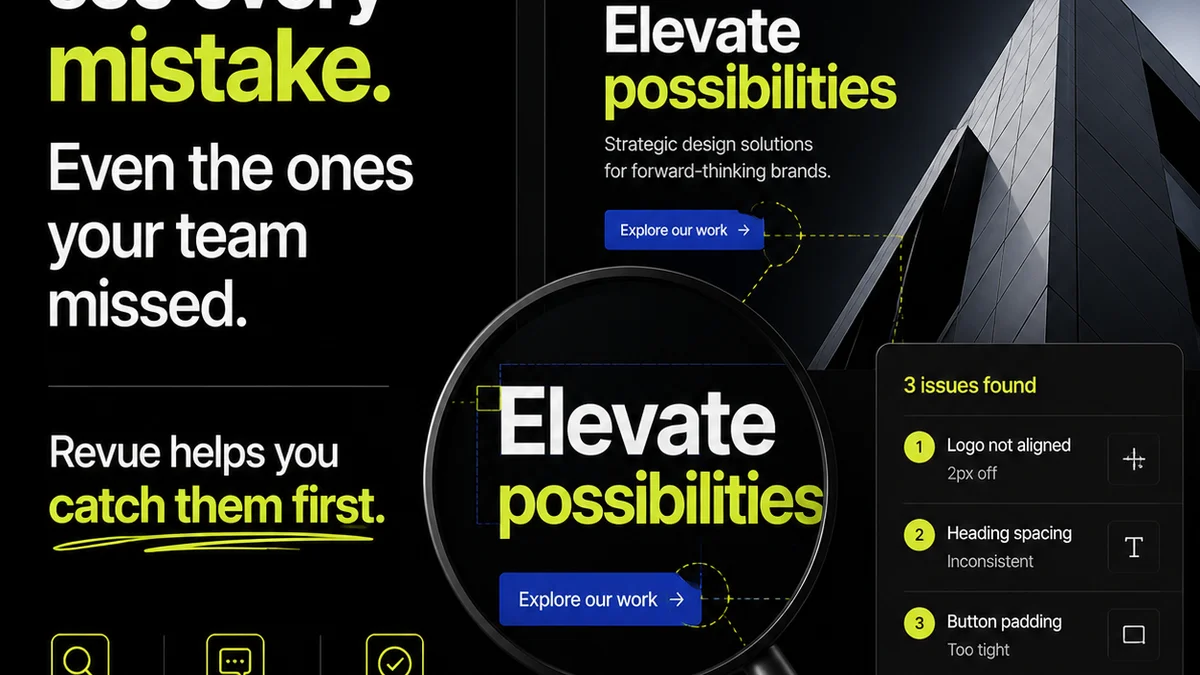
The common thread through all these scaling failures is a lack of centralized control and visibility. This is precisely where Revue excels.
Revue provides a single source of truth for your creative projects. It’s designed to tackle the operational friction that prevents creative teams from scaling effectively.
Imagine:
- All client feedback consolidated in one place, directly on the creative assets. No more hunting through emails or Slack messages.
- Clear revision history, showing every change, every comment, and every approval. Know exactly where you are at any given moment.
- Streamlined approval workflows that provide clear sign-offs, reducing ambiguity and preventing rework.
- Centralized project management that gives visibility into task status and team workload.
- Automated quality checks and standardized review processes to catch errors before they become problems.
By bringing structure to feedback, revisions, and approvals, Revue frees your team from the administrative burden of managing chaotic workflows. This allows them to focus on what they do best: creating great work. Scaling becomes a matter of leveraging efficient processes, not just hiring more people.
Final Thought
Scaling creative operations isn't about hiring more people to do more work. It's about building robust, efficient systems that allow your existing and future team to produce higher quality work, faster, and with less friction.
Are you adding more people to a broken process, or are you investing in the systems that enable true, sustainable growth?
Frequently asked questions
What is the biggest mistake companies make when trying to scale their creative teams?
The biggest mistake is assuming that scaling creative capacity simply means hiring more people. While talent is important, companies often fail because they try to pour more work into inefficient, unstructured processes. This amplifies existing problems like poor feedback loops, unclear revisions, and inadequate quality control, leading to frustration and wasted resources.
How does unstructured client feedback hinder creative scaling?
Unstructured feedback, coming from multiple channels (email, Slack, documents) and often containing conflicting or vague notes, creates significant administrative overhead. Creative teams spend excessive time consolidating, deciphering, and cross-referencing feedback instead of focusing on creative work. This inefficiency directly limits the team's ability to increase output and scale effectively.
Why are revision processes so critical for scaling creative work?
A chaotic revision process, characterized by endless subjective tweaks, unclear approvals, and scope creep, is a major bottleneck. Scaling requires predictability and clear sign-offs. When revision workflows are undefined, it leads to rework, delays, and missed deadlines, consuming valuable time and resources that should be dedicated to new projects or strategic initiatives.
How can a company improve its creative quality control as it scales?
Scaling companies often neglect quality control (QC) in favor of speed, which is a critical error. To scale effectively, QC must be built into the workflow, not treated as an afterthought. This involves using clear checklists, standardized review processes, and ensuring timely reviews by the right people. Catching errors early, when they are easiest to fix, protects reputation and ensures high-quality output alongside increased volume.
What role does centralized feedback and revision management play in successful creative scaling?
Centralized feedback and revision management tools, like Revue, provide a single source of truth for all project communication and approvals. This eliminates the chaos of scattered notes, clarifies revision history, streamlines workflows, and offers visibility into project status. By reducing administrative friction and ambiguity, these systems empower creative teams to focus on production, enabling sustainable and efficient scaling.