Everyone talks about scaling. It’s the holy grail for ambitious agencies and growing in-house teams. You hear it all the time: “Just hire more talent, expand your services, and watch the revenue climb.”
None of that is wrong. But it’s incomplete.
The real challenge of scaling isn't acquiring resources; it's managing the complexity that comes with them. Growth introduces friction, bottlenecks, and communication breakdowns if you're not prepared.
The hard truth is that scaling a creative operation is less about adding headcount and more about refining your operational infrastructure. It’s about building systems that can handle more volume, more clients, and more projects without sacrificing quality or sanity.
1. The Myth of Linear Growth
Many leaders assume that if you double your team, you can double your output. This is rarely the case in creative work. Creative processes are inherently non-linear. They involve collaboration, iteration, and subjective judgment – things that don't scale neatly.
Adding people often adds communication overhead. Every new team member means more Slack channels, more emails, more meetings, and more potential for misinterpretation. This is the famous “Brooks's Law” in software development: “Adding manpower to a late software project makes it later.” While not directly applicable to creative work, the principle of increased communication complexity holds true.
The Hidden Costs of More People
- Increased onboarding time and resources.
- More management overhead for team leads and department heads.
- Higher risk of duplicated effort or conflicting directions.
- Dilution of company culture if not managed proactively.
- Potential for burnout if processes can't keep up with the increased workload.
You can’t just keep adding bodies and expect efficiency to magically appear. You need a framework that supports and channels that growth.
2. Process as Your Scalable Asset
If talent isn't the *only* answer, what is? Process. Not rigid, bureaucratic process, but flexible, adaptable systems that guide work from intake to delivery.
Think of your creative process like a riverbed. The water is your creative output, your talent. The riverbed is your process. A well-defined, well-maintained riverbed channels the water efficiently, preventing it from spreading out and becoming stagnant or eroding the banks. A poorly defined one leads to chaos.
What does good process look like in a creative context?
- Clear intake and brief-building: Every project starts with a solid foundation of understanding.
- Defined roles and responsibilities: Everyone knows who is doing what and who to ask.
- Structured feedback loops: Clients and internal stakeholders know how and when to provide input.
- Standardized review and approval gates: No more endless revisions because the sign-off was unclear.
- Consistent quality control: A final check to ensure everything meets standards before delivery.
These aren't bottlenecks; they are guardrails. They ensure that as volume increases, quality doesn't suffer.
3. Technology as the Enabler, Not the Solution
Many agencies chase the latest software, believing it's the silver bullet for scaling. While technology is crucial, it’s the *application* of technology to your *processes* that matters.
You can have the most advanced project management tool in the world, but if your workflow is broken, the tool will just help you manage the chaos more efficiently. It won’t fix the underlying issues.
Choosing the Right Tools
Focus on tools that address your specific pain points:
- Project Management: To track tasks, deadlines, and resources.
- Client Communication & Feedback: To centralize input and reduce email chains.
- Asset Management: To organize and retrieve final files and previous versions.
- Time Tracking: To understand project profitability and resource allocation.
- Collaboration: For seamless internal teamwork.
The key is integration. How well do these tools talk to each other? How much manual data entry do they require?
When technology amplifies your refined processes, that’s when you unlock true scalability. It automates repetitive tasks, provides visibility, and ensures consistency.
4. Client Management in High Volume
Scaling doesn't just impact internal operations; it profoundly affects client relationships. Managing more clients, or larger accounts with more stakeholders, requires a more robust client management strategy.
Assumption: More clients mean more account managers. Deeper truth: More clients mean more standardized, efficient client interaction points.
This means:
- Proactive Communication Cadences: Regular, scheduled updates rather than reactive responses.
- Clear Scope Management: Documenting and agreeing on what’s in and out of scope from the outset.
- Centralized Client Portals: Giving clients a single source of truth for project status, feedback, and deliverables.
- Defined Escalation Paths: Knowing exactly who to contact when issues arise.
Your clients want to feel valued and informed, regardless of how many other clients you’re juggling. A scalable client management approach ensures they do.
5. The Role of Data and Metrics
You can’t manage what you don’t measure. Scaling requires a data-driven approach to understand performance, identify bottlenecks, and make informed decisions.
What metrics matter when scaling?
- Project profitability: Are your projects covering costs and generating healthy margins?
- Resource utilization: Are your team members consistently busy but not overloaded?
- Client satisfaction: Are your clients happy with the process and the outcome?
- Cycle time: How long does it take from brief to final delivery?
- Revision rounds: Are projects getting bogged down in endless feedback loops?
Tracking these metrics provides the insights needed to refine processes, allocate resources effectively, and ensure that growth is profitable and sustainable, not just busywork.
Where Revue Fits In
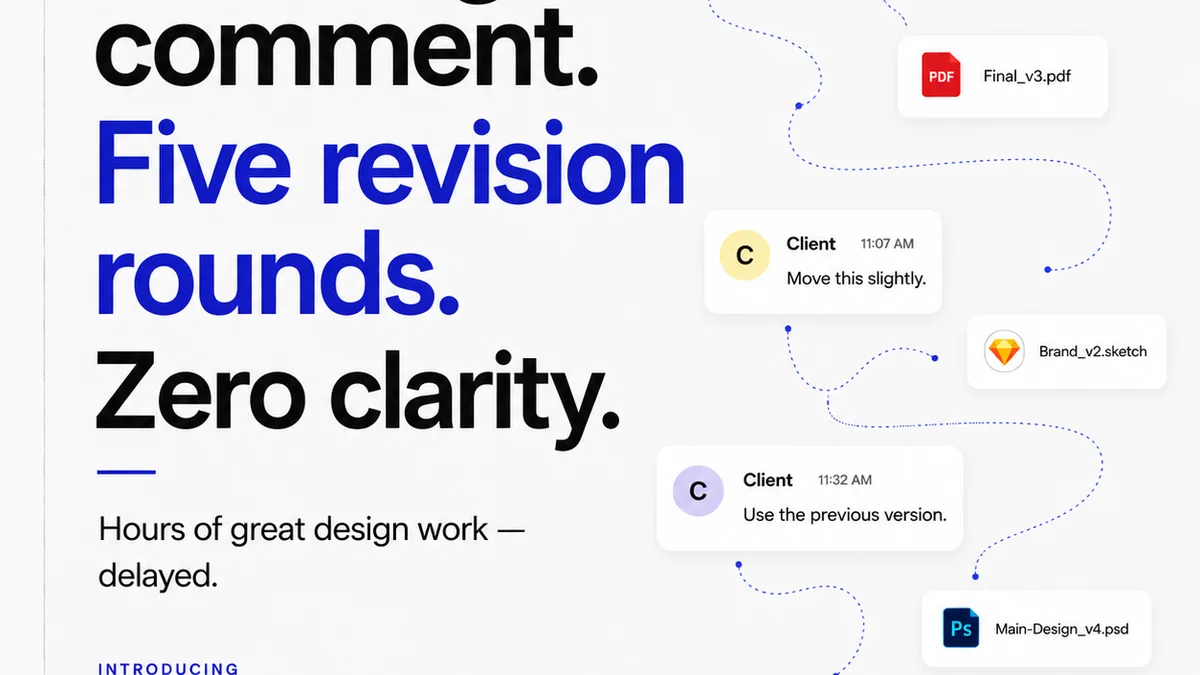
Managing client feedback, revisions, and approvals is often the biggest bottleneck in creative scaling. Scattered email threads, lost comments in shared docs, and unclear sign-offs can derail even the best projects.
Revue is built to address this directly. It centralizes all client feedback in one place, linked directly to the creative assets. This provides absolute clarity on what needs to be changed, by whom, and when it was requested.
With Revue, you get:
- A single source of truth for feedback: No more hunting through inboxes.
- Clear revision history: Track every change and iteration.
- Visible approval status: Know exactly when a piece is signed off.
- Streamlined quality checks: Ensure all feedback is addressed before final delivery.
By bringing order to the chaos of client collaboration and approvals, Revue helps your team move faster, reduce errors, and maintain high quality as you scale.
Final Thought
Scaling is not an event; it's an ongoing process of refinement. It requires a shift from thinking about *more* to thinking about *better*. Better processes, better systems, better integration. Are your operational foundations strong enough to support the growth you envision?
Frequently asked questions
What is the biggest misconception about scaling a creative agency?
The biggest misconception is that scaling is primarily about hiring more people. While talent is essential, the real challenge lies in building robust operational systems and processes that can handle increased volume without sacrificing quality or efficiency.
How can process help with creative scaling?
Well-defined, adaptable processes act as the infrastructure for growth. They provide clear guidelines for intake, collaboration, feedback, and approvals, ensuring consistency and quality as your team and project load increase. Think of it as building a riverbed to channel your creative output effectively.
What role does technology play in scaling?
Technology is an enabler, not a magic solution. The right tools, when applied to well-defined processes, can automate tasks, improve communication, and provide visibility. Focus on technology that solves specific workflow bottlenecks rather than just chasing the latest software.
How do I manage client feedback effectively when scaling?
Scaling requires standardizing client interaction points. Implement proactive communication cadences, clear scope management, and centralized feedback systems (like Revue) to ensure clients feel informed and valued, even as your client base grows.