Everyone wants to deliver high-quality creative work. It’s the goal, right? The ultimate aim. The reason we pour ourselves into projects.
And that’s not wrong. But it’s incomplete.
Focusing solely on the *outcome* of quality – that perfect final pixel, that flawless campaign – misses the operational engine that drives it. Think of it like admiring a race car. You see the sleek design, the powerful engine. But you don’t see the pit crew, the meticulous maintenance schedule, the constant diagnostics.
The hard truth? Quality isn’t an accident. It’s a system. And for creative teams, that system needs to be built around managing feedback, revisions, and approvals with ruthless efficiency. Without it, you’re just hoping for the best. And hoping doesn’t pay the bills.
1. The Myth of the 'Creative Genius'
We love the idea of the lone genius, conjuring brilliance out of thin air. The client gives a vague brief, and *poof* – a masterpiece appears.
This romantic notion is a killer of good process. It implies that quality is an innate talent, not a cultivated skill or a structured output.
The reality is far more collaborative and far more iterative. Quality emerges from clear communication, structured feedback loops, and a shared understanding of the project goals. It’s built, not discovered.
The Feedback Black Hole
Where does feedback usually go to die?
- Scattered across countless email threads.
- Buried in Slack messages.
- Annotated on random PDF versions.
- Whispered in meetings without documentation.
When feedback is fragmented, it’s impossible to track. It’s easy to misinterpret. And it’s almost guaranteed that something crucial will be missed.
This isn't just inconvenient. It’s a direct threat to quality. How can you ensure you’re hitting the mark when the target keeps moving, unseen and undocumented?
2. Building a Feedback Framework
Forget waiting for inspiration. Start building a framework for how feedback is collected, processed, and actioned. This is the bedrock of consistent quality.
A robust framework ensures that every piece of input is:
- Captured: No more lost comments.
- Contextualized: Tied directly to the creative asset.
- Prioritized: Differentiating between critical fixes and minor tweaks.
- Actioned: Assigned and tracked to completion.
This isn’t about stifling creativity; it’s about channeling it effectively. It’s about making sure that the brilliant ideas everyone has actually make it into the final deliverable, without getting lost in translation or buried under revisions.
The Single Source of Truth
Your creative assets need a home base. A place where the latest version lives, and where all feedback is gathered.
This eliminates the “which version is this?” confusion that plagues so many projects. When everyone is looking at and commenting on the same, most up-to-date file, the chances of misinterpretation drop dramatically.
Think about it: If your client is sending feedback on version 3, but you’re working off version 5 based on a previous conversation, you’re already misaligned. A centralized system prevents this disconnect.
3. The Revision Revision
Revisions are inevitable. They are part of the creative process. But uncontrolled revisions are a quality killer.
What does an uncontrolled revision cycle look like?
- Endless back-and-forth on minor details.
- Scope creep disguised as 'just one more change'.
- Designers and developers spinning their wheels on non-essential edits.
- Frustration mounting on both sides of the client-agency relationship.
This isn't just inefficient; it erodes the quality of the final output. When teams are constantly reacting to shifting demands, the strategic vision can get lost. The original brief, the core message – these can become casualties of the revision melee.
Defining 'Done'
Every revision cycle needs clear boundaries. This means defining what constitutes a 'completed' revision and when a deliverable is truly ready for final approval.
This involves:
- Clear acceptance criteria: What specific changes need to be made?
- Defined scope: What’s in and what’s out for this round?
- Time limits: Setting expectations for how long a revision round will take.
Without these guardrails, revision rounds can become infinite loops, sucking time, budget, and creative energy without moving the project forward effectively.
4. Approval: Not Just a Signature
Client approval is more than a rubber stamp. It’s a critical quality gate.
When approvals are handled casually – a quick email confirmation, a verbal OK – you lose a vital checkpoint.
This casual approach can lead to:
- Misunderstandings about what was actually approved.
- Disputes down the line about scope or deliverables.
- A lack of accountability for the final sign-off.
True approval means a clear, documented sign-off on a specific version of the work, confirming it meets the agreed-upon requirements. It’s a commitment from the client that the work is acceptable.
The Risk of Ambiguity
Ambiguity around approvals is a breeding ground for problems. If there’s no clear record of who approved what, and when, you’re exposed.
This can manifest as:
- Clients claiming they never approved a certain direction.
- Clients asking for changes that were already signed off.
- Internal teams being unsure if they have the green light to proceed.
A structured approval process removes this ambiguity. It creates a clear trail, protecting both your team and your client from future confusion.
5. Quality Assurance: The Final Gauntlet
Quality assurance (QA) is often treated as an afterthought, a quick check before launch. It’s seen as the final hurdle, not an integrated part of the process.
This perspective is dangerous. QA isn't just about finding typos or broken links. It's about ensuring the creative strategy, the brand guidelines, and the client's objectives have been met.
When QA is rushed or superficial, you risk:
- Shipping work with errors that damage your client’s brand.
- Failing to deliver on the core objectives of the project.
- Undermining the credibility of your agency.
A thorough QA process should be a structured review against a defined checklist, covering not just technical execution but strategic alignment.
Beyond the Spellcheck
What does comprehensive QA really involve?
- Functional testing: Does everything work as intended?
- Usability testing: Is it easy and intuitive to use?
- Content accuracy: Is all text and imagery correct and on-brand?
- Brand compliance: Does it adhere to all brand guidelines?
- Objective alignment: Does it meet the project’s stated goals?
Treating QA as a vital step, rather than a last-minute scramble, is key to consistently delivering high-quality work.
Where Revue Fits In
Managing all of this – feedback, revisions, approvals, QA – across multiple clients and projects is where most creative operations break down.
This is why we built Revue. It’s designed to bring order to the creative chaos.
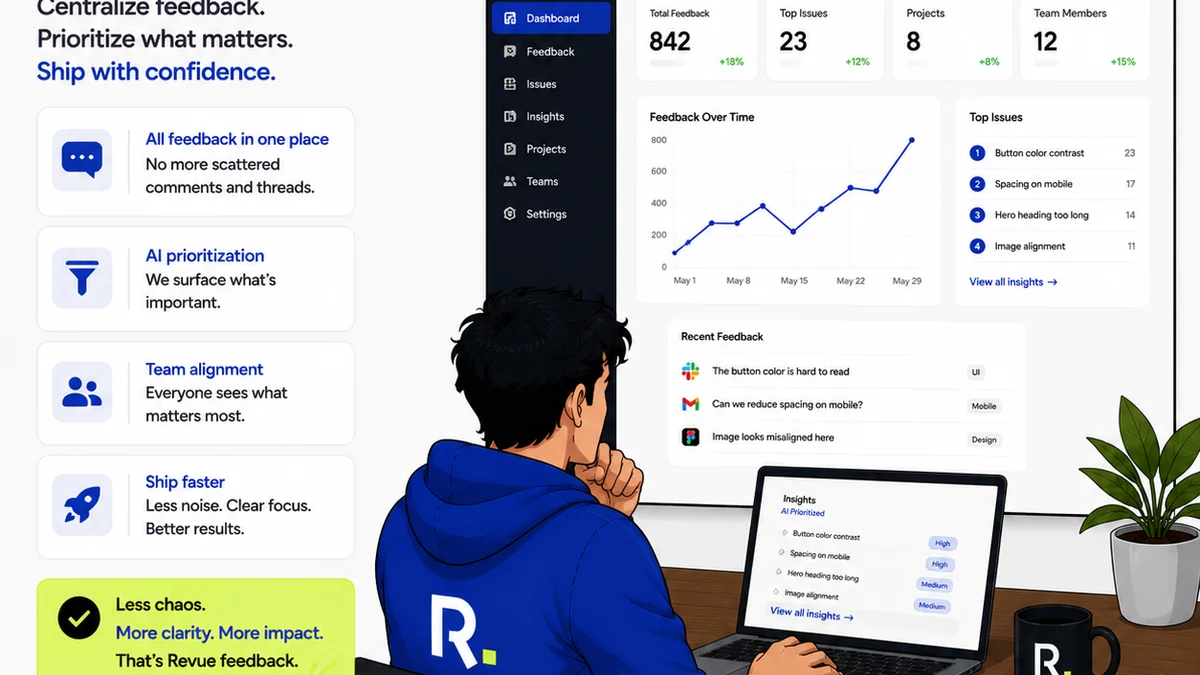
Revue acts as your central hub for creative assets and client collaboration. Instead of chasing feedback across email, Slack, and scattered documents, all comments, annotations, and discussions happen directly on the asset itself, within Revue.
This creates a single, undeniable source of truth. Every version is tracked, every revision is documented, and every approval is a clear, recorded event.
With Revue, you can:
- Centralize all client feedback and internal discussions.
- Visualize the entire revision history, understanding exactly how a piece evolved.
- Streamline the approval process with clear sign-offs.
- Build more efficient QA workflows by having all context readily available.
It’s about moving from reactive chaos to proactive control, ensuring that quality is built into every step of your creative process, not just hoped for at the end.
Final Thought
Delivering consistently high-quality creative work isn't about having the most talented individuals. It's about having the most robust systems.
Are you building a system, or just hoping for genius?
Frequently asked questions
What is the biggest mistake creative teams make regarding quality?
The biggest mistake is treating quality as an outcome of individual brilliance rather than a result of a well-defined operational system. This leads to scattered feedback, uncontrolled revisions, and ambiguous approvals, all of which erode quality.
How can I centralize client feedback effectively?
Use a dedicated platform where clients can comment directly on creative assets. This creates a single source of truth, preventing feedback from getting lost in emails or messages and ensuring all comments are contextualized.
What makes a revision process 'uncontrolled'?
An uncontrolled revision process is characterized by endless back-and-forth, scope creep, and a lack of clear criteria for what constitutes a completed revision. This leads to wasted time and can dilute the original project vision.
Why is documented approval so important?
Documented approval serves as a critical quality gate. It removes ambiguity, establishes accountability, and prevents disputes down the line by providing a clear record of what was agreed upon and when.
How does quality assurance differ from a simple proofread?
Quality assurance goes beyond checking for typos or broken links. It's a comprehensive review that verifies the creative work meets strategic objectives, adheres to brand guidelines, and functions as intended, ensuring both technical accuracy and alignment with project goals.