Everyone talks about visibility in creative agencies. They mean knowing who’s working on what, when deadlines are looming, and who’s overloaded. It’s about project management software, shared calendars, and maybe a daily stand-up.
None of that is wrong. But it’s incomplete. It’s like saying a car needs an engine. True. But what kind of engine? And what about the transmission? The steering? The brakes?
The hard truth is this: Visibility isn’t just about knowing what’s happening. It’s about having the power to *control* what’s happening. It’s about predictability. And for an agency, predictability equals profitability.
1. The Illusion of Control
Most agencies operate on a wing and a prayer. They’ve got a project management tool, sure. But is it actually *used*? Is it kept up-to-date? Or is it just another place where tasks go to die?
This creates a dangerous illusion of control. You *think* you know where your projects stand. But you’re often relying on gut feelings, frantic Slack messages, and the hope that your team is being honest about their bandwidth.
The Symptoms of Low Visibility
- Missed deadlines that weren’t predicted.
- Scope creep that sneaks in unnoticed.
- Team members burning out because no one saw their workload.
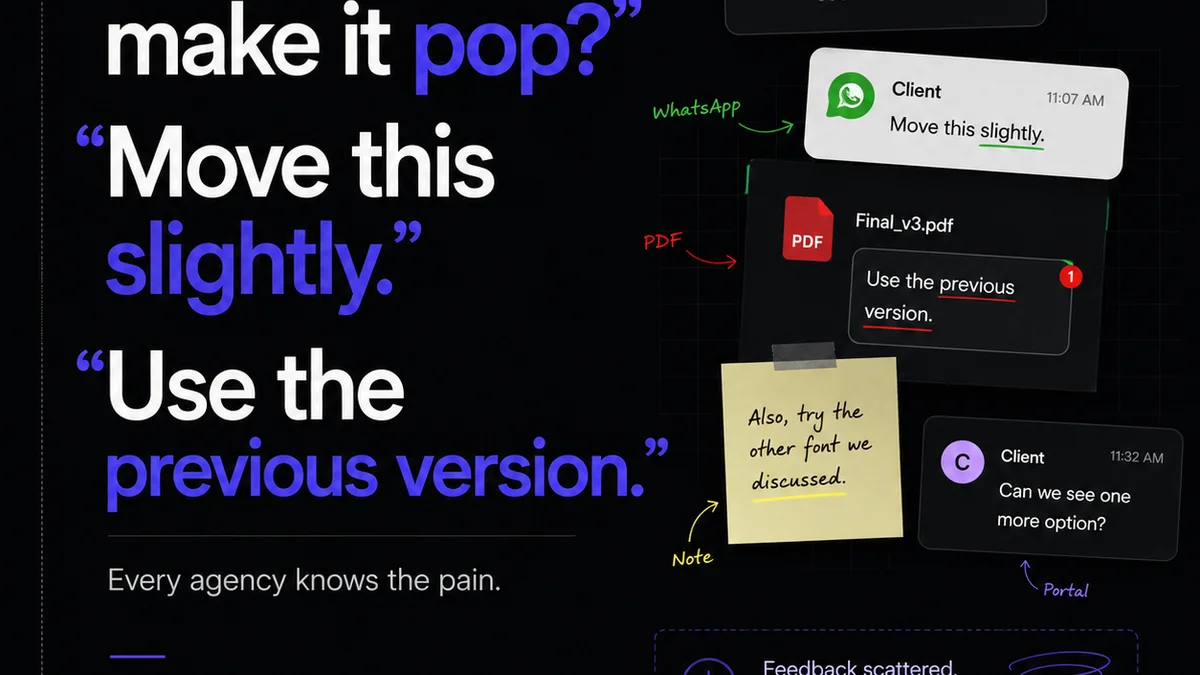
- Clients constantly asking for updates because you’re often in the dark yourself.
- Rush jobs that cost more than they make.
These aren’t just minor annoyances. They are direct drains on your bottom line.
2. The Cost of Guesswork
Every hour your team spends guessing, searching for information, or correcting avoidable mistakes is an hour they *aren’t* spending on billable, high-value work.
When you lack visibility, you’re essentially flying blind. You can’t accurately estimate project timelines or costs. You can’t identify bottlenecks before they grind your workflow to a halt. You can’t spot opportunities to upsell or improve efficiency.
This guesswork has a tangible cost:
- Wasted time: Searching for files, clarifying feedback, redoing work.
- Increased stress: For teams and clients alike.
- Eroded trust: When deadlines slip and quality suffers.
- Reduced profitability: Because you’re doing more for the same price, or worse, less for the same price.
Your current system might feel like it’s working. But is it optimized? Or is it just ‘good enough’?
3. The Profitability Paradox
Here’s the contrarian bit: The more you focus on *operational visibility*, the less you have to worry about *profitability*. They aren't separate goals; they are intrinsically linked.
Think about it. If you can see exactly where every piece of feedback is, who’s responsible for the next action, and how many revisions are left… what happens?
- You can predict project completion dates with accuracy.
- You can identify scope creep immediately and address it.
- You can manage client expectations proactively.
- You can ensure your team is working on the most impactful tasks.
- You can onboard new clients and projects smoothly, without the usual chaos.
This level of control means fewer surprises. Fewer fire drills. Fewer write-offs. And more predictable revenue.
4. Building a Transparent Workflow
Achieving true visibility isn’t about more meetings or more complex software. It’s about a clear, centralized system for managing the entire creative lifecycle.
Key Elements of a Visible Workflow:
- Centralized Feedback: All client comments, stakeholder input, and internal notes live in one place. No more sifting through emails or Slack threads.
- Clear Revision Tracking: Easily see every version, who approved what, and what changes were made.
- Defined Approval Stages: A clear path from draft to final sign-off, with accountability at each step.
- Real-time Status Updates: Everyone—team members, project managers, account leads, and even clients (selectively)—knows exactly where a project stands.
- Resource Management Insights: Understand who is available, who is overloaded, and where potential capacity issues lie.
When these elements are in place, the guesswork disappears. The chaos subsides. And your team can focus on what they do best: creating great work.
Where Revue Fits In
This is where tools like Revue become essential. It’s not just another project management tool; it’s a dedicated platform for managing the creative review and approval process.
Revue provides that crucial layer of visibility:
- Centralized feedback: All client comments and internal notes are attached directly to the creative asset.
- Streamlined revisions: Track every iteration, compare versions, and ensure no feedback gets lost.
- Clear approvals: Define clear sign-off stages, reducing ambiguity and speeding up the process.
- Quality control: Ensure all feedback is addressed before final delivery, reducing costly post-launch revisions.
By bringing clarity to the feedback and revision cycle, Revue empowers your team to work more efficiently, reduce errors, and maintain a healthier profit margin.
Final Thought
Visibility. It sounds so simple, doesn’t it? Just knowing what’s going on. But the reality is far more profound. It’s the bedrock of operational efficiency, client satisfaction, and ultimately, agency profitability. Are you truly seeing your workflow, or just looking at a blurry picture?
Frequently asked questions
What is creative team visibility?
Creative team visibility refers to having a clear, real-time understanding of all ongoing projects, tasks, team member workloads, feedback status, and revision cycles within a creative agency or team. It goes beyond basic project tracking to encompass the entire creative workflow.
How does visibility impact agency profitability?
High visibility leads to predictable project timelines, accurate cost estimations, and immediate identification of scope creep. This reduces wasted time, minimizes costly errors and revisions, and allows for better resource allocation, all of which directly contribute to higher profitability.
What are the signs of low visibility in a creative team?
Common signs include missed deadlines, frequent client requests for status updates, team burnout due to unmanaged workloads, scope creep that goes unnoticed, and a general feeling of chaos or lack of control over projects.
How can a creative team improve visibility?
Improve visibility by centralizing feedback, implementing clear revision and approval tracking, using a single source of truth for project information, and ensuring real-time status updates are accessible to relevant team members. Dedicated tools can significantly help.
Is more project management software the answer to visibility?
Not necessarily. The answer isn't just *more* software, but the *right* software used effectively. Visibility comes from a system that centralizes critical information, particularly around feedback and approvals, and is consistently updated and utilized by the team.