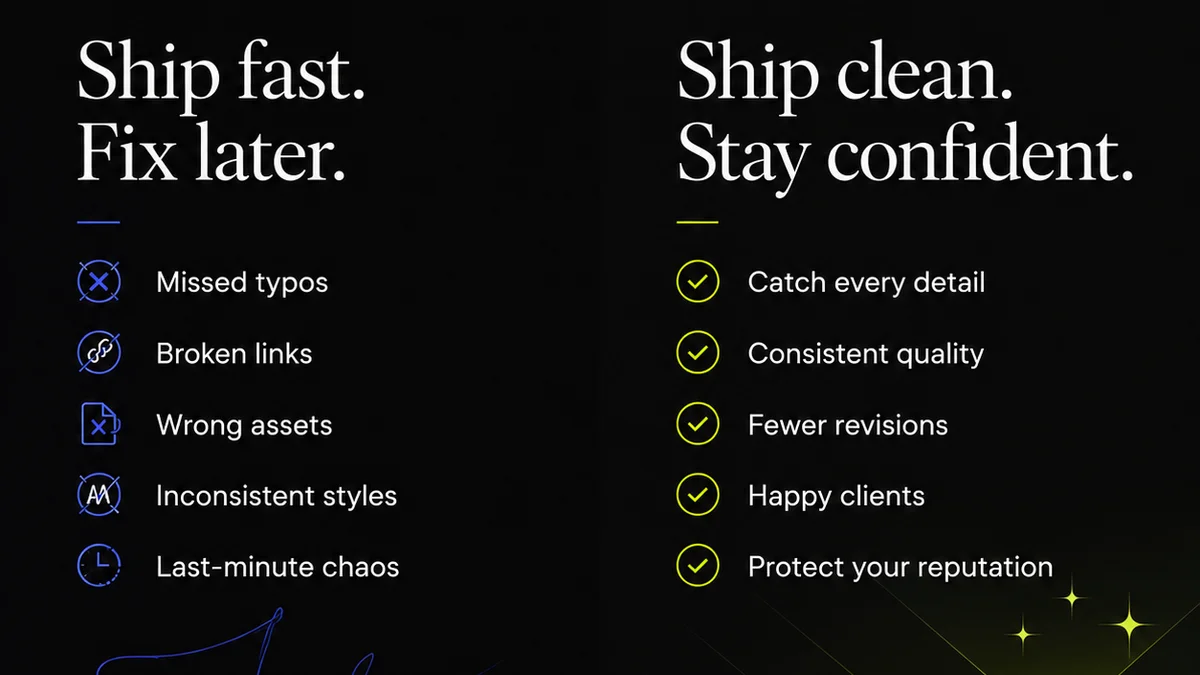
You’ve probably heard that great design is iterative. That feedback is gold. That a culture of continuous improvement is the secret sauce to agency success.
None of that is wrong. But it’s incomplete.
The hard truth? You can’t just *want* a culture of continuous improvement. You have to *build* it. And that means getting beyond the buzzwords and into the messy, operational reality of how your teams actually work.
Most agencies think continuous improvement means endless rounds of tweaks, hoping something sticks. They see it as a reactive scramble to satisfy clients. But real improvement isn't about chasing perfection; it's about building systems that make getting better an inherent part of the workflow.
1. Define What “Better” Actually Means
Before you can improve, you need to know what you’re aiming for. This isn’t about subjective taste. It’s about measurable outcomes.
For the Client
What does success look like for your client’s business? Is it increased conversion rates? Better brand recall? Smoother user journeys? Connect design decisions directly to these objectives.
For Your Agency
What does operational excellence mean for your team? Faster turnaround times? Reduced revision cycles? Higher client satisfaction scores? Clearer communication?
Without these definitions, “improvement” is just a vague aspiration. It’s a directionless conversation.
2. Embed Feedback Loops, Don’t Just Collect It
Feedback is useless if it sits in an inbox or a Slack channel, unread and unacted upon. The goal isn't to *get* feedback; it's to *integrate* it.
Systematize Intake
Establish clear channels for feedback. Whether it’s a dedicated tool or a structured process for client calls, make it obvious where and how feedback should be submitted.
Centralize and Clarify
Scattered feedback is a recipe for chaos. Bring all comments, annotations, and approvals into a single source of truth. This prevents miscommunication and ensures everyone is working from the same playbook.
Actionable Insights
Train your team to distinguish between subjective opinions and actionable critiques. Not all feedback requires a design change. Teach them to ask: What is the underlying problem this feedback is trying to solve?
3. Make Revisions a Process, Not a Problem
Revision rounds are often seen as a necessary evil. A sign of a job not done perfectly the first time. That’s the wrong mindset.
Revisions are an opportunity to refine and align. But only if they’re managed effectively.
Structured Revision Cycles
Define the scope and expected outcome of each revision round. What specific elements are up for discussion? What decisions need to be made?
Clear Ownership and Accountability
Who is responsible for incorporating feedback? Who signs off on the final changes? Ambiguity here leads to delays and dropped balls.
Version Control That Works
Keep track of every iteration. This prevents confusion about which version is current and allows you to roll back if a change proves detrimental.
4. Foster a Learning Mindset, Not a Blame Game
Mistakes will happen. Designs will miss the mark sometimes. The crucial difference between a struggling agency and a thriving one is how they respond.
Post-Mortems That Matter
After a project, conduct a blameless review. What went well? What could have been done differently? What did we learn?
Focus on process, not people. Identify systemic issues, not individual failings.
Knowledge Sharing
Create mechanisms for sharing lessons learned across teams. Case studies, internal presentations, or even just dedicated Slack channels can help disseminate best practices and prevent repeating the same errors.
Empower Your Team
Give designers the space and support to experiment and learn. Encourage them to push boundaries, knowing that not every experiment will be a home run, but every one will yield insights.
5. Measure What You Can, Improve What You Measure
You can’t manage what you don’t measure. This applies to design processes just as much as it applies to sales funnels.
Track Key Metrics
Monitor metrics like the number of revision rounds per project, time spent on revisions, client approval times, and adherence to project scope.
Identify Bottlenecks
Use your tracked data to pinpoint where your process is slowing down. Are client feedback loops too long? Are internal reviews taking too much time? Is scope creep rampant?
Iterate on Your Process
Treat your agency’s workflow like a design project. Analyze it, identify areas for improvement, propose solutions, implement them, and then measure the impact. It’s a continuous cycle.
Where Revue Fits In
Building a culture of continuous design improvement isn’t about adding more software. It’s about optimizing the tools you have to support a better process.
Revue acts as the central nervous system for creative feedback and approvals. It provides a single source of truth for all client input, making it easy to track discussions, manage revisions, and ensure clarity. This eliminates the friction points that kill momentum and hinder improvement.
With centralized feedback, you can easily see the history of changes and understand the rationale behind them. Revision tracking becomes transparent, not a black box. Quality checks are integrated, not an afterthought.
This operational clarity frees up your team to focus on what matters: designing great work and learning from every step.
Final Thought
Are you optimizing for perfect output on day one, or are you building a system that guarantees progress over time?
Frequently asked questions
What's the difference between feedback and improvement?
Feedback is information received about your work. Improvement is the systematic process of using that information to make your work and your process better over time.
How can we make client feedback more actionable?
Centralize feedback, clarify expectations for what needs to be addressed, and train your team to identify the underlying problem behind subjective comments.
Is it possible to reduce revision rounds?
Yes, by establishing clearer initial briefs, setting expectations for revision scope, and ensuring all feedback is consolidated and actionable. Revue helps manage this visibility.
How do we measure design process improvement?
Track metrics like the number of revision rounds, time spent on revisions, client approval times, and project scope adherence. Analyze this data to find bottlenecks and iterate on your workflow.