Everyone agrees that collaboration is good. Essential, even. We talk about it in terms of brainstorming, team spirit, and creative energy. It’s the fuzzy stuff, the soft skill that makes agency life… livable.
None of that is wrong. But it’s incomplete. Severely incomplete.
The hard truth is that design collaboration isn't just about making nice with your colleagues. It’s a fundamental component of efficient, effective creative operations. When collaboration breaks down, it’s not just morale that suffers. Project timelines stretch, budgets balloon, and the final creative product is almost always compromised.
1. The Myth of the Lone Genius vs. the Operational Reality
We’re still a little too fond of the idea of the brilliant designer working in isolation, having a stroke of genius that saves the day. It’s a romantic notion, but it’s a terrible operational model.
Real-world creative work is a team sport. It requires input from strategists, account managers, clients, and other designers. Each brings a unique perspective that can elevate the work. Ignoring that input isn’t just rude; it’s inefficient.
The Hidden Costs of Siloed Work
When designers work in silos, assuming they know best, several things happen:
- Decisions are made without crucial context.
- Redundant work gets done because others aren't aware of progress.
- Feedback loops become adversarial, not constructive.
- Client misunderstandings fester, leading to costly revisions.
- Onboarding new team members becomes a painful knowledge transfer process.
This isn't about diminishing individual talent. It's about recognizing that talent is amplified, not diluted, by structured, open communication and shared understanding.
2. Collaboration as a Process, Not Just a Vibe
If collaboration is merely a 'vibe,' it’s ephemeral. It’s dependent on personality and luck. To be a reliable part of creative operations, collaboration needs to be a defined process.
This means establishing clear protocols for how and when feedback is given, how decisions are documented, and how changes are tracked. It’s about building systems that facilitate effective interaction, regardless of who is in the room (or on the Zoom call).
Defining Collaboration Touchpoints
Think about where collaboration needs to happen in your typical project lifecycle:
- Brief Interpretation: Does the creative team fully grasp the client’s objectives?
- Concept Development: Are multiple ideas being explored and debated constructively?
- Design Iteration: Is feedback being given clearly and acted upon efficiently?
- Client Reviews: Is there a unified front presenting the work and managing feedback?
- Final Approval: Are all stakeholders aligned before sign-off?
Each of these points is an opportunity for collaboration to either streamline the process or create bottlenecks.
3. The Feedback Loop: The Engine of Creative Progress
Client feedback is the lifeblood of agency work. But it’s often treated like a necessary evil, a hurdle to be cleared.
Effective collaboration transforms feedback from an obstacle into an engine for creative progress. This requires a structured approach to both soliciting and delivering feedback.
From Ambiguity to Actionable Insights
How many times have you seen feedback like:
- “Make it pop more.”
- “I don’t like it.”
- “Can we try something else?”
This isn't feedback; it's noise. True collaboration involves guiding clients toward providing specific, actionable critiques. It also means internal teams know how to interpret and act on that feedback constructively.
When collaboration is strong, the feedback loop looks different:
- Internal Alignment: The team discusses the feedback, identifies the core issues, and proposes solutions *before* going back to the client.
- Client Clarification: If feedback is vague, the team proactively asks clarifying questions, using visual annotations or brief calls to pinpoint exact concerns.
- Documented Decisions: All feedback and subsequent decisions are logged, creating a clear audit trail.
This disciplined approach prevents the endless back-and-forth that drains resources and erodes creative quality.
4. Revision Management: Beyond the Email Chain
Managing revisions is a core operational challenge. Without a robust collaborative framework, it’s chaos.
Think about the typical revision process: emails flying, different versions saved with confusing names (v2_final_really_final.ai), and no clear record of what was changed and why.
The Pitfalls of Unmanaged Revisions
- Version Control Nightmares: Which file is the latest? What changes were made in revision 3?
- Scope Creep: It's easy for unmanaged requests to snowball into significant extra work.
- Lost Context: Why was that specific change made? The rationale gets buried.
- Team Miscommunication: Different team members might be working off outdated versions or have conflicting instructions.
A collaborative approach means having a centralized system where all feedback, revisions, and approvals are tracked. This provides transparency for the entire team and the client, ensuring everyone is working from the same, up-to-date source of truth.
5. Quality Assurance: The Collaborative Checkpoint
Quality assurance (QA) is often seen as a final gate. But true QA is a continuous, collaborative effort.
When collaboration is weak, QA becomes a last-minute scramble to catch errors that should have been prevented earlier. It’s reactive, not proactive.
Integrating QA into the Collaborative Workflow
A collaborative workflow embeds QA checks throughout the process:
- Early Concept Reviews: Does the core idea align with the brief?
- Mid-Stage Feedback: Are the chosen design directions technically sound and strategically on point?
- Pre-Approval Checks: Does the final output meet all technical specifications and brand guidelines?
When the entire team is involved in reviewing work at various stages, issues are caught earlier, when they are cheapest and easiest to fix. This shared responsibility for quality is a hallmark of strong creative operations.
Where Revue Fits In
Operationalizing design collaboration requires tools that support a seamless workflow. This is where Revue becomes indispensable.
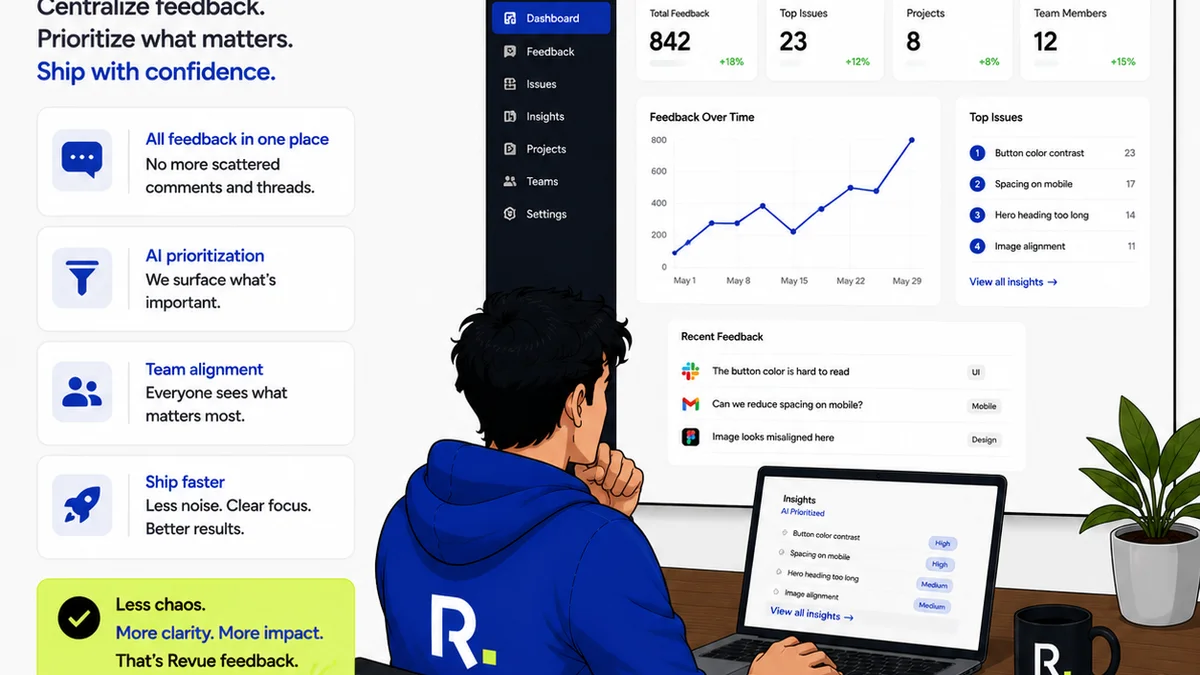
Revue is built to centralize client feedback, making it visible and actionable for the entire team. Instead of scattered emails and chat messages, all comments, markups, and approvals live in one place, tied directly to the creative asset.
This transparency is key to effective collaboration. Designers know exactly what feedback they’re addressing. Account managers can track progress and client sentiment. Approvals are clear and documented, eliminating ambiguity.
By providing a single source of truth for feedback and revisions, Revue helps transform collaboration from a 'nice-to-have' into a robust operational process. It streamlines communication, reduces errors, and ultimately, helps you deliver better creative work, faster.
Final Thought
Are you treating design collaboration as a fluffy byproduct of teamwork, or as a critical operational lever? The answer might be the difference between projects that merely get done and projects that truly excel.
Frequently asked questions
What's the difference between 'collaboration' and 'teamwork' in a creative agency?
Teamwork is the general act of people working together. Collaboration, in the context of creative operations, is a more structured and intentional process of shared input, feedback, and decision-making specifically aimed at improving the creative output and workflow efficiency.
How can I make client feedback more actionable?
Encourage clients to be specific. Instead of 'make it pop,' ask 'what specific elements should be more prominent?' Use visual annotation tools to pinpoint exact areas. Schedule brief calls to clarify vague feedback. Document all feedback and proposed actions clearly.
What are the biggest operational risks of poor design collaboration?
The biggest risks include scope creep, version control chaos, wasted time on rework, client misunderstandings leading to dissatisfaction, missed deadlines, budget overruns, and ultimately, a lower quality creative product.
How does a centralized feedback tool like Revue improve collaboration?
Revue centralizes all feedback, markups, and approvals in one place, linked to the specific creative asset. This provides transparency for the entire team, ensures everyone is working from the latest version, clarifies feedback, and creates an auditable record of decisions, reducing miscommunication and errors.