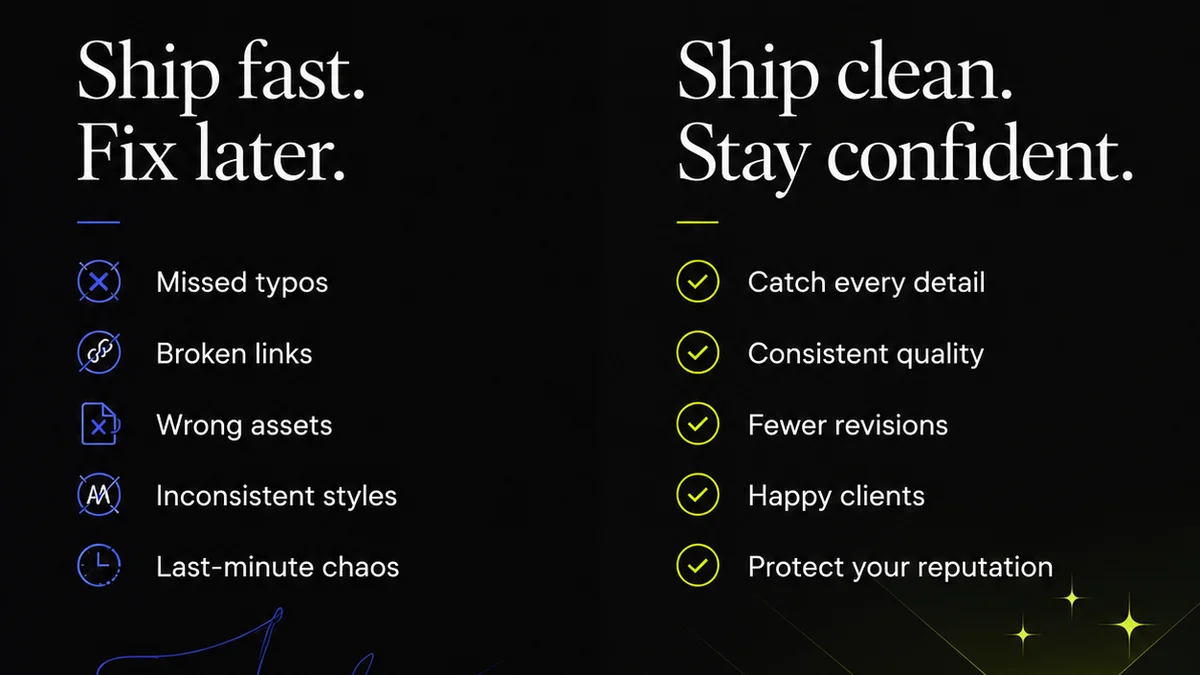
You think your agency is slow because your designers aren't fast enough. Or maybe your account managers aren't organized enough. You’ve tried hiring more people, implementing new project management tools, and holding more stand-ups. You’re doing all the things.
None of that is wrong. But it’s incomplete.
The hard truth is, most growing agencies choke on their own documentation. Or rather, the lack of it. Or the wrong kind of it.
It’s not about speed. It’s about clarity. And clarity is built on documentation.
1. The 'It's Obvious' Assumption
This is the killer. The belief that everyone involved in a project — client, designer, account manager, strategist — is on the same page without explicit documentation.
It’s a fantasy.
The Real Cost of 'Obvious'
When you skip documenting:
- Client feedback becomes conversational, then contradictory.
- Designers guess at intent, not direction.
- Revisions spiral because the original brief is a ghost.
- Approvals are rushed or missed entirely.
- New team members take weeks to understand project history.
This isn't just inefficient. It's expensive.
Every hour spent clarifying what was *supposed* to be obvious is an hour not spent creating great work or onboarding new clients.
2. The 'Brief is Enough' Fallacy
The creative brief. It’s the cornerstone, right? You get it signed off, and you're good to go.
Except you’re not.
Beyond the Initial Brief
A brief is a snapshot. It’s the starting line. But creative projects are marathons.
What happens between the brief and the final delivery?
- Mid-project pivots: Clients change their minds. Stakeholders emerge. The market shifts.
- Clarification threads: A quick Slack message here, a whispered hallway conversation there. None of it gets formally captured.
- Scope creep disguised as 'small tweaks': Without documented scope, these 'tweaks' add up.
- Unclear decision-making: Who *really* signed off on that last-minute direction?
If your only documentation is the initial brief, you’re flying blind for 90% of the project.
3. The 'Too Much Documentation' Myth
Some agencies hoard documents like dragons hoard gold. They have process manuals thicker than novels, endless checklists, and sprawling knowledge bases.
And nobody uses them.
The Difference Between Volume and Value
Documentation isn't about quantity. It’s about accessibility and relevance.
- Overly complex systems: If it takes 15 clicks to find a single piece of feedback, it won’t get found.
- Stale information: Outdated process docs are worse than no docs. They breed confusion.
- Siloed knowledge: If project history lives only in a PM tool, and brand guidelines in a separate folder, and client comms in email – it’s not integrated.
- Fear of 'getting it wrong': Agencies often delay documenting until it's 'perfect', meaning it never gets documented.
The goal is *just enough* documentation, in the *right places*, *when it matters*.
4. The 'Feedback is Just Feedback' Trap
Client feedback. It’s the lifeblood. But how you handle it determines whether it’s helpful or harmful.
Treating feedback as an afterthought is a recipe for disaster.
From Raw Input to Actionable Insight
Here’s where agencies bleed time and money:
- Unstructured feedback: A jumble of comments across email, PDFs, and video calls.
- Ambiguous comments: "Make it pop." "I don't love it." "Can we try something else?"
- Lack of context: Feedback without reference to the brief or previous versions.
- Delayed feedback loops: The longer it takes to get feedback, the colder the trail.
- No clear owner for feedback: Who is the ultimate decision-maker on the client side?
When feedback isn't systematically captured and clarified, it becomes a guessing game. Designers iterate in the dark, clients get frustrated, and projects get derailed.
5. The 'We'll Figure It Out Later' Workflow
This is the default for many agencies. They operate reactively, not proactively.
It feels agile. It's not.
Proactive Documentation Builds Momentum
Think about what happens when documentation is an afterthought:
- Onboarding new team members: They're lost. They ask the same questions repeatedly.
- Handing off projects: Critical details are missed.
- Client reviews: You're scrambling to pull together context.
- Post-project analysis: Lessons learned are buried because no one documented the process.
When you build documentation into your workflow from the start, you create a self-sustaining engine for clarity and efficiency.
Where Revue Fits In
This isn't about adding more tools. It's about using the right tool to centralize what matters.
Revue helps you capture and manage feedback, revisions, and approvals in one place.
- Centralized Feedback: Instead of chasing comments across emails, Slack, and PDFs, all client feedback lives directly on the creative asset.
- Revision Visibility: See every version, every iteration, and the specific feedback that drove each change. No more 'who changed what and why?'
- Clear Approvals: Formalize the sign-off process. Know exactly when and by whom a piece of work was approved.
- Single Source of Truth: Project history, client decisions, and feedback trails are accessible to everyone who needs them, when they need them.
This isn't about creating more documents. It's about creating a living, breathing record of your creative process that reduces ambiguity and accelerates delivery.
Final Thought
Your agency's growth isn't limited by talent. It's limited by clarity.
Are you building clarity, or are you building complexity?
Frequently asked questions
What is the biggest mistake agencies make with design documentation?
The biggest mistake is assuming everyone is on the same page without documenting key decisions, feedback, and changes. This 'it's obvious' mentality leads to confusion, rework, and project delays.
How can I make sure client feedback is actionable?
Centralize feedback in one platform, encourage clients to be specific, and always link feedback to the relevant creative asset and project brief. Clarify ambiguous comments immediately.
Is it possible to have too much documentation?
Yes. Documentation is only valuable if it's accessible, relevant, and up-to-date. Overly complex systems or outdated information can be more harmful than no documentation at all.
How does documentation impact agency growth?
Clear, accessible documentation streamlines workflows, reduces rework, improves client communication, and makes onboarding new team members faster. This operational efficiency directly supports scalable growth.