Most agencies treat design Quality Assurance as a final checkpoint. A quick scan for typos, broken links, and maybe a pixel-out-of-place.
It’s a necessary step, sure. But it’s not the whole story.
Relying solely on a last-minute review to catch every error is like expecting a lifeguard to prevent every swimmer from drowning. They can save lives, but they can’t stop the initial risk.
The Hard Truth About Design QA
The real problem isn't the QA process itself. It's the expectation that QA is a standalone activity that magically fixes things. It’s not.
True quality is built in. It starts from the brief and continues through every single revision. QA is simply the confirmation that the built-in quality is still there.
If your QA is a frantic scramble before launch, you’re not doing QA. You’re doing damage control.
1. The “It’s Done When It’s Done” Assumption
This is the most dangerous assumption. It implies that quality is a binary state, achieved only at the very end.
This leads to a reactive approach. Errors accumulate, and the final QA becomes a bottleneck, delaying launches and frustrating clients. It’s inefficient and expensive.
The Real Cost of Late-Stage Fixes
- Increased revision cycles that eat into margins.
- Missed deadlines and damaged client relationships.
- Team burnout from constant firefighting.
- Compromised creative integrity due to rushed fixes.
Quality isn't a feature you bolt on at the end. It's a fundamental part of the design process itself.
2. Treating QA as a Single Person’s Job
Telling one person, or even a small team, to “do the QA” is a recipe for disaster. They become the sole gatekeeper, the ultimate bottleneck.
This person is expected to have perfect recall of every brief, every client comment, every previous iteration, and every brand guideline. It’s an impossible burden.
Why Siloed QA Fails
- Lack of context: The QA person doesn’t understand the *why* behind certain decisions.
- Oversight: Even the most diligent person will miss things under such pressure.
- Blame game: When errors slip through, the QA person is often unfairly blamed.
Every team member involved in a project is a quality gatekeeper. The designer, the project manager, the client services lead – they all play a role.
3. Vague or Inconsistent Feedback Loops
If client feedback is nebulous, how can you possibly QA against it? “Make it pop more” isn’t actionable feedback.
Similarly, if your internal feedback isn’t structured, QA becomes a guessing game. Did we address that comment? Which one? Was that a ‘must-do’ or a ‘nice-to-have’?
The Feedback Black Hole
- Ambiguous comments lead to subjective interpretations during QA.
- Lack of version control means feedback can get lost or misapplied.
- No clear audit trail of what was requested and what was delivered.
Clear, specific, and documented feedback is the bedrock of effective QA. Without it, you’re building on sand.
4. Ignoring the Client’s Role in QA
Clients aren’t just recipients of final work; they are critical partners in the QA process. Their input is invaluable.
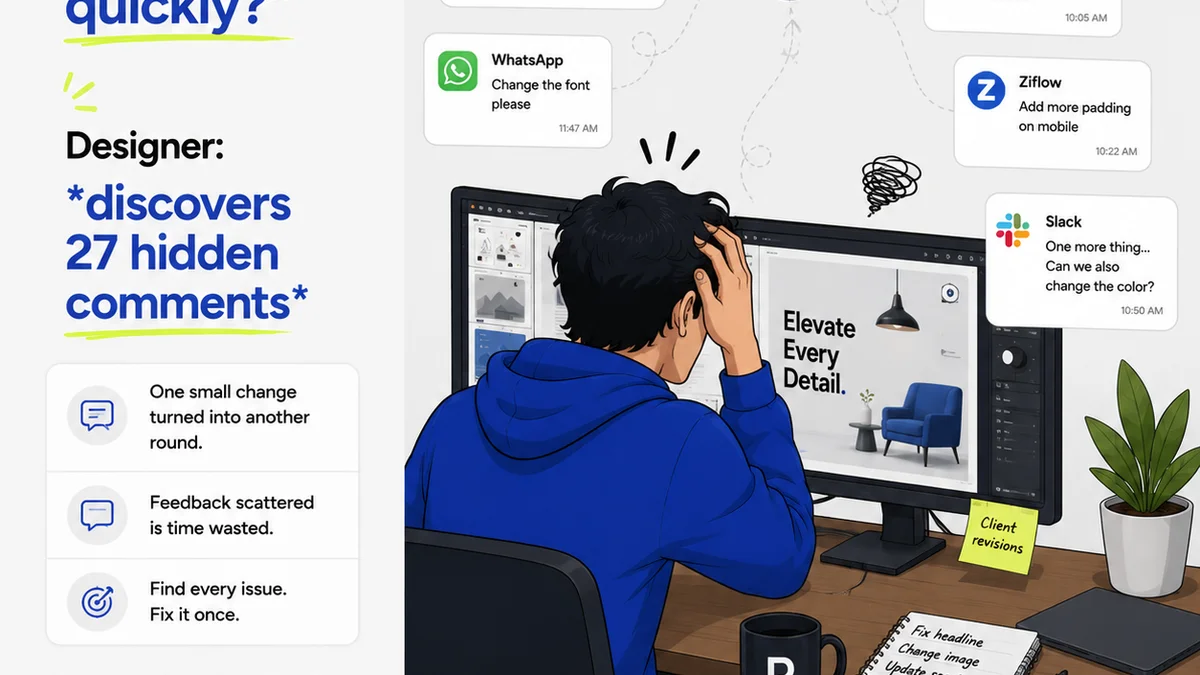
However, if their feedback mechanism is a chaotic email chain or a series of ad-hoc calls, the QA process devolves into chaos.
Client Feedback Chaos
- Miscommunication between client and agency.
- Difficulty tracking who said what and when.
- Client frustration with the revision process.
- Inability to definitively mark feedback as addressed or rejected.
A structured approach to client feedback transforms them from a potential source of error into a proactive quality partner.
5. Missing the “Why” Behind the Specs
You can check if a button is the right color. You can verify if a link works. But can you QA if the design actually solves the client’s problem?
This is where many QA processes fall short. They focus on execution, not on effectiveness.
Beyond Pixel-Perfect: Strategic QA
- Does the user flow make sense for the target audience?
- Does the design align with the stated business objectives?
- Are there any accessibility issues that weren’t considered?
- Does the overall piece feel on-brand and strategically sound?
Strategic QA requires a deeper understanding of the project goals, not just the visual output.
Where Revue Fits In
This is where a centralized platform like Revue becomes indispensable. It’s not just about managing files; it’s about managing the entire quality lifecycle.
Revue provides a single source of truth for all project feedback, revisions, and approvals. This drastically reduces the ambiguity that plagues traditional QA processes.
- Centralized Feedback: All client and internal comments are logged against specific versions of the creative asset. No more lost emails or buried Slack messages.
- Version Control Visibility: Track every iteration. See exactly what changed between versions and why. This context is crucial for effective QA.
- Streamlined Approvals: Formalize the approval process. Ensure that all stakeholders have signed off at the right stages, not just at the end.
- Audit Trail: Maintain a complete history of feedback and decisions. This is invaluable for post-project reviews and for ensuring accountability.
- Quality Checkpoints: Integrate structured quality checks directly into your workflow, rather than leaving them as an afterthought.
By centralizing feedback and revisions, you build quality into the process, making the final QA step a confirmation, not a crisis.
Final Thought
Is your design QA process a safety net, or a safety hazard?
If your QA team is constantly playing catch-up, if deadlines are slipping due to last-minute fixes, or if you’re unsure if the final output truly meets the brief’s objectives, it’s time to rethink your approach. Quality isn’t an afterthought. It’s the foundation.
Frequently asked questions
What is the biggest mistake agencies make in design QA?
The biggest mistake is treating design QA as a final, isolated step. True quality is built into the entire process, from the initial brief through every revision. Relying on a last-minute check is reactive and inefficient.
How can I make client feedback more actionable for QA?
Encourage clients to provide specific, clear feedback tied to project goals, rather than vague statements. Use a centralized platform where comments are logged against specific asset versions. This creates an audit trail and reduces subjective interpretation during QA.
Should QA be the responsibility of a single person?
No, QA should be a shared responsibility across the project team. While a dedicated QA role can be helpful, every team member—designers, project managers, account leads—plays a part in maintaining quality throughout the project lifecycle.
How does a tool like Revue help with design QA?
Revue centralizes all feedback, revisions, and approvals in one place. This provides crucial context, clear version control, and an audit trail, making it easier to track progress, understand changes, and confirm that quality standards are met at every stage, rather than just at the end.