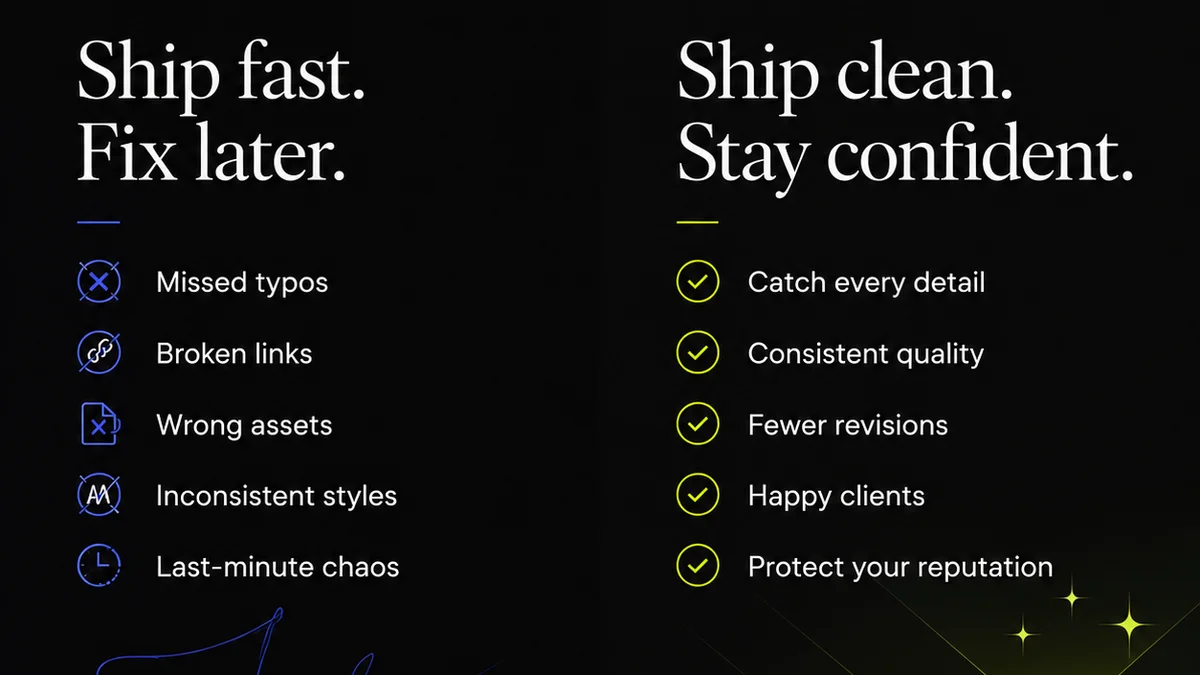
Everyone agrees design reviews are essential. They're the gatekeepers of quality, the sanity check before launch. It’s assumed that a checklist is the silver bullet. Just follow the steps, and great design emerges.
None of that is wrong. But it’s incomplete.
The hard truth? A generic checklist is a band-aid. For enterprise teams, where stakes are high and complexity is the norm, a truly effective design review process requires a deeper, more tailored approach. It’s not just about catching errors; it’s about embedding strategic alignment, brand consistency, and user experience excellence into every single deliverable.
1. Beyond the Pixel-Peeping: Strategic Alignment
Most checklists focus on the visible. Is the logo in place? Is the typography consistent? Is the color palette on-brand?
These are table stakes. For enterprise, the real win is ensuring the design serves the business objectives.
1.1. Campaign & Product Goals
Does the design clearly support the overarching campaign or product goals? Every element should have a purpose tied to these objectives.
- Does the primary CTA drive the desired user action?
- Does the visual hierarchy guide users toward key information or conversion points?
- Is the messaging clear and aligned with the campaign narrative?
1.2. Target Audience Resonance
Is the design speaking directly to the intended audience? This goes beyond demographics; it’s about psychographics and cultural relevance.
- Does the tone of voice match audience expectations?
- Are the visuals culturally appropriate and inclusive?
- Does it solve a problem or fulfill a need for this specific audience?
1.3. Brand System Adherence
This is where enterprise often struggles. Maintaining brand consistency across vast product suites and numerous marketing channels is a monumental task. A checklist should verify adherence to the established brand system, not just a single project’s interpretation.
- Are all brand assets (logos, colors, fonts, imagery styles) used correctly per guidelines?
- Is the design system applied consistently across all touchpoints?
- Does it feel like it belongs within the broader brand ecosystem?
2. The User Experience Audit
User experience isn't an afterthought; it's the core of effective design. A design review must rigorously assess the user's journey.
2.1. Usability & Accessibility
This is non-negotiable. Designs must be usable by everyone, everywhere. This means adhering to accessibility standards from the outset.
- Are interactive elements clearly identifiable and operable?
- Is there sufficient color contrast?
- Are form fields labeled correctly for screen readers?
- Is navigation intuitive and consistent?
- (See WCAG for detailed standards.)
2.2. Information Architecture & Flow
How does the user move through the experience? Is it logical, efficient, and free of friction?
- Is content organized logically?
- Are user flows streamlined and free of unnecessary steps?
- Is error handling clear and helpful?
2.3. Performance Considerations
Especially for digital products, performance is a user experience factor. A beautiful design that loads slowly or crashes is a failure.
- Are image assets optimized for web/app performance?
- Are custom fonts loaded efficiently?
- Is the design mindful of mobile network constraints?
3. Technical & Production Readiness
Great design is useless if it can’t be built or implemented effectively. Enterprise teams need to ensure designs are production-ready.
3.1. Technical Feasibility
Work closely with development teams. What looks good on screen might be a nightmare to code.
- Are the proposed interactions technically achievable within the existing tech stack?
- Are there known performance bottlenecks with the chosen approach?
- Are dependencies clearly defined for developers?
3.2. Asset Hand-off
Smooth hand-off is critical for efficiency. A disorganized hand-off leads to misinterpretations and costly rework.
- Are all necessary assets clearly named and organized?
- Are specifications (dimensions, spacing, states) provided?
- Is the design file structured logically for easy developer navigation? (e.g., Figma file organization best practices.)
3.3. Content Integration
Content and design are intertwined. Ensure the design accommodates real-world content, including variations in length and format.
- Does the design handle long-form text gracefully?
- Are placeholders representative of actual content?
- Is there flexibility for content updates or localization?
4. The Review Process Itself
A checklist is only as good as the process that uses it. How are reviews conducted? Who is involved?
4.1. Defined Roles & Responsibilities
Who is reviewing? Who is accountable? Clarity prevents bottlenecks and ensures consistent feedback.
- Design Lead/Manager: Overall creative quality, strategic alignment.
- Product Manager: Business goals, user needs, feature scope.
- Engineering Lead: Technical feasibility, implementation details.
- Brand Manager: Brand consistency, legal compliance.
- Accessibility Specialist: Usability for all.
4.2. Structured Feedback
Ad-hoc feedback is chaotic. Structured feedback is actionable. A checklist helps enforce this structure.
- Is feedback specific and actionable?
- Is it tied back to project goals or brand guidelines?
- Is it delivered constructively?
4.3. Iteration and Sign-off
Design is iterative. The review process must support this, not hinder it. Clear sign-off criteria are essential.
- Are revision rounds clearly defined?
- What are the criteria for final approval?
- How is feedback tracked and resolved?
Where Revue Fits In
Managing enterprise-level design reviews, especially across multiple projects and teams, demands robust tooling. A simple checklist document gets lost in email threads and endless Slack channels.
Revue provides a centralized platform for design feedback and approvals. Instead of scattered comments, you get a single source of truth for client and stakeholder input. This means:
- Centralized Feedback: All comments, annotations, and discussions live directly on the design asset. No more hunting through emails or chat logs.
- Revision Visibility: Track every iteration, compare versions, and see exactly what changed and why. This provides crucial context for reviewers and stakeholders.
- Streamlined Approvals: Define clear approval workflows, assign reviewers, and get formal sign-offs directly within the platform. This eliminates ambiguity and speeds up the process.
- Quality Control: Use the structured feedback and version history to ensure all review points are addressed and quality standards are met before final delivery.
This level of organization is what separates good enterprise design operations from great ones.
Final Thought
A design review checklist isn't about creating more work. It's about building a more resilient, strategic, and efficient creative process.
Are your reviews simply catching mistakes, or are they actively elevating the strategic impact and user value of your enterprise designs?
Frequently asked questions
What is the primary goal of an enterprise design review checklist?
The primary goal is to ensure designs align with strategic business objectives, maintain brand consistency, deliver excellent user experiences, and are technically feasible for production, rather than just catching surface-level errors.
How does an enterprise checklist differ from a standard one?
An enterprise checklist is more comprehensive, focusing on strategic alignment, brand system adherence across products, technical feasibility within complex stacks, and formal approval workflows, reflecting the higher stakes and scale involved.
What are the key areas to cover in an enterprise design review?
Key areas include strategic alignment with goals, user experience (usability, accessibility, flow), technical feasibility, production readiness (asset hand-off), and adherence to brand systems and guidelines.
How can a tool like Revue help with design reviews?
Revue centralizes feedback, tracks revisions, manages approval workflows, and provides a clear audit trail, making the review process more organized, efficient, and transparent for enterprise teams.