You think a design review process is just about collecting feedback. Gather comments, make changes, get approval. Simple, right?
None of that is wrong. But it’s incomplete. It misses the operational gears that make creative work move efficiently from concept to final delivery.
The hard truth is that a robust design review process isn't just a workflow; it's a strategic tool. It’s how you manage client expectations, minimize costly revisions, and ensure quality at scale. It’s the difference between a smooth project and a chaotic mess.
1. The Myth of the Single 'Right' Way
Many agencies assume there’s a universal template for design reviews. They look at what other shops do, or try to impose a rigid, one-size-fits-all system.
This is a trap. Every agency, every client, and every project is different. A process that works for a small branding project might crumble under the weight of a complex website redesign.
Your process needs to be adaptable. It needs to flex to the needs of the work and the client.
The Real Goal: Clarity, Not Conformity
What matters isn't adhering to a dogma, but achieving three core outcomes:
- Clear Accountability: Who is responsible for what feedback? Who gives the final sign-off?
- Efficient Communication: Is feedback consolidated, actionable, and easy to understand?
- Visible Progress: Can everyone see the status of revisions and approvals at a glance?
Without these, you’re just shuffling papers and emails.
2. Mapping Your Current Chaos
Before you build anything new, you need to understand what you’re dealing with. Most agencies *have* a process, but it’s often implicit, fragmented, and undocumented.
Grab a whiteboard or a digital canvas. Map out every touchpoint where design feedback occurs.
- Where does the initial brief come from?
- Who sees the first drafts?
- How is feedback collected (email, Slack, meetings, carrier pigeon)?
- Who consolidates that feedback?
- How are revisions tracked?
- Who gives the final go-ahead?
- What happens if feedback is contradictory?
Be brutally honest. Document the actual steps, not the idealized ones.
Identify the Bottlenecks
As you map, look for patterns of delay and confusion.
Are creative directors drowning in a sea of individual client comments?
Do designers spend hours chasing down clarification on vague feedback?
Are clients confused about what they’ve already approved?
These are your pain points. These are where your new process needs to focus its energy.
3. Defining Roles and Responsibilities
Ambiguity is the enemy of efficient design reviews. Clearly define who does what, and when.
The Client Side
- Primary Contact: Who is the single point of contact for feedback?
- Stakeholders: Who needs to review, and what’s their role (e.g., final approval, input only)?
- Feedback Window: How long do they have to provide feedback?
Setting these expectations upfront is crucial. A client who knows they have 48 hours to provide consolidated feedback is less likely to send a dozen emails over two weeks.
The Agency Side
- Project Manager/Account Manager: Responsible for consolidating feedback, communicating with the client, and tracking progress.
- Creative Lead/Director: Responsible for interpreting feedback, guiding the design team, and ensuring quality.
- Designer(s): Responsible for implementing revisions based on clear direction.
This clarity prevents miscommunication and ensures that feedback is channeled effectively.
4. Structuring the Review Gates
A project isn't a single review; it's a series of gates. Each gate has a specific purpose and set of deliverables.
Gate 1: Concept & Direction
- Deliverable: Mood boards, initial sketches, wireframes, or style tiles.
- Purpose: Align on the overall look, feel, and strategic direction.
- Feedback Focus: Broad strokes. Is this the right path?
Gate 2: Mid-Stage Development
- Deliverable: Key screens, core layouts, or significant feature mockups.
- Purpose: Refine the design based on initial feedback. Ensure the core structure is sound.
- Feedback Focus: Usability, hierarchy, core functionality.
Gate 3: Near-Final Polish
- Deliverable: High-fidelity mockups of most/all screens, interactive prototypes.
- Purpose: Fine-tune details, check for consistency, and prepare for final QA.
- Feedback Focus: Micro-interactions, typos, visual polish, adherence to brand.
Gate 4: Final Approval & Handoff
- Deliverable: Final, approved designs, assets, style guides.
- Purpose: Formal sign-off before development or launch.
- Feedback Focus: Minor tweaks only, sign-off confirmation.
Each gate should have clear criteria for moving to the next. This prevents scope creep and ensures that major issues are caught early.
5. Standardizing Feedback Collection
This is where most agencies trip up. Email chains, Slack messages, and random annotation tools create chaos.
You need a centralized system. A single source of truth for all feedback, comments, and approvals.
- Consolidation is Key: All feedback must be funneled through one person or system.
- Actionable Comments: Feedback should be specific, constructive, and clearly linked to a design element. Vague comments like “make it pop” are useless.
- Context Matters: Why is this change needed? What problem does it solve?
- Visual References: Use annotation tools or screen recordings to point to specific areas.
A disorganized feedback loop leads to wasted time, designer frustration, and ultimately, a weaker final product.
6. Where Revue Fits In
Managing feedback across multiple clients and projects is a constant battle. Emails get lost, Slack channels become unmanageable, and tracking revisions feels like detective work.
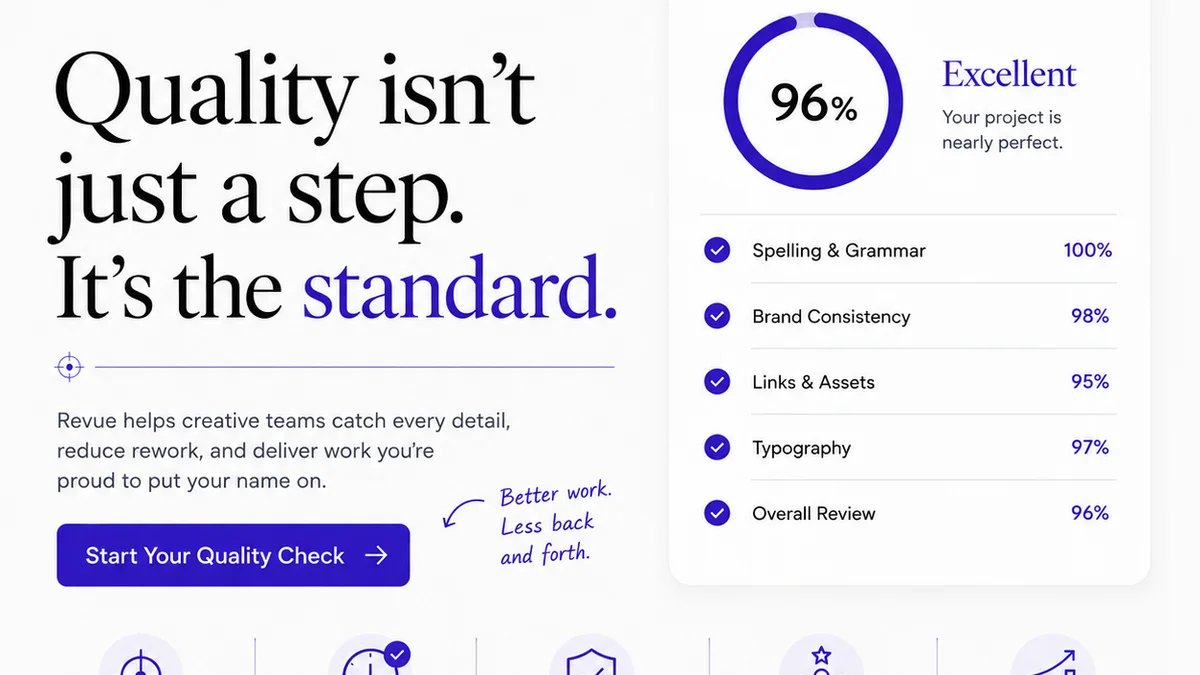
This is precisely the problem Revue solves. It acts as your centralized hub for all creative collaboration.
Instead of scattered comments, you have a clear, organized space for feedback directly on the design assets. Stakeholders can comment, discuss, and approve within a single platform.
This visibility means:
- No More Lost Feedback: Every comment is logged and tracked.
- Clear Revision History: See exactly what changed, when, and why.
- Streamlined Approvals: Get formal sign-offs without the email tennis match.
- Reduced Rework: Catch misunderstandings early with contextual feedback.
Revue helps you build that structured, efficient review process without the operational overhead.
7. Iteration vs. Re-Treading
There's a fine line between productive iteration and endlessly re-treading old ground.
A well-defined process helps you stay on the iteration side.
If you’re constantly revisiting decisions made in Gate 1 during Gate 3, your process is broken.
Establish
Frequently asked questions
What are the key roles in a design review process?
Key roles typically include the client's primary contact, relevant stakeholders for input and approval, the agency's project manager or account manager for coordination, the creative lead or director for quality and strategic guidance, and the designer(s) responsible for implementing changes.
How can I make client feedback more actionable?
Encourage clients to provide specific, constructive feedback directly related to design elements. Ask them to explain the 'why' behind their suggestions and to use visual annotation tools where possible. Consolidate all feedback through a single point person or system to avoid conflicting messages.
What is the difference between iteration and re-treading in design reviews?
Iteration involves making productive changes and refinements based on feedback to improve the design. Re-treading means revisiting and potentially undoing decisions that should have been finalized in earlier stages, often indicating a breakdown in the review process or unclear sign-offs.
How often should design reviews occur?
The frequency depends on the project's complexity and phase. Typically, reviews are structured around key project gates: concept approval, mid-stage development refinement, near-final polish, and final sign-off. Each gate ensures alignment before moving forward.