Every creative team has heard it.
"Just one more round."
The problem is that one more round rarely means one more change.
It means:
New comments.
New exports.
New versions.
New approvals.
And sometimes, a change to something that was already approved.
Most agencies don't have a design problem here.
They have a revision management problem.
And the longer you leave it alone, the more expensive it becomes.
1. The Revision Cycle Isn't the Problem
Revision is part of creative work.
It should be.
Clients need to react to real work.
Designers need feedback.
Creative directors need to challenge ideas.
Iteration is how good work gets better.
So trying to eliminate revisions completely is the wrong goal.
The goal is to make revisions controlled, visible and purposeful.
There's a huge difference between:
"The client requested three changes."
and:
"We're on revision three because nobody knows which feedback has been addressed."
The first is creative iteration.
The second is operational failure.
2. Why Design Revisions Keep Expanding
There are a few predictable reasons.
Feedback arrives in pieces
The client sends one email.
Then another stakeholder sends a Slack message.
Then someone mentions something during a meeting.
Then another comment arrives the next morning.
The designer starts working before the full picture exists.
That almost guarantees another revision.
Different people give contradictory feedback
The marketing manager wants one thing.
The creative director wants another.
The CEO wants something completely different.
Nobody has agreed on who gets the final say.
So the designer becomes the referee.
That's not a design problem.
It's a decision-making problem.
Nobody knows what changed
Version 7 is sent.
Someone asks:
"What's different from version 6?"
Now the team has to compare files manually.
That wastes time and creates another opportunity for mistakes.
Approval isn't actually approval
A client says:
"Looks good."
Two days later:
"One small thing..."
Was the first version approved?
Was the new request a revision?
Was it a new scope item?
If your system can't answer that, your revision process has no boundary.
3. The Real Cost of Poor Revision Management
The obvious cost is designer time.
But that's only the beginning.
Poor revision management also creates:
Account-management time
Someone has to chase comments and consolidate feedback.
Project-management time
Someone has to move deadlines.
Creative-director time
Someone has to resolve conflicting opinions.
Client-service time
Someone has to explain what happened.
Client frustration
The client sees more rounds than expected.
Team frustration
Designers spend more time correcting and tracking than creating.
The biggest cost is often invisible:
Momentum disappears.
4. Stop Asking for "Feedback"
This sounds strange.
But "feedback" is too broad.
Ask for specific decisions.
Instead of:
"Thoughts?"
Try:
"Does this direction match the approved campaign concept?"
Instead of:
"Any changes?"
Try:
"Please review the headline, image selection and CTA. These are the three areas open for feedback."
Instead of:
"Let me know what you think."
Try:
"Please consolidate feedback from your team before submitting comments."
Better questions create better feedback.
Better feedback creates fewer revisions.
5. Separate Feedback From Decisions
This is one of the most important distinctions in revision management.
A comment isn't necessarily a decision.
For example:
"I don't love this color."
That's feedback.
But:
"Change the background to the approved brand blue."
That's an actionable decision.
Your process needs to distinguish between:
Comment
Request
Decision
Approval
Otherwise every sentence becomes another task for the designer.
6. Establish Revision Rules Before the Project Starts
Good revision management begins before the first revision.
Your agency should establish:
Who reviews?
Define the stakeholders.
What are they reviewing?
Define the scope.
When do they review?
Set a review window.
How should feedback be submitted?
Use one channel.
Who consolidates feedback?
Give one person responsibility.
Who has final authority?
Define the decision-maker.
What counts as a new request?
Make scope boundaries clear.
This doesn't make the process rigid.
It makes the process predictable.
7. Use Version Control as a Creative Tool
Version control isn't just file organization.
It is decision history.
Imagine:
V1 — Initial Concept
↓
V2 — Client Feedback
↓
V3 — Revised Layout
↓
V4 — Copy Updated
↓
V5 — Final QA
↓
V6 — Approved
Now everyone understands what happened.
Compare that with:
final.pdf
final2.pdf
final-new.pdf
final-new-2.pdf
FINAL-APPROVED.pdf
We've all seen it.
The filename isn't a workflow.
8. Put Feedback Where the Design Is
This is another major improvement.
If someone says:
"Move this slightly left."
Where is "this"?
In an email?
A screenshot?
A PDF?
A Slack message?
The designer shouldn't have to reconstruct the location.
Visual feedback should be attached directly to the creative whenever possible.
That creates context.
And context reduces interpretation.
This is one of the reasons centralized visual feedback is becoming such an important part of creative collaboration workflows. Revue's current product positioning specifically focuses on centralized comments and annotations, revision visibility and approval tracking.
9. Create a Revision Gate
Before starting another revision round, ask:
Has all feedback been collected?
If not, wait.
Is the feedback consistent?
If not, resolve it.
Is it within scope?
If not, discuss the change before production.
Is the decision-maker involved?
If not, you're probably going to repeat the round.
Is the current version clearly identified?
If not, fix version control first.
This five-question gate can eliminate a surprising amount of unnecessary back-and-forth.
10. Know When a Revision Becomes Scope Creep
This is where agencies often lose money.
A client approves a direction.
Then asks for:
a different layout
new messaging
a different campaign concept
additional deliverables
another format
a new audience
And the team says:
"Sure, we'll squeeze it in."
That's not client service.
That's unmanaged scope.
Your revision workflow should make it possible to see whether a request is:
Included revision
or
New request
That distinction protects both sides.
11. Quality Checks Should Happen Before Final Approval
There's another reason revisions multiply.
The team sends creative to the client before checking the basics.
The client finds:
spelling errors
alignment issues
incorrect copy
inconsistent typography
missing elements
brand inconsistencies
Now the client is doing your QA.
That's backwards.
The client should be reviewing the creative decision.
Your team should be catching the obvious execution errors first.
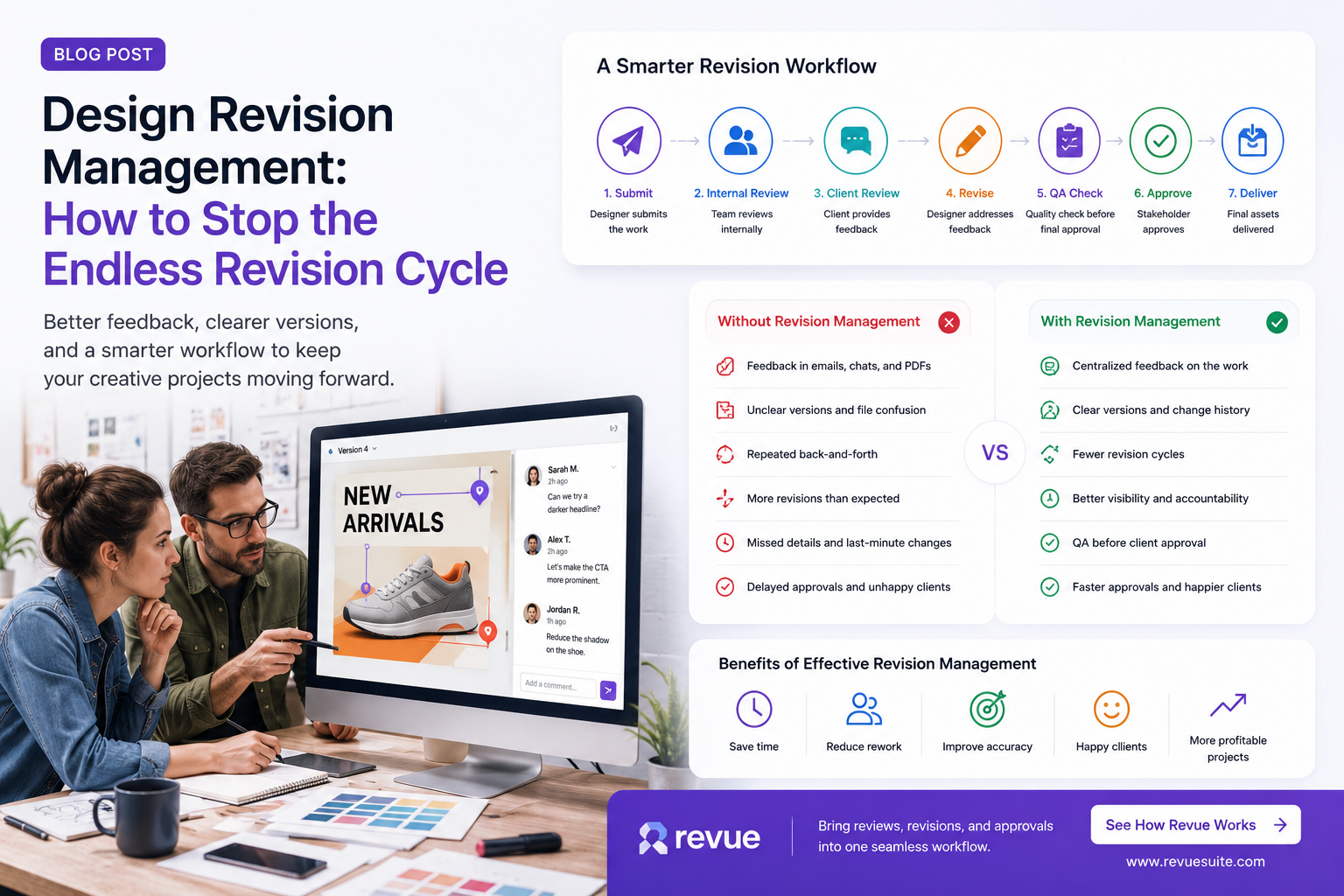
A strong workflow therefore looks like:
Create → Internal Review → QA → Client Review → Revision → QA → Approval
Not:
Create → Client Finds Problems → Fix → Client Finds More Problems
12. Where Revue Fits In
This is the point where revision management becomes more than a process document.
You need a system that can hold the process together.
Revue brings creative feedback, revision visibility, review and approvals into one workspace so teams don't have to reconstruct the history of a project from email threads and chat messages.
See How Revue Handles Creative Review & Revisions
The important idea isn't simply "put comments in Revue."
It's:
Make the revision history visible.
When feedback stays connected to the creative work and versions, the team has more context when deciding what needs to change.
When approval is explicit, there is less ambiguity about whether a piece of work is actually finished.
And when quality checks are part of the workflow, the client isn't forced to become the final QA department.
13. A Better Design Revision Workflow
Here's a practical model for US creative agencies and in-house teams.
Step 1 — Submit
Designer submits the creative for review.
Step 2 — Internal review
Creative leadership checks direction and execution.
Step 3 — QA
Check copy, typography, alignment, brand requirements and other relevant standards.
Step 4 — Client review
Client receives a clearly identified version.
Step 5 — Consolidate
Client stakeholders submit feedback through one defined process.
Step 6 — Revise
Designer addresses agreed feedback.
Step 7 — Re-QA
Check the revised version before resubmitting.
Step 8 — Approve
Authorized stakeholder signs off.
Step 9 — Lock
The approved version becomes the delivery version.
That's a revision workflow.
Not a revision loop.
14. The Revision Management Checklist
Before sending creative to a client, ask:
Is this the correct version?
Has internal feedback been addressed?
Has the creative passed QA?
Are all requested changes implemented?
Are there unresolved comments?
Is the client reviewing the right asset?
Is the expected feedback clearly defined?
Is the approval owner known?
If the answer to any of these is "no," you're not ready for client review.
15. The Bigger Shift: Stop Managing Revisions. Manage Decisions.
This is the real change.
The goal isn't to make designers respond to feedback faster.
It's to make the decision-making process clearer.
When everyone understands:
What is being reviewed → What decision is needed → Who decides → What changes → What gets approved
the number of unnecessary loops naturally falls.
That is what good revision management does.
It doesn't eliminate creative disagreement.
It makes disagreement manageable.
Final Thought
Every agency says it values creativity.
But creative teams don't lose their best hours because they're designing.
They lose them because they're searching, clarifying, chasing, comparing, exporting and waiting.
If your designers are spending too much time asking:
"Which version?"
"Did the client approve this?"
"Was that feedback from yesterday?"
"Who is supposed to review this?"
you don't have a designer problem.
You have a workflow problem.
And that's exactly the kind of problem worth fixing.
See How Revue Can Bring Reviews, Revisions and Approvals Into One Workflow
Frequently asked questions
What is design revision management?
Design revision management is the process of collecting feedback, tracking requested changes, managing versions, completing revisions and confirming approval without losing context or control.
How can agencies reduce unnecessary design revisions?
Centralize feedback, define review stages, assign decision-makers, consolidate client feedback, maintain clear version control and perform internal QA before client review.
How many design revision rounds should an agency allow?
There is no universal number. The right number depends on the scope and type of project. What matters is defining the expected revision process and distinguishing included revisions from new requests.
Why does version control matter in design revisions?
Version control makes it clear which creative is current, what changed between iterations and which version was approved. Without it, teams can easily work from outdated feedback or files.
Can software eliminate design revision cycles?
No. Revision is a normal part of creative work. The right software can make revisions more structured, visible and actionable, but it cannot replace creative judgment or client decision-making.