In 2018, two design studios started around the same time.
Both had talented designers.
Both produced beautiful work.
Both won appreciation from clients.
Both dreamed of building a respected creative business.
Five years later, one studio had grown into a profitable agency with multiple employees, recurring clients, and predictable revenue.
The other had shut down.
The surprising part?
The failed studio arguably produced better design work.
So what happened?
Let's call them Studio A and Studio B.
Studio A: The Business-First Design Studio
Studio A believed great design mattered.
But they also believed that great design alone wasn't enough.
Every week, the founders spent time on:
Sales outreach
Building relationships
Creating proposals
Following up with leads
Tracking finances
Monitoring profitability
Managing cash flow
The founders understood something many creatives hate to admit:
Design is the product. Sales is the distribution.
A masterpiece nobody buys is not a business.
It is art.
Studio A wasn't ashamed of selling.
They understood that revenue wasn't the enemy of creativity.
Revenue was what allowed creativity to survive.
As projects came in, they carefully tracked how many hours were spent.
They knew the cost of every designer.
They understood utilization rates.
They measured profitability.
Sometimes they even stopped pursuing perfection because the additional improvements wouldn't justify the additional cost.
The result?
Steady growth.
A healthy team.
Reliable salaries.
And enough financial stability to take creative risks.
Studio B: The Passion-First Design Studio
Studio B loved design.
The founders obsessed over every pixel.
A logo revision could take days.
A presentation could go through countless refinements.
Design quality became an addiction.
Clients loved the work.
Designers loved the culture.
The founders proudly claimed:
"We don't do sales."
"Our work speaks for itself."
"We rely on word of mouth."
"We don't want to be pushy."
They believed that one day, somehow, their exceptional work would become famous and clients would magically line up at their door.
So they waited.
And waited.
And waited.
The problem wasn't the quality of their work.
The problem was that while they were polishing pixels, their costs kept increasing.
The Invisible Meter That Never Stops Running
Every design studio has a meter running in the background.
Most founders don't see it.
But it never stops.
Every designer's salary.
Every manager's salary.
Office rent.
Software subscriptions.
Internet bills.
Taxes.
Recruitment costs.
Training costs.
Equipment costs.
The meter runs every single day.
Even when no client signs.
Even when no invoice gets paid.
Even when founders are busy perfecting a presentation nobody asked them to perfect.
Many studios focus entirely on output quality while ignoring operational economics.
The result is predictable.
The studio produces exceptional work while quietly becoming financially unhealthy.
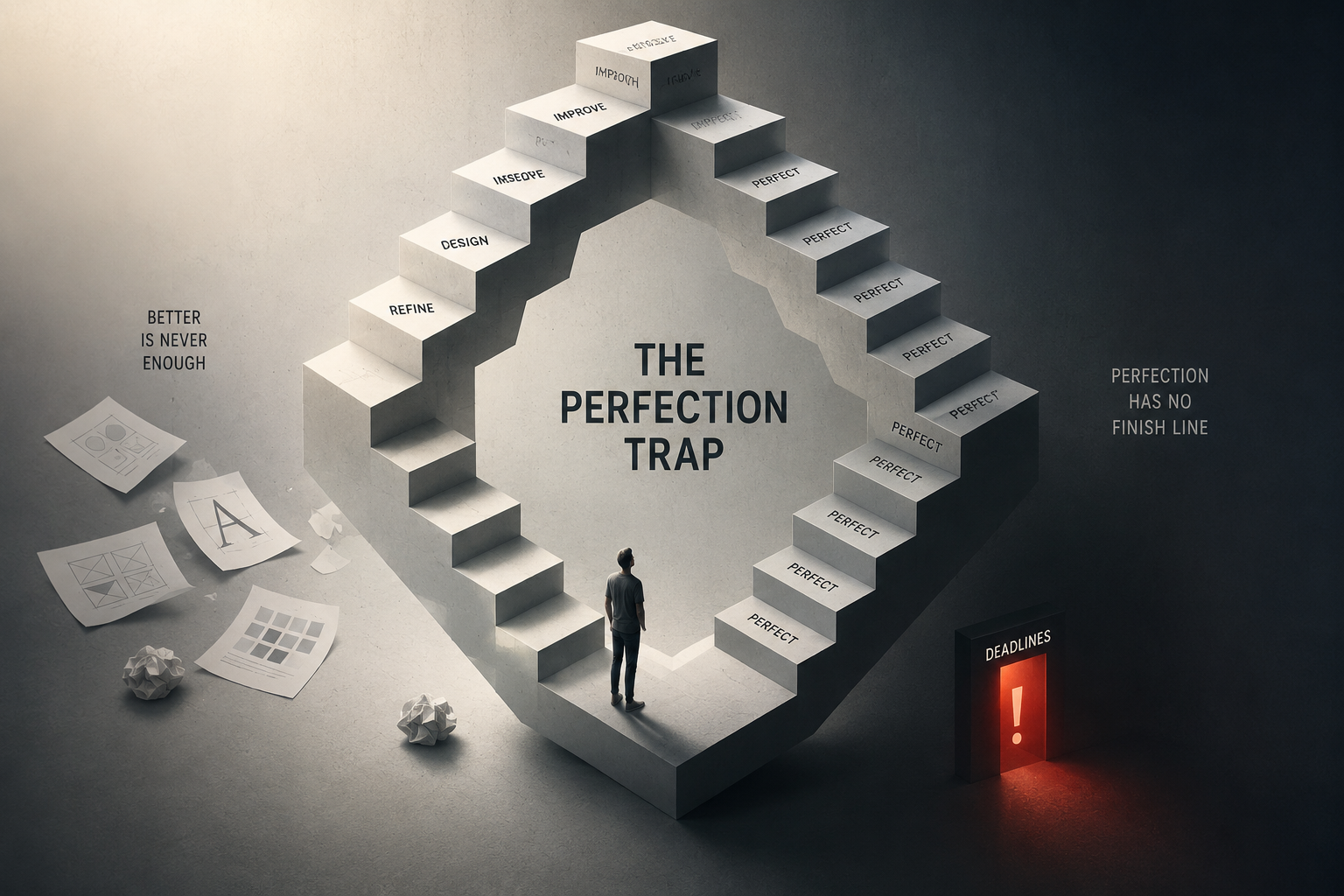
The Perfection Trap
One of the biggest dangers in creative businesses is confusing perfection with value.
Clients pay for outcomes.
Studios often charge for effort.
These are not the same thing.
A designer might spend:
20 hours creating a solution
Another 20 hours refining it
Another 10 hours polishing details
The client may perceive almost identical value between Version 2 and Version 15.
The studio absorbs the additional cost.
The client rarely pays extra.
Over time, this behavior destroys profitability.
The founders feel busy.
The team feels productive.
The bank account tells a different story.
Why Most Design Studios Avoid Sales
Most designers didn't start their careers because they loved selling.
They started because they loved creating.
Sales feels uncomfortable.
Sales feels commercial.
Sales feels less noble than design.
So many studio owners convince themselves that sales isn't necessary.
They hide behind statements like:
"We only want inbound leads."
"Good work sells itself."
"We grow through referrals."
"We don't chase clients."
The reality is simpler.
They are avoiding sales because sales involves rejection.
And rejection is uncomfortable.
But discomfort doesn't disappear because you ignore it.
It simply shows up later as financial stress.
The Dangerous Myth of Word-of-Mouth
Word-of-mouth is powerful.
But it is also unpredictable.
A business cannot rely entirely on luck.
Referrals should be a bonus.
Not a business strategy.
Imagine a restaurant saying:
"We don't advertise."
"We don't have a signboard."
"We don't tell anyone we exist."
"We'll just wait for customers."
Everyone would immediately recognize the flaw.
Yet countless design studios operate exactly this way.
When a Studio Fails, It's Not Just the Founders Who Suffer
This is where the conversation becomes serious.
Many founders view failure as a personal risk.
It isn't.
A studio is not just a logo.
It is not just a portfolio.
It is not just an Instagram page.
A studio is a collection of people.
Behind every designer is a family.
Behind every account manager is a rent payment.
Behind every project manager is a child whose school fees depend on that salary.
When a studio ignores business fundamentals, everyone carries the risk.
And when the building collapses financially, founders are not the only ones affected.
The employees often suffer the most.
The founder may recover.
The founder may start another business.
The employees suddenly face unemployment, uncertainty, and financial pressure.
This is why business responsibility matters.
Not because money is everything.
But because people's lives depend on it.
A Design Studio Is Either a Business or a Hobby
This may sound harsh.
But it is important.
A design studio that ignores:
Sales
Financial planning
Profitability
Lead generation
Cash flow
is not operating like a business.
It is operating like a hobby that occasionally generates revenue.
There is nothing wrong with hobbies.
There is nothing wrong with passion projects.
But founders must be honest about which game they are playing.
A hobby can survive without revenue.
A business cannot.
The Real Job of a Design Studio Founder
Many founders believe their primary responsibility is producing great work.
That is only half the job.
The other half is ensuring the business survives long enough to continue producing great work.
Your responsibility is not only to design.
It is to create a machine that consistently generates:
Leads
Revenue
Profit
Opportunities
Career growth for employees
Because the best design studio is not the one with the most awards.
It is the one that can still pay salaries ten years from now.
Final Thoughts
Creative excellence matters.
Craft matters.
Quality matters.
But none of them matter for very long if the business underneath them is collapsing.
The harsh reality is that many design studios fail not because they produce bad work.
They fail because they treat business as an afterthought.
The studios that survive understand a simple truth:
Design is the craft.
Business is the engine.
Without the engine, even the most beautiful vehicle goes nowhere.
Frequently asked questions
1. Why do many design studios struggle financially despite doing great work?
Many studios focus heavily on creative excellence while neglecting sales, profitability, cash flow management, and business development. Great work alone does not guarantee a sustainable business.
2. Is relying on referrals and word-of-mouth enough to grow a design studio?
No. Referrals are valuable but unpredictable. Successful studios treat referrals as one lead source among many and build consistent sales and marketing systems to generate opportunities.
3. What is the "Perfection Trap" in a design studio?
The Perfection Trap occurs when teams spend excessive time refining work beyond the point where clients perceive additional value. This increases internal costs without increasing revenue or profitability.
4. Why is business sustainability important for a design studio?
A studio's success impacts more than its founders. Designers, project managers, account managers, and their families depend on the studio's financial health. Sustainable businesses create stable careers, growth opportunities, and long-term security for their teams.