A lot of agencies mistake activity for strength.
The team is constantly moving. Designers are fully occupied. Slack is noisy. Client calls are stacked. Projects are in motion. Deadlines are tight. Founders are involved everywhere. There’s never a quiet week.
From the inside, that level of movement can feel like proof that the business is growing.
It isn’t.
Sometimes it’s proof that the agency has demand.
Sometimes it’s proof that the team works hard.
But very often, it’s proof that the operating system underneath the work is weak.
That’s the distinction agency founders need to understand: being busy is not the same as being scalable.
A busy agency is often one that’s constantly reacting. It’s full of effort, but low on structural leverage. Work gets done, but it takes more human energy than it should. Deadlines are met, but only because someone stayed late, someone chased approvals manually, someone caught a mistake at the last minute, or the founder stepped in to unblock a mess.
A scalable agency is different.
It can handle more work without the same rate of confusion, rework, or founder dependence. It has clearer systems around intake, feedback, revisions, approvals, version control, quality checks, and ownership. The team still works hard, but the work moves through a stronger machine.
That difference matters because agencies don’t usually fail from lack of effort. They fail from building a business where effort is the only thing holding the workflow together.
A Busy Agency Feels Full. A Scalable Agency Feels Controlled.
This is the first useful lens.
Busy agencies often feel intense. There’s always something happening. The team is stretched. Every person seems important. The founder is in constant motion. There’s a sense that everyone is “giving it everything.”
Scalable agencies feel different.
Not lazy. Not slow. But more controlled.
Projects move with less drama. People know where work lives. Feedback doesn’t get scattered across five channels. Reviews happen in a more predictable way. Fewer things need rescuing. Senior people spend less time doing cleanup and more time doing actual leverage work. The founder isn’t the default solution to every ambiguous situation.
From the outside, the scalable agency may even look less frantic.
That’s a good sign.
Because the goal of scale is not to create more visible intensity. It’s to create more output, more quality, and more profitability without multiplying chaos at the same rate.
The Core Difference: Busy Agencies Add Effort. Scalable Agencies Add Leverage.
When pressure rises, a busy agency’s default response is usually effort.
Work harder.
Reply faster.
Stay later.
Hire another person.
Jump on another call.
Do one more revision.
Double-check the file manually.
Push it through somehow.
That can keep the business moving for a while. But it doesn’t actually improve the system.
A scalable agency responds differently. It asks:
Why did this project get stuck?
Why did this approval take so long?
Why did this feedback arrive in three places?
Why did the wrong version get reviewed?
Why did the team need founder input again?
Why did this revision reopen a supposedly approved deliverable?
Why are we solving this with people instead of process?
That mindset shift is everything.
Busy agencies keep spending human energy to absorb operational friction.
Scalable agencies try to remove the friction itself.
What Busy Agencies Usually Look Like
Let’s make this concrete.
A busy agency often has some combination of the following traits.
1. Founders Are the Hidden Operating System
The founder knows which client feedback matters.
The founder knows what the brief really means.
The founder knows which file is safe to send.
The founder knows when the work is good enough.
The founder resolves conflicting comments, catches missing details, and steps in when timelines slip.
From the outside, that can look like leadership.
In reality, it’s often a sign that the business hasn’t built enough system strength to operate without constant founder intervention.
If the founder is still carrying approval logic, quality control, client context, and escalation management in their head, the agency may be busy—but it is not scalable.
2. Feedback Is Scattered and Expensive to Manage
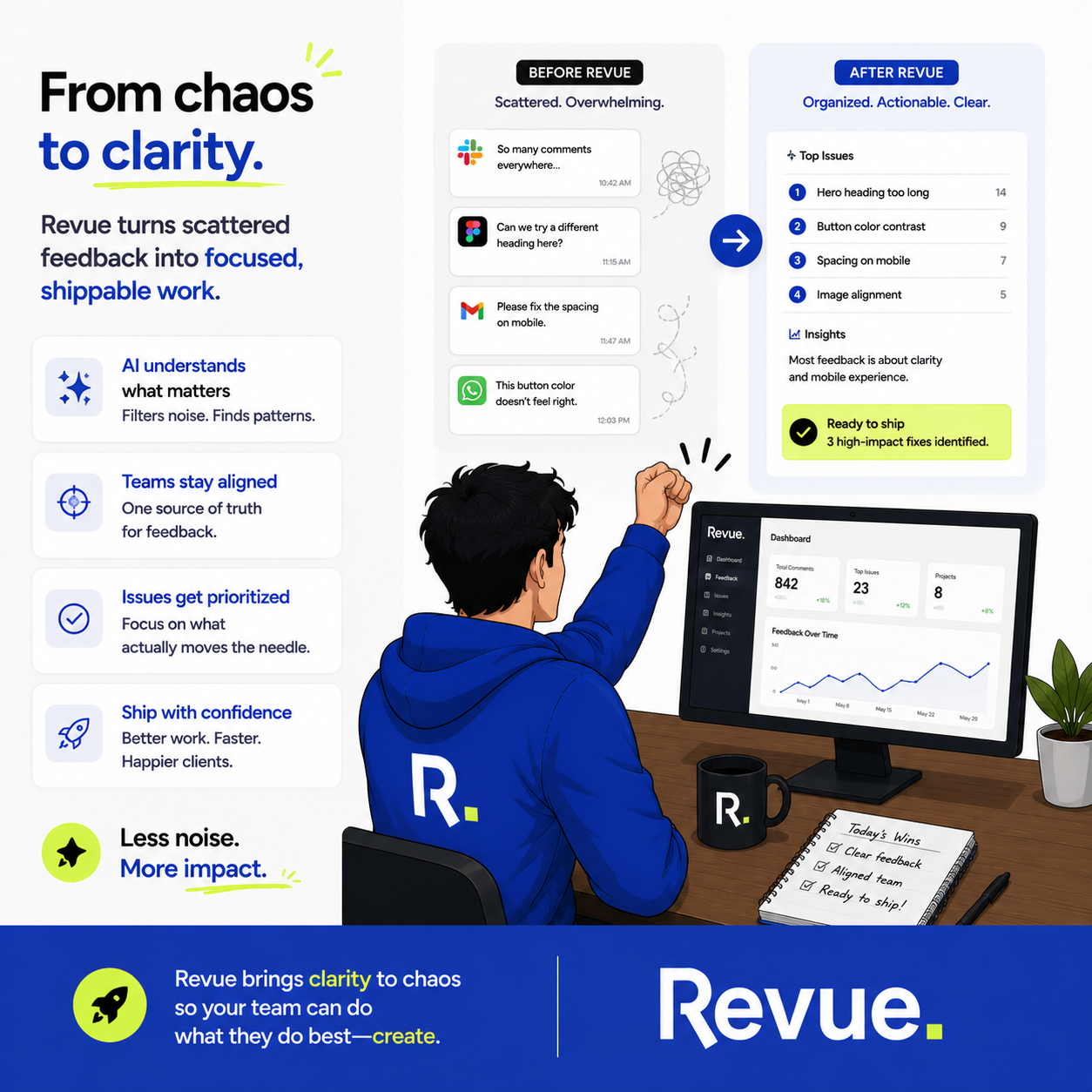
Comments live in Slack, email, WhatsApp, PDFs, screenshots, calls, and random follow-up messages.
Now someone has to gather, interpret, reconcile, and route all of it.
That person is often an account manager, project lead, designer, or founder. They spend time doing coordination work that doesn’t directly improve the creative output but is required just to keep the project coherent.
Busy agencies normalize this because the work still moves.
Scalable agencies treat it as a system failure.
That’s why scalable agencies care much more about:
centralized review environments
creative feedback management
proofing workflows
approval visibility
reducing ambiguity in revision cycles
They know feedback chaos doesn’t just waste time. It makes growth harder.
3. Version Control Is Fragile
A busy agency often has some version of this problem:
the wrong file gets reviewed
someone comments on an outdated export
edits happen on multiple versions
no one is fully sure which file is final
a previous fix gets overwritten during a last-minute revision
The team finds ways to recover, but recovery itself becomes part of the workload.
Scalable agencies don’t assume naming files “Final_v7_UseThisOne” is a process. They build stronger control around what’s current, what changed, what’s approved, and what should no longer be touched.
Because they know version confusion is not a small annoyance. It’s a tax on delivery.
4. Quality Depends on Heroics
In a busy agency, quality often survives because a few responsible people keep catching mistakes manually.
A senior designer spots the spacing issue.
A founder notices the wrong copy.
An account lead rechecks the deck before it goes out.
A creative director catches the outdated asset in time.
That may protect the output in the short term. But it’s not a scalable quality system. It’s a reliance on vigilance.
Scalable agencies try to reduce how much quality depends on last-minute heroics by building repeatable review logic and quality-control steps into the workflow itself.
5. Hiring Is Used to Absorb Chaos
Busy agencies often solve operational pain by adding people:
hire a PM because approvals are messy
hire an account manager because client communication is scattered
hire another designer because revisions keep eating capacity
hire a senior creative because too much work needs checking
Sometimes those hires are valid.
But if the workflow underneath is weak, the agency is not really solving the problem. It’s buying more capacity to tolerate the problem.
That’s why busy agencies can keep growing headcount without feeling much more in control.
6. Profitability Feels Worse Than the Revenue Suggests
This is one of the clearest signs of a busy agency.
The business is working hard. Revenue may even be growing. But margins feel thin. The team feels stretched. The founder feels overloaded. Delivery takes more effort than expected.
Why?
Because too much of the agency’s time is being consumed by invisible operational work:
chasing approvals
reconciling feedback
reopening files
fixing preventable mistakes
checking versions
managing rework
clarifying unclear briefs
resending work that should have moved cleanly the first time
That effort is real labor. It just doesn’t always show up cleanly in pricing, project estimates, or time tracking.
What Scalable Agencies Usually Do Differently
Now let’s look at the other side.
A scalable agency is not perfect. It still has revisions, mistakes, pressure, and difficult clients. But it behaves differently at the system level.
1. It Builds Workflow Clarity Before It Adds Complexity
Scalable agencies don’t wait until chaos becomes unbearable before defining process.
They proactively build clarity around:
how projects enter the team
where briefs live
how feedback is given
what each review stage means
who approves what
how versions are tracked
when quality checks happen
what “final” actually means
That doesn’t make the agency rigid. It makes the work easier to move.
2. It Centralizes the Review Layer
Scalable agencies understand that the review-and-approval layer is where a huge amount of hidden waste accumulates.
That’s where comments get lost.
That’s where revisions loop unnecessarily.
That’s where version confusion starts.
That’s where late changes reopen approved work.
That’s where preventable errors survive into delivery.
So they don’t treat review as a loose collection of habits. They treat it as a system to be designed.
3. It Reduces Dependency on Memory
A scalable agency does not rely on “the founder knows,” “the senior designer remembers,” or “the account manager has it in their notes.”
It creates enough structure that the team can operate without needing key context trapped in individual heads.
That means clearer ownership, clearer project visibility, clearer approval status, and more predictable handoffs.
4. It Protects Quality Without Overloading Senior People
Scalable agencies still care deeply about quality. But they don’t assume the only way to protect quality is by making senior people manually review everything forever.
They create workflows where preventable errors are less likely to survive in the first place.
That can include:
defined QA steps
structured review sequences
better version control
clearer feedback trails
systems for checking design consistency before final delivery
5. It Treats Operations as a Competitive Advantage
This is a big one.
Busy agencies often think of operations as admin.
Scalable agencies think of operations as infrastructure.
They know that stronger systems don’t just make the team’s life easier. They make the agency:
easier to scale
easier to manage
more reliable for clients
less founder-dependent
more profitable per project
more resilient under growth
In other words, they understand that operational maturity is not separate from creative excellence. It’s one of the things that protects it.
The Hidden Risk of Staying “Busy”
Some founders secretly like the feeling of busyness because it feels validating.
The agency is in demand. People are working hard. There’s momentum. The founder is needed everywhere. The pace feels intense and important.
But busyness has a trap built into it.
If the agency keeps normalizing hustle as the operating model, it becomes harder to notice when the business has stopped becoming healthier and has simply become heavier.
That’s when you get:
more revenue with less margin
more people with less clarity
more projects with more rework
more founder involvement with less real leverage
more delivery effort with less control
At that point, the agency is not scaling. It’s inflating.
How to Tell Which Kind of Agency You’re Building
Ask yourself a few uncomfortable questions:
If client volume doubled, would our review process still hold?
If I disappeared for two weeks, what would break?
Do we know exactly where feedback, approvals, and version history live?
How often are we solving workflow pain by adding people instead of fixing the process?
How much senior time is spent on manual QA and project rescue?
How many hours per week disappear into coordination that should not exist?
Does our revenue growth actually feel operationally healthy—or just operationally heavier?
Your answers will tell you a lot.
If the agency keeps surviving through extra effort, founder memory, and people compensating for weak systems, you are building a busy agency.
If the agency is steadily reducing ambiguity, controlling review chaos, protecting quality through process, and making growth less dependent on heroics, you are building a scalable one.
Where Revue Fits In
Revue matters here because one of the clearest differences between busy and scalable agencies shows up in the creative review layer.
Busy agencies often lose time and margin there:
feedback is scattered
comments get missed
revisions reopen work repeatedly
approvals are unclear
version control breaks under pressure
manual QA becomes a bottleneck
Scalable agencies need that layer to be tighter.
Revue helps by giving creative teams more structure around:
centralized feedback and annotations
clearer review workflows
visibility across revisions and approvals
better control over design consistency and quality checks
a more reliable path from draft to sign-off
That doesn’t magically make an agency scalable on its own. But it strengthens one of the most operationally fragile parts of the workflow—and that matters a lot.
Final Thought: Stop Mistaking Motion for Maturity
This is the bottom line.
A busy agency can look successful from the outside. It can have clients, revenue, talent, and momentum. But if the business still depends on hustle, scattered communication, founder intervention, and manual rescue work, it has not really built scale. It has built a fragile machine that needs constant human force to keep moving.
A scalable agency is different.
It doesn’t eliminate hard work. It eliminates unnecessary friction.
It doesn’t eliminate complexity. It learns to control it.
It doesn’t remove people from the system. It makes people more effective inside it.
So if your agency feels full all the time, don’t ask only, “How do we handle more work?”
Ask a better question:
Are we building a business that gets stronger with growth—or just busier with it?
That answer is the difference between short-term motion and long-term scale.
Frequently asked questions
1. What is the difference between a busy agency and a scalable agency?
A busy agency relies heavily on hustle, founder involvement, and reactive coordination to keep work moving. A scalable agency has stronger systems for feedback, approvals, quality control, version tracking, and ownership, so growth creates less chaos.
2. Can a busy agency still be profitable?
Yes, but it’s usually more fragile. Busy agencies often hide operational waste behind hard work, which can reduce margins, overload senior people, and make growth harder to sustain.
3. Why do busy agencies struggle to scale?
Because they add work faster than they improve the systems around the work. As projects, stakeholders, and revisions increase, scattered feedback, weak approvals, and manual QA create more operational drag.
4. What makes an agency scalable?
A scalable agency has repeatable systems for project intake, briefing, feedback, approvals, version control, quality checks, and handoffs. It can take on more work without increasing confusion and founder dependence at the same rate.
5. How do founders know if their agency is just busy instead of scalable?
Common signs include constant firefighting, heavy founder involvement in approvals and problem-solving, scattered feedback, frequent rework, unclear ownership, and revenue growth that feels operationally messy.
6. Do scalable agencies still work hard?
Absolutely. The difference is that their hard work moves through a stronger system. They spend less time on preventable coordination, rework, and rescue work, and more time on actual creative and strategic output.
7. How can a busy agency become more scalable?
It starts by building stronger systems around project intake, feedback collection, approvals, version control, quality checks, and ownership visibility—especially in the review-and-revision layer where creative chaos tends to accumulate.