Everyone talks about editorial workflow as a neat, linear path from brief to final delivery. It sounds simple: brief, draft, review, revise, approve, deliver. That’s the theory, anyway.
None of that is wrong. But it’s incomplete.
The deeper, harder truth is that a truly effective editorial workflow isn't about a perfect process; it's about managing the inherent messiness of creative collaboration and client feedback. It’s about navigating ambiguity, not eliminating it.
1. The Myth of the Single Source of Truth
Most agencies assume their project management tool is the central hub for all information. This is a dangerous assumption. Emails, Slack messages, random Google Docs, whispered hallway conversations – these all contain critical feedback and decisions.
This fragmented communication creates blind spots. A designer might miss a crucial revision note buried in an email thread, leading to wasted time and rework.
The Symptoms of Fragmented Truth:
- Endless email chains asking for clarification.
- Team members chasing down feedback from different channels.
- “Who signed off on this version?” confusion.
- Inconsistent versions of creative assets circulating.
Your team needs a single, accessible place where all feedback, decisions, and versions live. Otherwise, you’re building on shifting sand.
2. Revision Cycles Aren't Linear
The standard model of feedback assumes clients give clear, actionable notes and designers implement them perfectly the first time. Reality is far messier.
Clients often provide subjective feedback (“make it pop”) or conflicting direction. Revisions can lead to new questions, which lead to more revisions, spiraling outward.
You can't predict every twist and turn. Your workflow needs to accommodate this unpredictability, not pretend it doesn't exist.
Embracing Ambiguity:
- Build buffer time into schedules for unexpected revision rounds.
- Train clients on how to provide constructive, specific feedback.
- Establish clear escalation paths for conflicting feedback.
- Document every revision request and its resolution.
Treating revision cycles as a fixed number of steps is a recipe for missed deadlines and stressed-out teams.
3. The Hidden Cost of Approval Bottlenecks
Approvals are often seen as a simple checkpoint. In reality, they are frequent points of failure in the editorial workflow.
Who is responsible for the final sign-off? Are they available? Do they have all the context? When feedback is delayed, entire projects stall.
This isn't just about waiting; it's about the opportunity cost. Every day a project sits waiting for approval is a day you could have been moving on to the next client, or the next phase of work.
Mitigating Approval Delays:
- Clearly define approval roles and responsibilities upfront.
- Set explicit deadlines for feedback and approvals.
- Use tools that provide clear visual comparisons of revisions.
- Automate reminders for pending approvals.
A slow approval process doesn’t just delay a single asset; it creates a ripple effect that impacts your entire agency’s capacity.
4. Quality Control is Not an Afterthought
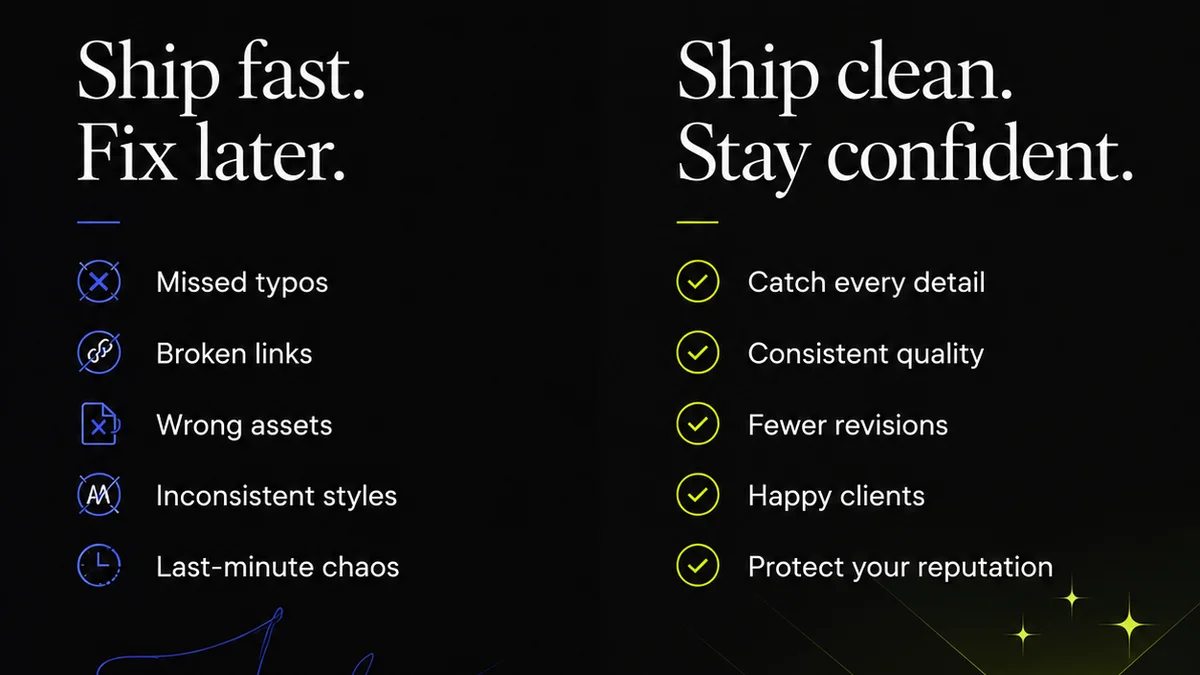
Many teams treat quality control (QC) as the final step before delivery – a quick check for typos or broken links. This is a mistake.
True quality control needs to be integrated throughout the entire editorial workflow. It's about ensuring consistency, adherence to brand guidelines, and technical correctness at every stage.
Skipping or rushing QC is a false economy. The cost of fixing errors after delivery is exponentially higher than catching them early.
Integrating QC:
- Develop detailed QC checklists relevant to each project type.
- Assign specific team members responsible for QC at different stages.
- Automate checks where possible (e.g., link validation, accessibility checks).
- Include client review of final proofs as a formal QC step.
A robust editorial workflow includes checks and balances, not just a final sign-off.
5. Where Revue Fits In
Managing the complexities of creative feedback, revisions, and approvals is where a tool like Revue becomes essential. It’s built to handle the messiness.
Revue centralizes all client feedback directly on the creative assets themselves. No more hunting through emails or Slack.
You get clear visibility into every revision cycle. Track who said what, when it was approved, and what changed. This eliminates ambiguity and speeds up decision-making.
The platform also facilitates structured quality checks, ensuring nothing slips through the cracks before final delivery.
It’s about bringing order to the chaos, not by pretending the chaos doesn’t exist, but by providing the tools to manage it effectively.
Final Thought
Is your editorial workflow designed for the ideal scenario, or does it actually support the messy, unpredictable reality of creative work? The answer might be costing you more than you think.
Frequently asked questions
What are the key stages of an editorial workflow?
A typical editorial workflow includes briefing, drafting, internal review, client feedback, revisions, final approval, and delivery. However, the reality is often less linear, with feedback and revisions looping back multiple times.
How can I improve client feedback quality?
Train clients on providing specific, actionable feedback. Clearly define what constitutes 'final' feedback and establish expectations for subjective vs. objective comments. Using a centralized platform like Revue can help ensure feedback is captured accurately and in context.
What is the biggest challenge in managing revisions?
The biggest challenge is often managing conflicting feedback, unclear direction, and the sheer volume of back-and-forth. Without a clear system for tracking changes and approvals, revision cycles can become chaotic and time-consuming.
Why is quality control often overlooked?
Quality control is sometimes treated as a final step rather than an integrated process. This happens due to tight deadlines, pressure to deliver quickly, or a lack of dedicated resources. However, skipping QC leads to costly errors discovered post-delivery.
How does a tool like Revue help with editorial workflow?
Revue centralizes feedback directly on creative assets, provides clear version control and approval tracking, and streamlines communication. This reduces the chaos of fragmented communication and speeds up the entire review and revision process.