Everyone uses email. It’s the default. For creatives, that often means it becomes the default for client feedback too. Clients send their thoughts, revisions, and approvals right into your inbox. It feels organized, or at least, familiar.
None of that is wrong. But it’s incomplete.
The hard truth? Email is a terrible tool for managing creative feedback and approvals. It’s a digital black hole that breeds confusion, delays projects, and erodes client relationships.
1. The Inbox Is Not a Project Management System
Your inbox is designed for communication, not for tracking the granular details of creative work. When feedback gets buried in email chains, it’s lost.
Consider this:
- A client sends a revision request in an email.
- You reply, asking for clarification.
- They reply again, with more detail.
- Somewhere in between, another client sends an urgent request.
- Your original feedback is now three pages deep in a thread you can barely find.
This isn't managing feedback; it's managing an archive of conversations.
Lost in Translation
Email lacks the contextual clarity needed for design feedback. Is the client referring to the logo in the header or the one in the footer? Is that red color change for the button or the background element? Without a visual reference point directly tied to the feedback, interpretation becomes guesswork.
This ambiguity leads to multiple revision rounds, wasted designer hours, and frustration on both sides.
2. Version Control Nightmares
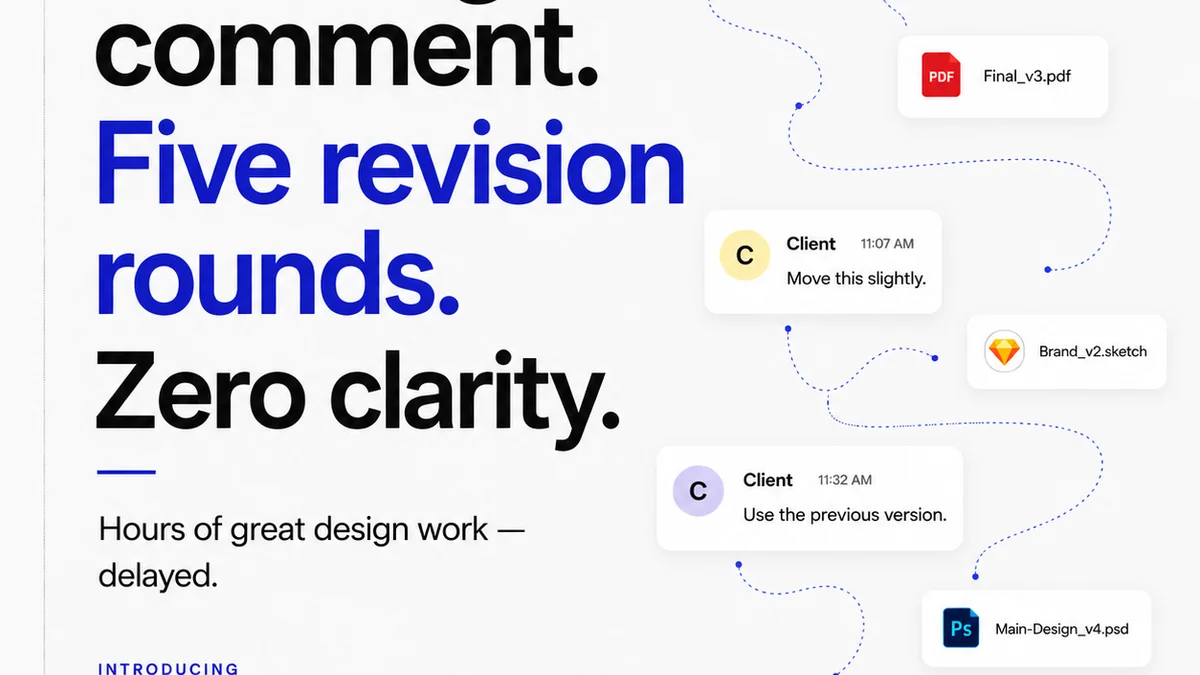
Email makes tracking different versions of creative assets nearly impossible. You send a PDF. The client replies with feedback. You send another PDF. Then another.
Which PDF is the latest? Which one has the approved copy? Which one should the developer build from?
You end up with filenames like:
- final_logo_v3.pdf
- final_logo_v3_REALLY_final.pdf
- final_logo_v3_REALLY_final_FOR_PRINT.pdf
It's chaos. And it guarantees mistakes will be made.
3. The Approval Illusion
An email saying "Looks good" or "Approved" is not a formal, trackable approval. It's a casual statement lost in a sea of other messages.
What happens if the client later claims they never approved a specific version? Or that their approval was conditional? Without a clear, documented record, you have no defense.
This lack of auditable approval trails leaves agencies vulnerable to scope creep and disputes.
4. Scope Creep's Best Friend
Because email is so unstructured, it's easy for new requests to slip in unnoticed. A casual suggestion in an email thread can easily morph into a significant change request without proper scope acknowledgment or billing.
This is how projects balloon in scope and budget, often without the client realizing the impact, and without the agency being properly compensated.
5. Wasted Time and Energy
Searching for feedback, deciphering vague comments, redoing work based on misunderstood instructions, chasing down approvals—this is the hidden cost of using email for creative feedback.
This time could be spent on creative strategy, improving designs, or client communication that actually moves the project forward. Instead, it's lost in the administrative drag of managing an inappropriate tool.
6. Where Revue Fits In
This is why tools like Revue exist. They are built specifically to solve the problems email creates for creative workflows.
Revue centralizes client feedback directly on creative assets. Instead of digging through inboxes, all comments, discussions, and decisions live in one place, attached to the specific version of the design being reviewed.
This means:
- Contextual Clarity: Feedback is tied directly to the visual element it refers to.
- Version Control: Every iteration is tracked, with clear markers for what’s been reviewed and approved.
- Auditable Approvals: Formal sign-offs are recorded, creating a clear trail and protecting your agency.
- Scope Management: Changes and new requests are visible and can be managed proactively.
- Efficiency: Designers and clients spend less time searching and clarifying, and more time creating and approving.
It streamlines the entire review and approval process, making it faster, cleaner, and less prone to error.
Final Thought
Email has its place. It's great for initial outreach, general announcements, and non-project-specific communication. But for the critical, iterative process of creative feedback and approvals, it's a liability.
Are you still relying on email for your client feedback? What's the biggest headache it causes you?
Frequently asked questions
Why is email bad for creative feedback?
Email is bad for creative feedback because it lacks context, makes version control impossible, offers no auditable approval trail, and easily leads to scope creep and wasted time. It's a communication tool, not a project management system for creative assets.
What are the main problems with using email for approvals?
The main problems include the lack of a clear, documented approval record, making it easy for clients to dispute approvals later. It also blurs the lines between casual conversation and formal sign-off, leading to misunderstandings and potential disputes.
How can agencies improve their feedback process?
Agencies can improve by adopting specialized tools that centralize feedback directly on creative assets, provide clear version tracking, and offer formal, auditable approval mechanisms. This moves feedback out of chaotic email threads and into a structured environment.
Can email ever be used for feedback?
Email can be used for very simple, non-visual feedback or initial project discussions. However, for any visual creative work involving iterations and approvals, it quickly becomes inefficient and error-prone compared to dedicated feedback platforms.