Everyone uses email. It’s the default. Client feedback arrives in an inbox, and everyone responds within that same thread. Simple, right?
None of that is wrong. But it’s incomplete. Email is a terrible tool for creative feedback in 2026. It’s slow, chaotic, and actively hostile to clear communication.
The hard truth? Relying on email for creative feedback is a direct path to missed deadlines, unhappy clients, and a frustrated creative team. It’s time to acknowledge the limitations and find a better way.
1. The Illusion of Centralization
Email promises a single source of truth. A conversation thread that captures everything. In reality, it’s a black hole.
Emails get lost. Threads multiply. Key stakeholders miss critical replies buried under marketing newsletters and internal memos. Who has the latest version? Good luck finding out by sifting through 200 emails.
The Chaos of CC and Reply All
The 'Reply All' button is a menace. It floods inboxes with irrelevant updates for people not involved in the immediate discussion.
The 'CC' field becomes a dumping ground. Does Jane really need to see every minor tweak, or is she just being kept in the loop out of habit? This adds noise and distracts from actionable feedback.
Version Control Nightmare
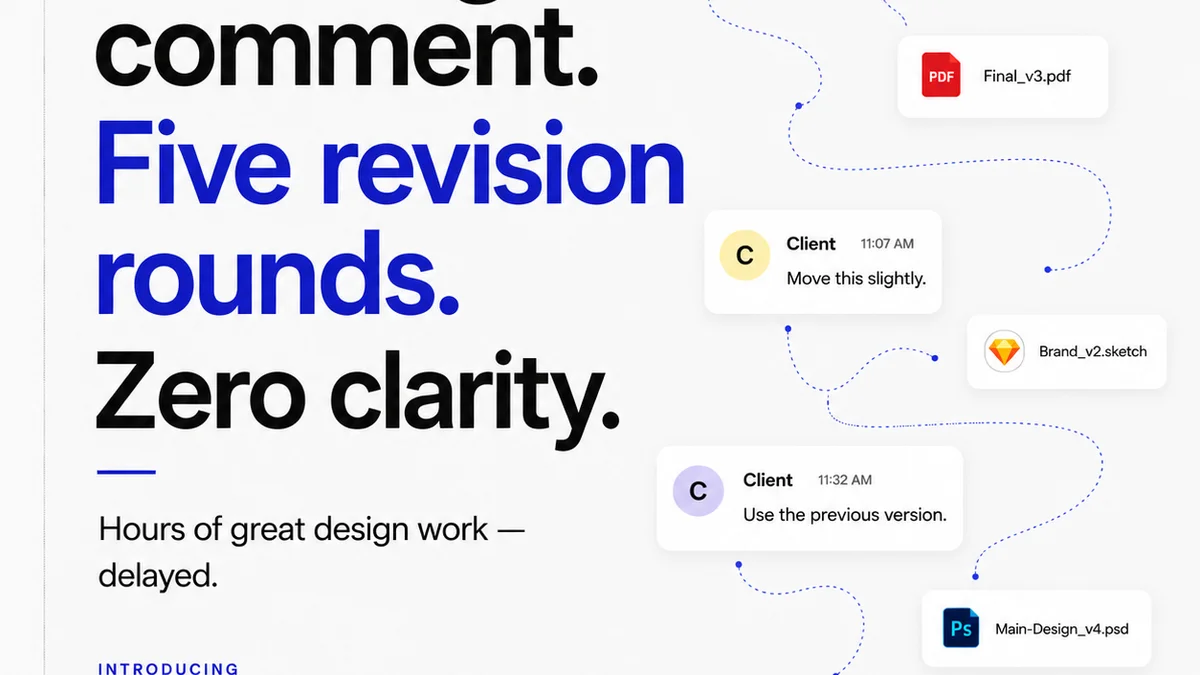
Which attachment is the final one? The one named logo_v3_final_really_final.ai or logo_final_v4_USE_THIS_ONE.ai?
Email offers zero built-in version control. Every file transfer is a potential point of failure, leading to revisions on outdated assets.
2. Feedback Becomes a Textual Minefield
Email forces feedback into a linear, text-based format. This is fundamentally at odds with visual creative work.
Imagine trying to explain a precise color shift or a subtle kerning adjustment using only words in an email. It’s inefficient and prone to misinterpretation.
Lack of Context
Feedback detached from the visual asset is dangerous. A client might write, “Make the headline bigger.” But how big? Bigger than what?
Without the ability to annotate directly on the design, feedback relies on subjective interpretation. This leads to endless back-and-forth emails trying to clarify simple points.
Actionability Gap
Is the feedback a suggestion, a requirement, or a mild preference? Email rarely clarifies this.
Creative teams spend hours deciphering vague comments, guessing the client’s true intent, and hoping they’re addressing the most important points first. This guesswork kills productivity.
3. The Slowdown Effect
Email introduces deliberate friction into the feedback loop. It’s not designed for rapid iteration.
The asynchronous nature of email means waiting for responses. A client might be busy, on vacation, or simply not checking their email diligently.
Delays and Bottlenecks
A single piece of feedback can get stuck in an inbox for days. This creates bottlenecks that stall entire projects.
The ripple effect is significant. A delayed approval on a banner ad can hold up the entire campaign launch. This is unacceptable in a fast-paced digital world.
Opportunity Cost
Every hour spent managing email feedback is an hour not spent designing, strategizing, or client-servicing.
For creative directors and agency owners, this means less time focused on high-level growth and more time bogged down in the weeds of revision management. It’s a drain on valuable resources.
4. Accountability and Transparency Black Holes
Who said what, and when? Email makes tracking accountability a Herculean task.
It’s easy for feedback to get lost, forgotten, or conveniently “misunderstood” when buried in an email thread.
The Blame Game
When things go wrong, email trails can be weaponized. “You approved this on Tuesday.” “No, I approved the previous version!”
This lack of clear, auditable records creates fertile ground for finger-pointing and erodes trust between agency and client.
Lack of Visibility
Team members often don’t have visibility into the full feedback loop. They see their assigned task but miss the broader context of client discussions.
This siloed information prevents proactive problem-solving and can lead to duplicated effort or misaligned work.
5. Security and Confidentiality Risks
Creative assets, especially early concepts or client data, are sensitive.
Email is not a secure channel for transmitting confidential information. Attachments can be easily forwarded, intercepted, or accidentally sent to the wrong person.
Data Breaches
A compromised email account can expose entire project histories, client lists, and proprietary creative work.
The reputational and financial damage from such a breach can be catastrophic for an agency.
Compliance Concerns
Depending on the client and the data involved, using email for feedback might violate data privacy regulations like GDPR or HIPAA.
Agencies need to ensure their workflows meet industry standards for data protection.
Where Revue Fits In
This is where a dedicated feedback and approval platform becomes indispensable. Tools like Revue are built to solve the exact problems email creates.
Imagine a world where all client feedback lives in one place, directly attached to the asset being reviewed. Where comments are contextual, actionable, and visible to the entire team.
- Centralized Feedback: All comments, revisions, and approvals are logged against specific versions of a creative asset. No more digging through email chains.
- Visual Annotation: Provide precise feedback directly on the design. Click on an element, type your comment. It’s that simple.
- Clear Revision Tracking: Easily see the history of changes, who approved what, and when. Maintain a clear audit trail.
- Streamlined Approvals: Clients can approve or request revisions with a single click, reducing friction and speeding up the process.
- Enhanced Collaboration: Keep all stakeholders informed and on the same page, reducing miscommunication and speeding up decision-making.
By moving feedback off email and onto a platform designed for creative workflows, agencies can reclaim lost time, reduce errors, and build stronger client relationships.
Final Thought
Email was revolutionary. It connected the world. But it’s a blunt instrument in a world that demands precision.
Are you still treating client feedback like a simple message, or are you treating it like the critical project management component it is?
Frequently asked questions
Why is email bad for creative feedback?
Email is bad for creative feedback because it lacks context, leads to version control issues, creates communication chaos with 'reply all' and CC chains, introduces delays, and offers poor accountability and transparency. It's a linear, text-based system ill-suited for visual collaboration.
What are the main problems with email feedback for agencies?
Agencies face problems like lost feedback, misinterpretation of comments, prolonged revision cycles, difficulty tracking approvals, increased risk of errors due to outdated versions, and wasted time managing chaotic email threads instead of focusing on creative work.
How can agencies improve their client feedback process?
Agencies can improve their client feedback process by adopting dedicated feedback and approval platforms that offer visual annotation, centralized communication, clear version control, streamlined approval workflows, and better project visibility. This moves feedback away from the limitations of email.
Can email ever be useful for client communication?
Email remains a useful tool for general communication, initial project outlining, and final contract agreements. However, for the iterative, visual, and time-sensitive nature of creative feedback and revisions, it is an inefficient and problematic choice in 2026.