Everyone’s talking about AI, personalization, and sustainability in enterprise branding. That’s all true, to a point.
But it’s not the whole story. It’s like saying a house is built with bricks and mortar. Accurate, but missing the plumbing, the wiring, the foundation.
The real story for creative leaders isn’t just the *output* of branding, but the *process* behind it. The operational shifts that enable that output are what separate the leaders from the laggards.
The hard truth? Enterprise branding is becoming less about static campaigns and more about dynamic, integrated systems. It’s a shift that demands operational rigor, not just creative flair.
1. The Rise of the Brand Ecosystem, Not Just the Brand Guide
For years, the brand guide was king. A beautiful PDF, meticulously crafted, outlining every color, font, and logo usage. It was the rulebook.
But in a world of rapid content creation, fragmented customer journeys, and global teams, a static guide is a bottleneck.
Enterprise brands are now thinking in terms of ecosystems. This means:
- Modular Design Systems: Reusable components and templates that ensure consistency without stifling speed.
- Dynamic Brand Application: Tools and platforms that allow for real-time adaptation of brand assets based on context, audience, or channel.
- Decentralized Brand Governance: Empowering teams with clear guardrails and accessible resources, rather than relying on a central gatekeeper for every minor asset.
This shift means your role as a creative leader is less about policing the brand guide and more about building and maintaining the infrastructure that makes brand application seamless and scalable.
The Operational Bottleneck
Think about it: how many requests for minor logo variations, color tweaks, or template adaptations land on your desk or your team’s inbox every week?
Each one is a micro-delay. Multiply that across an enterprise, and you’re talking about significant drag on creative output and market responsiveness.
The brand ecosystem approach aims to eliminate that drag by making the brand inherently adaptable.
2. From Campaign-Centric to Continuous Engagement
Traditional branding often revolved around big, splashy campaigns. Launch, sustain, retire. Rinse and repeat.
The modern consumer, however, expects continuous interaction and relevance.
This means brands need to be in a constant state of conversation, not just periodic pronouncements.
What does this look like operationally?
- Always-On Content Pipelines: Not just for social media, but for website updates, email newsletters, internal communications, and product marketing.
- Personalization at Scale: Leveraging data to tailor brand messaging and creative assets to specific audience segments, not just broad demographics.
- Agile Creative Production: The ability to pivot and produce new creative assets quickly in response to market shifts, competitor moves, or emerging trends.
This requires a move away from waterfall project management for creative and towards more iterative, agile methodologies. It means your team needs to be structured for speed and flexibility.
The Illusion of Control
Many agencies and in-house teams still operate on a campaign-by-campaign basis, thinking they have a handle on the brand. But in today’s always-on world, that’s an illusion.
The brand is being experienced continuously, in a thousand small touchpoints. If those touchpoints aren’t managed cohesively, the overall brand perception suffers, regardless of how polished your last big campaign was.
3. The Data-Driven Creative Mandate
Gut feeling and intuition have always been crucial in branding. But relying solely on them in the enterprise space is a fast track to irrelevance.
Data isn't just for performance marketing anymore; it's fundamental to understanding brand perception, audience behavior, and creative effectiveness.
For creative leaders, this means:
- Integrating Analytics into Creative Briefs: Understanding what's worked, what hasn't, and why, before the creative process even begins.
- Measuring Brand Health Beyond Awareness: Tracking sentiment, engagement, loyalty, and advocacy.
- A/B Testing Creative Assets: Iteratively refining visuals, copy, and calls-to-action based on real-world performance.
- Understanding Audience Segmentation: Using data to inform creative choices for specific, defined groups.
This isn't about letting data dictate creativity, but about using data to inform and optimize it. It’s about making smarter creative decisions that resonate more deeply.
The Fear of Numbers
Many creatives are uncomfortable with data, seeing it as sterile or restrictive. But in the enterprise, data is your ally. It provides objective insights that can elevate creative strategy and prove its value.
Ignoring data in enterprise branding is like navigating a complex city without a map. You might get somewhere, but it’s unlikely to be the most efficient or effective route.
4. Sustainability and Purpose as Core Brand Pillars
This isn't just a CSR checkbox anymore. For major enterprise brands, a genuine commitment to sustainability and social purpose is increasingly non-negotiable for consumers, employees, and investors.
It needs to be woven into the fabric of the brand, not just a marketing overlay.
What this means for creative leadership:
- Authenticity is Paramount: Greenwashing or purpose-washing is quickly called out and severely damages brand trust.
- Storytelling with Substance: Communicating impact and commitment requires genuine narratives, backed by action.
- Internal Alignment is Key: Employees are often the first and most important audience for purpose-driven branding.
- Long-Term Vision: Building a purpose-driven brand is a marathon, not a sprint.
Your creative output needs to reflect a deep understanding of the company’s actual impact and future commitments. This requires close collaboration with operations, HR, and executive leadership.
The Cynicism Trap
There’s a lot of skepticism about corporate purpose initiatives. And rightly so, given the history of empty promises.
But the trend is clear: brands that can authentically demonstrate positive impact are building deeper loyalty and attracting top talent. As a creative leader, you have the power to shape how that story is told. But it must be a true story.
5. AI as a Co-Pilot, Not a Replacement
The AI conversation in creative is often framed as a threat. Will AI replace designers? Will it automate all branding?
The reality for enterprise branding is far more nuanced and, frankly, more interesting.
AI is proving to be an incredibly powerful tool for:
- Accelerating Ideation: Generating mood boards, exploring visual concepts rapidly, and overcoming creative blocks.
- Automating Repetitive Tasks: Resizing assets, creating variations, and performing basic edits at scale.
- Enhancing Personalization: Analyzing data to inform dynamic content generation.
- Improving Efficiency: Streamlining workflows for tasks like transcription, translation, and initial draft generation.
The key for creative leaders is to understand how to integrate AI tools strategically. It’s about augmenting human creativity, not replacing it.
The Skill Shift
This means the skills in demand are evolving. Prompt engineering, AI tool integration, and critical evaluation of AI-generated output are becoming essential. Your team needs to be trained and encouraged to experiment.
The risk isn't AI taking over; the risk is being left behind by teams that leverage AI to become more efficient and innovative.
Where Revue Fits In
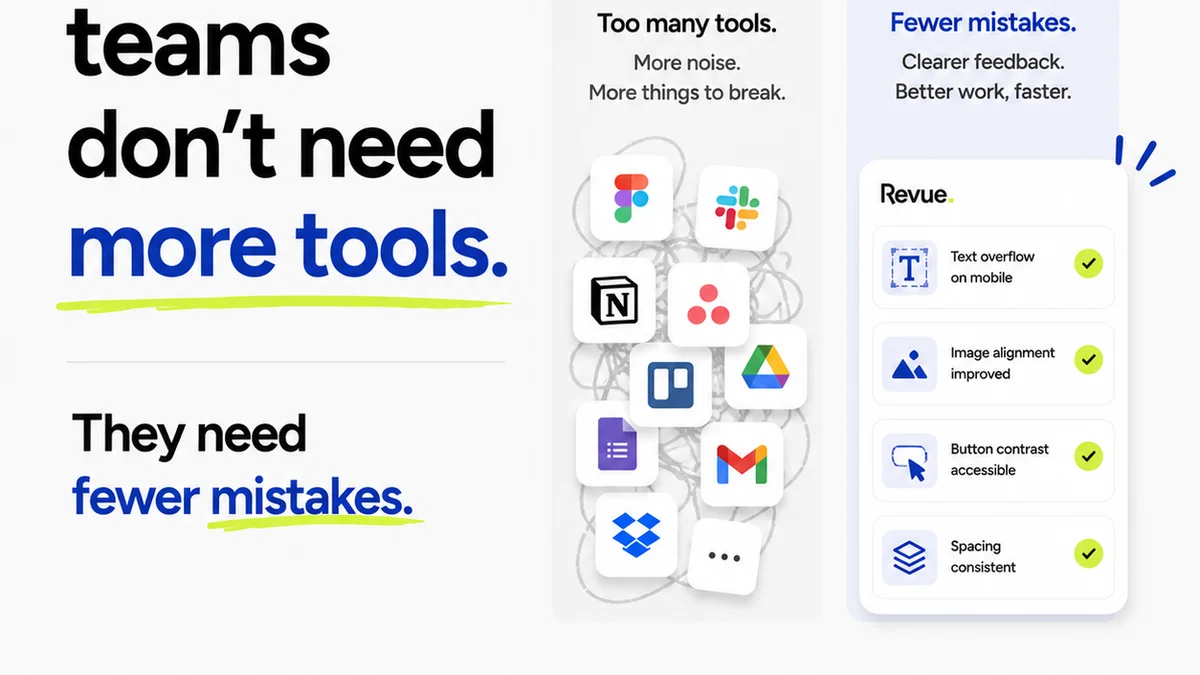
All these trends – the brand ecosystem, continuous engagement, data-driven creative, purpose integration, and AI co-piloting – point to a fundamental need for better workflow management.
Enterprise branding is no longer a series of isolated, static projects. It’s a dynamic, interconnected system that requires constant iteration, feedback, and approval.
This is where a platform like Revue becomes essential.
Centralizing client feedback, managing revisions, and ensuring quality checks across all creative assets, from campaign materials to website updates to personalized content variations, is critical.
When you’re building a brand ecosystem, not just a brand guide, you need a system that can handle the complexity and speed required.
You need visibility into every stage of the creative process.
You need to ensure consistency across a multitude of touchpoints.
Revue helps bridge the gap between creative vision and operational reality.
Final Thought
The landscape of enterprise branding is shifting from a focus on polished deliverables to a focus on agile, integrated systems. Are you building for the future of branding, or are you still operating with the tools and mindsets of the past?
Frequently asked questions
What is a brand ecosystem in enterprise branding?
A brand ecosystem refers to the interconnected network of all brand touchpoints, assets, and experiences, managed through modular design systems and dynamic application, rather than relying solely on a static brand guide.
How does data impact enterprise branding strategy?
Data informs enterprise branding by providing insights into audience behavior, brand perception, and creative effectiveness. It allows for data-driven creative briefs, performance measurement beyond awareness, and iterative refinement of assets through A/B testing.
Is AI replacing creative roles in enterprise branding?
No, AI is primarily acting as a co-pilot in enterprise branding, accelerating ideation, automating repetitive tasks, and enhancing personalization. The focus is on augmenting human creativity and efficiency, not replacing it.
Why is sustainability important for enterprise brands?
Sustainability and purpose are increasingly critical because consumers, employees, and investors expect genuine commitment. Authentic storytelling backed by action builds deeper loyalty and attracts talent, while greenwashing severely damages trust.