Everyone talks about streamlining client reviews. They preach collaboration tools, agile sprints, and transparent communication. And none of that is wrong. But it’s incomplete.
For enterprise creative teams, the real challenge isn’t adopting new software. It’s wrestling with the sheer complexity of internal stakeholders, legacy systems, and the massive volume of creative assets that flow through a large organization. The ‘hard truth’ is that best practices aren’t about finding the *one perfect way* to get feedback. They’re about building an operational framework that can absorb and manage the inherent messiness of enterprise-level creative production.
1. The Illusion of Centralized Feedback
Many teams assume that if they just pick *one* tool for feedback, all their problems will vanish. They’ll buy a fancy platform, mandate its use, and expect magic. This is a common trap.
The reality in large organizations is that feedback doesn't live in a vacuum. It’s influenced by:
- Marketing departments with their own established channels.
- Legal and compliance teams with specific review gates.
- Product development cycles that dictate timelines.
- Regional offices with unique communication norms.
- Executive leadership who expect high-level summaries, not granular comments.
A single tool can’t magically override decades of established workflows and power structures. It can only provide a better place to *record* the feedback that eventually arrives.
Beyond the Tool: Mapping the Feedback Labyrinth
Before you even think about software, map out where feedback *actually* comes from. Who provides it? What’s their typical process? What are their usual pain points?
For instance, legal reviews might be notoriously slow because they’re buried under other responsibilities. Marketing feedback might be vague because they’re focused on the big picture, not pixel-level details. Understanding these nuances is crucial.
2. Revision Management: The Never-Ending Story
The assumption here is that once feedback is given, the revision process is straightforward. Just make the changes and resubmit, right?
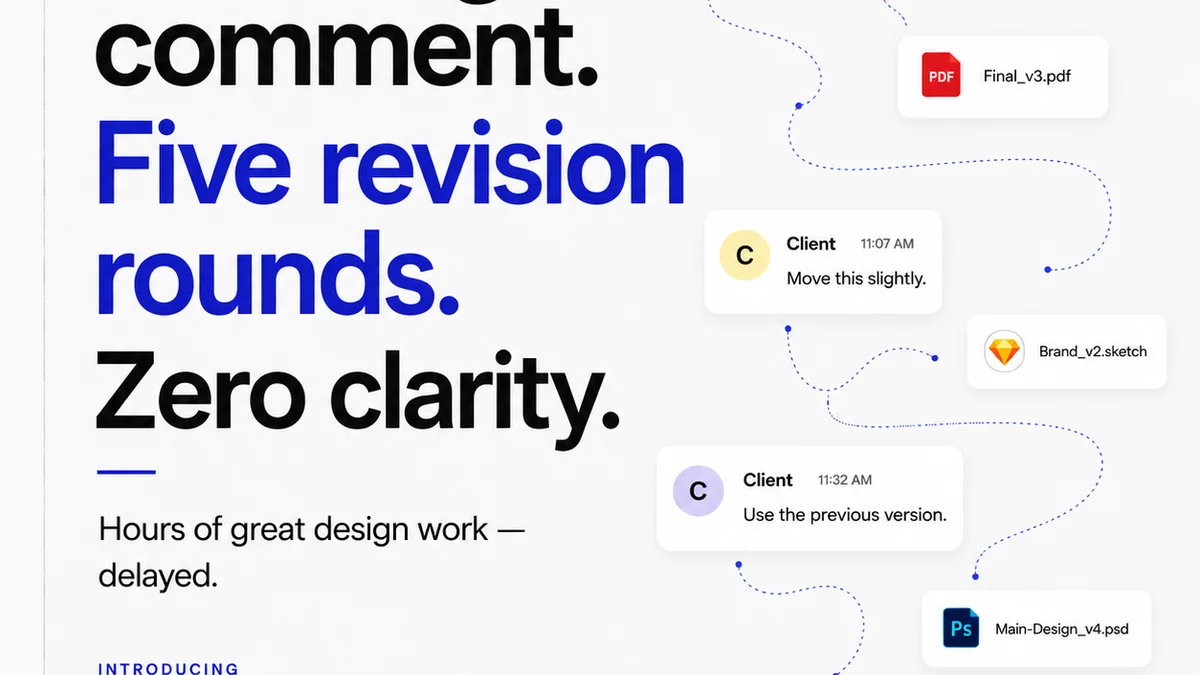
Wrong. In enterprise settings, revisions often trigger a cascade of secondary reviews. A minor tweak to a banner ad might require re-approval from a regional marketing manager, a brand guardian, *and* the legal department again, just to be safe.
This is where the real time sinks happen. Not in the creative execution itself, but in the waiting and re-routing.
The Cost of Re-Routing
Every time a creative asset has to be sent back into the review cycle, it incurs:
- Time Delay: Days, sometimes weeks, lost waiting for the next gatekeeper.
- Context Switching: Creatives stop working on new tasks to manage revisions, losing momentum.
- Scope Creep: What started as a small revision can balloon as new feedback emerges in subsequent rounds.
- Resource Drain: Account managers and project managers spend valuable time chasing approvals.
You need a system that doesn't just track feedback, but also tracks the *status* of each piece of feedback and the asset’s journey through multiple approval stages.
3. Quality Checks: More Than Just Proofreading
A common misconception is that quality checks are primarily about catching typos or ensuring the logo is the right size. For enterprise creative, it’s much broader.
A true quality check involves ensuring the creative:
- Aligns with the original brief and strategic objectives.
- Adheres to brand guidelines across all touchpoints.
- Meets legal and compliance requirements for the specific market.
- Is technically sound for the intended platform (e.g., web specs, print resolution).
- Reflects the correct localization and cultural nuances.
This isn’t a task for a single proofreader. It requires a cross-functional understanding and often multiple sign-offs at different stages.
Building a Gatekeeping Function
Instead of tacking on quality checks at the end, embed them into the workflow. Define clear checkpoints:
- Brief Alignment Check: Does the concept meet the core strategic need?
- Brand Compliance Review: Is the visual identity on point?
- Legal/Risk Assessment: Are there any compliance red flags?
- Technical Readiness Check: Is the asset ready for production/deployment?
Each of these gates needs clear ownership and a defined outcome: approved, needs revision, or rejected with clear reasons.
4. The Assumption of Universal Understanding
We assume clients and internal stakeholders understand the creative process. That they know what a
Frequently asked questions
How can enterprise teams manage feedback from multiple departments?
Map out all feedback sources and their typical review processes. Implement a centralized system to capture feedback, but understand that each department might still use their own internal channels. The key is to have a definitive place where all feedback is logged and tracked for the creative team.
What’s the biggest bottleneck in enterprise creative reviews?
Often, it's the re-routing and re-approval process after initial revisions. A single tweak can trigger multiple secondary reviews across legal, brand, and regional teams, causing significant delays.
How do enterprise teams ensure creative quality at scale?
Embed quality checks throughout the workflow, not just at the end. Define specific gates for brief alignment, brand compliance, legal review, and technical readiness. Assign clear ownership to each gate.
Is adopting a new feedback tool enough for enterprise teams?
No. A tool is just a repository. Enterprise teams need to address the underlying operational complexities, stakeholder management, and internal communication norms first. The tool should support the process, not dictate it.