Everyone talks about collaboration tools. Slack, Teams, Asana, Monday.com. The assumption is that if you just get the *right* software, your agency’s enterprise-level collaboration problems will magically disappear. More integrations, more features, more dashboards. It’s supposed to make things easier, right?
None of that is wrong. But it’s incomplete.
The hard truth is, enterprise collaboration isn’t solved by technology alone. It’s solved by process. It’s about how work actually flows, how feedback is managed, and how decisions are made. Tools are just enablers.
1. The Myth of the Centralized Inbox
Agencies often think that consolidating communication channels – email, Slack, Teams, project management comments – into one place is the silver bullet. They champion the idea of a single source of truth.
But that’s not how enterprise clients operate. They have their own systems, their own preferred communication methods, and their own internal politics. Trying to force them into your agency’s preferred tool is a losing battle. It creates friction, delays, and misunderstandings.
The real goal isn't a single inbox for *your* team. It's a predictable, transparent flow of information *between* your team and the client’s.
Client Communication Channels: The Reality
- Email threads that span weeks and dozens of replies.
- Ad-hoc video calls with no clear action items documented.
- Internal client-side chat that never makes it back to the agency.
- Formal approval gates buried in lengthy documents.
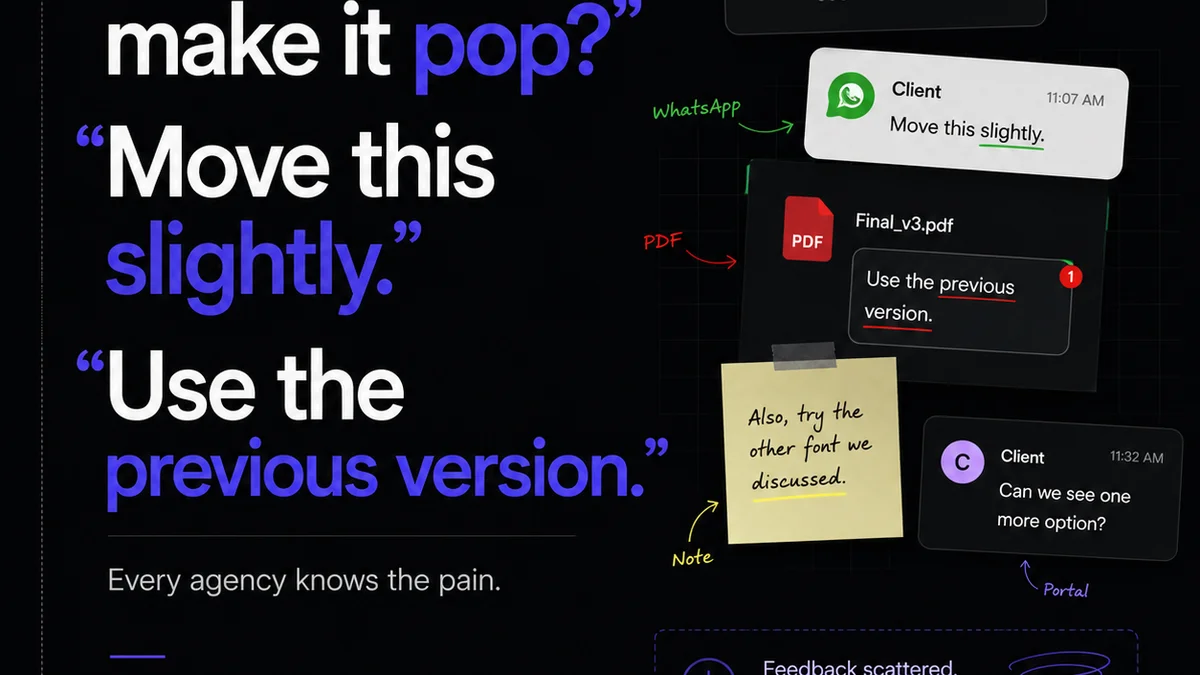
- Feedback delivered verbally via phone calls.
Your job isn't to absorb all of this into your shiny new dashboard. It's to create a system that can gracefully ingest, process, and act upon it, regardless of its origin.
2. Standardizing Feedback, Not Tools
The biggest bottleneck in agency-client collaboration is almost always feedback. It’s vague, contradictory, late, or missing entirely. This isn’t because clients are difficult. It’s because they lack a structured way to provide it.
Leading agencies don’t try to train clients on their internal PM tools. Instead, they standardize the *feedback process* itself. They build a clear path for clients to give input that’s actionable.
This means establishing clear stages for review, defining what kind of feedback is expected at each stage, and providing a simple, intuitive way for clients to deliver it.
Designing the Feedback Loop
- Define Review Stages: Clearly map out when and what kind of feedback you need. Is it conceptual? Is it specific copy edits? Is it final sign-off?
- Contextualize Feedback: Ensure feedback is tied directly to the asset being reviewed. No more
Frequently asked questions
What's the biggest mistake agencies make with enterprise collaboration?
Focusing solely on technology and neglecting the underlying processes. The right tools are important, but they can't fix broken workflows.
How can agencies handle diverse client communication channels?
By creating a system that gracefully ingests and processes feedback regardless of its origin, rather than forcing clients into agency-specific tools.
What does 'standardizing feedback' mean for an agency?
It means establishing clear stages for review, defining the type of feedback expected at each stage, and providing simple, intuitive ways for clients to deliver that feedback, rather than expecting them to learn complex agency software.
How does Revue help with enterprise collaboration?
Revue provides a centralized platform for managing client feedback, tracking revisions and approvals, and conducting quality checks, streamlining the entire review process and ensuring clarity between agency and client.