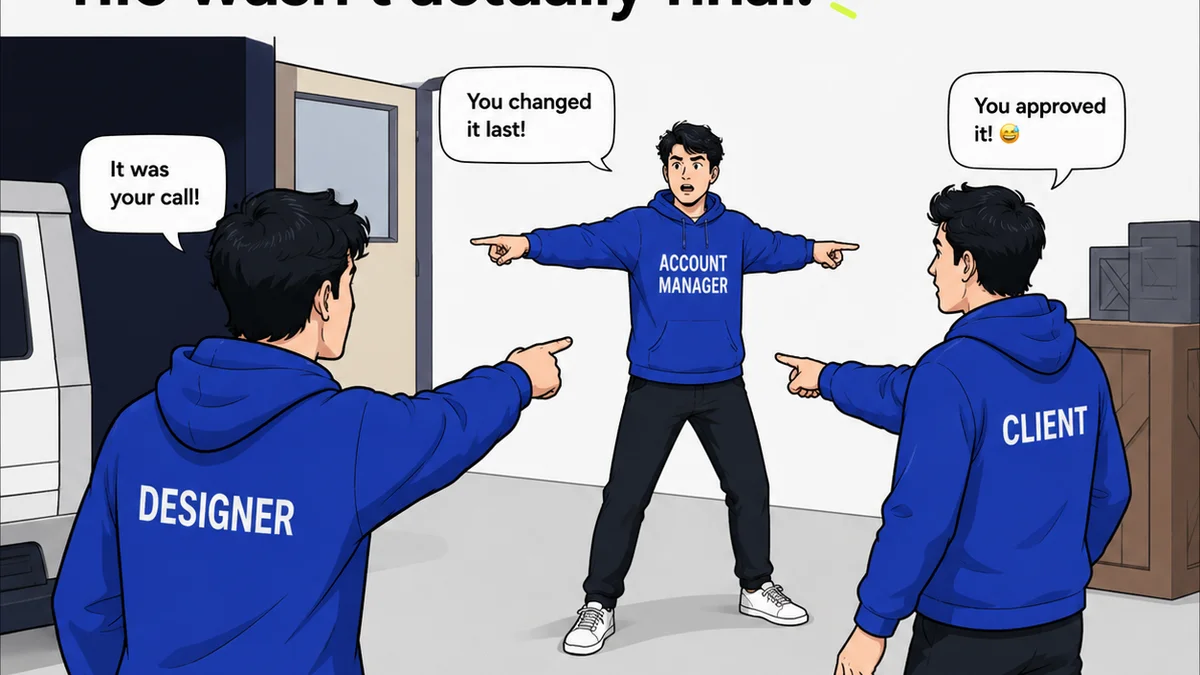
Everyone thinks enterprise creative workflows are about massive teams, complex org charts, and endless layers of approval. And none of that is wrong. But it’s incomplete.
The real challenge isn't just scale; it's fragmentation. It's the silent killer of creativity and efficiency: disparate tools, siloed communication, and a lack of clear process.
This playbook cuts through the noise. We’re talking about a hard truth: your enterprise creative workflow is only as strong as its weakest link. And usually, that link is communication and visibility.
1. The Myth of the 'Managed' Process
The assumption is that enterprise teams have 'managed' processes. That there are systems in place, checks and balances, and everyone knows their role.
The reality? Often, it's a patchwork quilt of tools and tribal knowledge. Project managers juggle spreadsheets, designers use one platform for feedback, clients email revisions, and legal signs off in a separate system. Sound familiar?
This creates:
- Endless version control nightmares.
- Delayed feedback loops that stall momentum.
- Missed revisions and costly rework.
- Frustrated teams and unhappy clients.
- A lack of clear audit trails.
This isn't 'managed.' It's chaos masquerading as process.
2. Building Blocks of an Enterprise Workflow
A truly effective enterprise workflow isn't built on more tools. It's built on fewer, better-integrated systems and clear, enforced protocols.
Let’s break down the core components:
2.1. Centralized Briefing and Intake
Everything starts with a clear brief. For enterprise teams, this means a standardized intake process that captures essential information upfront. No more hunting for project goals, target audiences, or key deliverables.
This intake form should be the gateway, not an afterthought. It needs to be accessible and comprehensive.
2.2. Collaborative Asset Development
This is where the magic (and the mess) happens. Teams need a space to create, share, and iterate on assets without friction.
Think:
- Version control that actually works.
- Clear annotation and markup tools.
- Real-time collaboration where possible.
- Integration with existing design software.
The goal is to reduce the back-and-forth across emails and chat apps.
2.3. Streamlined Feedback and Approval Cycles
This is the Everest of enterprise creative workflows. Clients, stakeholders, legal, and marketing all have a say. Without a system, this becomes a black hole of conflicting feedback and endless revisions.
Key elements include:
- Designating clear approvers and reviewers.
- Setting defined timelines for feedback.
- A single source of truth for all comments and decisions.
- Automated notifications for new feedback or approvals.
This is where most enterprise workflows break down. It needs rigorous attention.
2.4. Quality Assurance and Final Delivery
Before anything goes live, it needs a final check. This isn't just a spell check. It’s a full review against the brief, brand guidelines, and technical specifications.
Your QA process should include:
- Checklists for brand compliance.
- Technical specs verification (e.g., file formats, resolution).
- Final sign-off from authorized personnel.
This step prevents embarrassing errors and ensures brand consistency across all outputs.
2.5. Performance Analysis and Iteration
What worked? What didn't? Enterprise teams have the unique advantage of scale, meaning they can gather more data on creative performance.
This involves:
- Tracking asset performance against KPIs.
- Gathering feedback on the creative itself post-launch.
- Using insights to refine future briefs and creative direction.
This closes the loop, making your workflow intelligent and adaptive.
3. The Pain Points of Enterprise Scale
Enterprise creative work isn't just about producing more. It’s about producing more, for more stakeholders, across more channels, with more constraints.
This scale introduces specific challenges:
- Brand Governance: Ensuring consistency across dozens, sometimes hundreds, of assets and campaigns.
- Compliance: Navigating legal, regulatory, and internal policy requirements.
- Global Distribution: Managing localization, regional variations, and translation workflows.
- Cross-Functional Collaboration: Integrating with marketing, sales, product, and legal teams, each with their own priorities and processes.
- Technology Sprawl: The sheer number of tools in use, leading to integration issues and data silos.
Ignoring these pain points means your workflow will inevitably buckle under the pressure of enterprise demands.
4. Where Revue Fits In
Let’s be direct. You’re juggling a lot. You need clarity, control, and confidence in your creative output.
Revue isn't another tool to add to the sprawl. It's the connective tissue for your enterprise creative workflow.
Think of it as your central hub for managing the entire lifecycle of creative projects:
- Centralized Feedback: All client and stakeholder comments live in one place, directly on the asset. No more digging through emails, Slack threads, or disparate documents. Every comment is tracked, attributed, and actionable.
- Revision and Approval Visibility: See exactly who has reviewed what, what feedback is outstanding, and who needs to give the final sign-off. Automated workflows ensure no one misses a step, and you always know the status.
- Quality Checks: Use Revue to build your QA process directly into the workflow. Ensure brand guidelines, legal requirements, and technical specs are met before final delivery. Create standardized checklists for consistent reviews.
Revue brings order to the chaos, giving enterprise teams the visibility and control they desperately need to deliver high-quality creative, on time and on budget.
5. Implementing Your Enterprise Workflow Playbook
This isn't a theoretical exercise. It’s about actionable steps.
5.1. Audit Your Current State
Where are the bottlenecks? What tools are redundant? Where is information getting lost?
Talk to your teams. Talk to your clients. Get honest feedback.
5.2. Define Your Ideal Workflow
Map out the ideal journey for an asset from brief to final delivery. Identify key stages, decision points, and required inputs/outputs.
Document this. Make it accessible.
5.3. Standardize Where Possible
Create templates for briefs, feedback forms, and QA checklists. Define roles and responsibilities clearly.
Consistency is your superpower.
5.4. Integrate and Automate
Look for opportunities to connect your existing tools or consolidate them. Automate repetitive tasks like notifications and status updates.
This is where efficiency gains are realized.
5.5. Train and Enforce
Simply implementing a new process isn’t enough. Your teams need to understand it, buy into it, and use it. Ongoing training and clear enforcement are critical.
Lead by example.
Final Thought
Enterprise creative work is inherently complex. But complexity doesn't have to mean chaos. By focusing on clear processes, centralized communication, and integrated tools, you can move beyond the myth of 'managed' workflows and build a truly efficient, effective creative engine.
The question isn't whether you can manage enterprise creative volume. It's whether you can master the workflow that makes it possible.
Frequently asked questions
What are the biggest challenges for enterprise creative teams?
Enterprise creative teams often face challenges with scale, brand governance, compliance, global distribution, cross-functional collaboration, and technology sprawl, all of which can lead to fragmented communication and inefficient workflows.
How can a centralized feedback system improve an enterprise workflow?
A centralized feedback system consolidates all comments and revisions in one place, directly on the asset. This eliminates confusion from scattered emails and chats, ensures all feedback is captured, and provides clear visibility into the review and approval process.
What is the role of Quality Assurance (QA) in an enterprise creative workflow?
QA in an enterprise workflow ensures that all creative assets meet brand guidelines, legal requirements, and technical specifications before final delivery. Integrating QA checks directly into the workflow prevents errors, maintains brand consistency, and reduces costly rework.
How does Revue help enterprise creative teams specifically?
Revue acts as a central hub for enterprise creative workflows by providing centralized feedback, clear revision and approval tracking, and integrated quality check capabilities. This helps large teams manage complexity, improve visibility, and deliver high-quality creative assets efficiently.