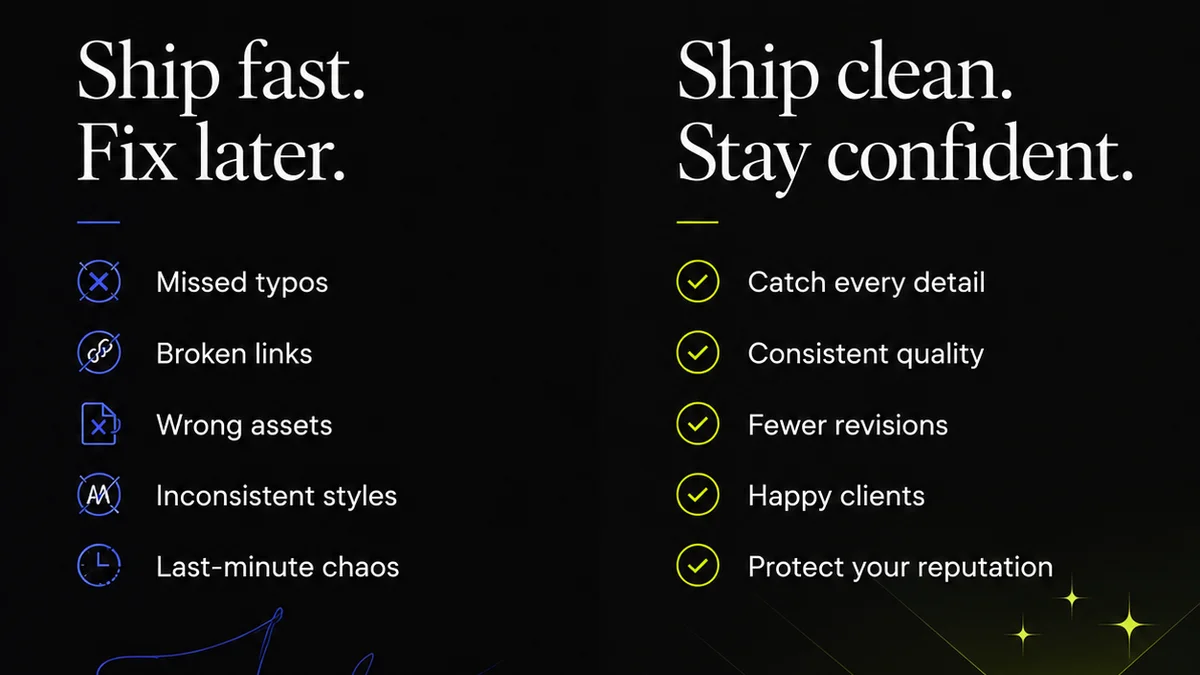
Everyone assumes that maintaining design quality at enterprise scale is about having a massive brand guide. Or maybe a dedicated brand police team. Or at least a rigorous, multi-stage approval process. None of that is wrong. But it’s incomplete.
The hard truth? It’s about systematizing the *human* element of creative review. It’s about building a workflow that catches subtle errors and ensures brand consistency without slowing down the entire operation.
1. Beyond the Brand Guide: Codifying the Intangible
Your brand guide is foundational. It dictates fonts, colors, logos, and tone of voice. But it can’t capture the *feel* of your brand. It can’t articulate why a certain image evokes trust or why a particular layout feels cluttered.
Enterprise teams that excel at quality control go deeper. They create frameworks for evaluating creative that aren’t just about ticking boxes on a style sheet.
Defining the 'Good'
This means articulating principles like:
- What constitutes 'on-brand' emotional resonance?
- How do we measure the effectiveness of a visual metaphor?
- What are the key elements of a 'user-friendly' layout for our specific audience?
These aren’t typically found in a PDF. They’re often developed through workshops, post-mortems, and ongoing dialogue between creative leadership and the teams executing the work.
Practical Application
This translates into concrete actions:
- Creating mood boards that go beyond aesthetics to capture sentiment.
- Developing checklists for usability and accessibility that are specific to the product or service.
- Establishing clear criteria for what constitutes a 'final' asset versus a 'draft' that needs further refinement.
It’s about moving from subjective interpretation to objective, albeit nuanced, evaluation criteria.
2. The Power of Process: Standardizing for Scale
When you’re dealing with thousands of assets—across dozens of campaigns, multiple product lines, and various global markets—a loose process is a recipe for disaster. Quality inevitably dips.
The key isn’t just having *a* process, but having a *smart* process. One that is integrated, efficient, and provides clear accountability.
Feedback Loops That Work
How is feedback given? To whom? How is it tracked and actioned?
- Centralized Intake: All requests and feedback funnel through a single point or system. No more scattered emails and Slack messages.
- Defined Reviewers: Clearly identify who needs to review what. Avoid involving everyone and no one.
- Actionable Comments: Train reviewers to provide specific, constructive feedback, not just
Frequently asked questions
What are the biggest challenges in maintaining design quality at scale?
The biggest challenges include inconsistent feedback, lack of clear brand guidelines beyond aesthetics, inefficient review processes, and difficulty tracking revisions across a high volume of assets.
How can teams move beyond just a brand guide for quality control?
Teams can move beyond static guides by developing frameworks for evaluating creative sentiment and effectiveness, creating specific checklists for usability and accessibility, and codifying intangible brand principles through workshops and dialogue.
What role does technology play in managing enterprise design quality?
Technology plays a crucial role by centralizing feedback, providing clear visibility into revision history and approvals, streamlining the asset management process, and enabling efficient collaboration across distributed teams.
How do you ensure consistency across different markets or product lines?
Consistency is maintained by establishing clear, adaptable guidelines, using centralized platforms for asset management and feedback, empowering regional leads with clear parameters, and conducting regular audits to catch deviations.