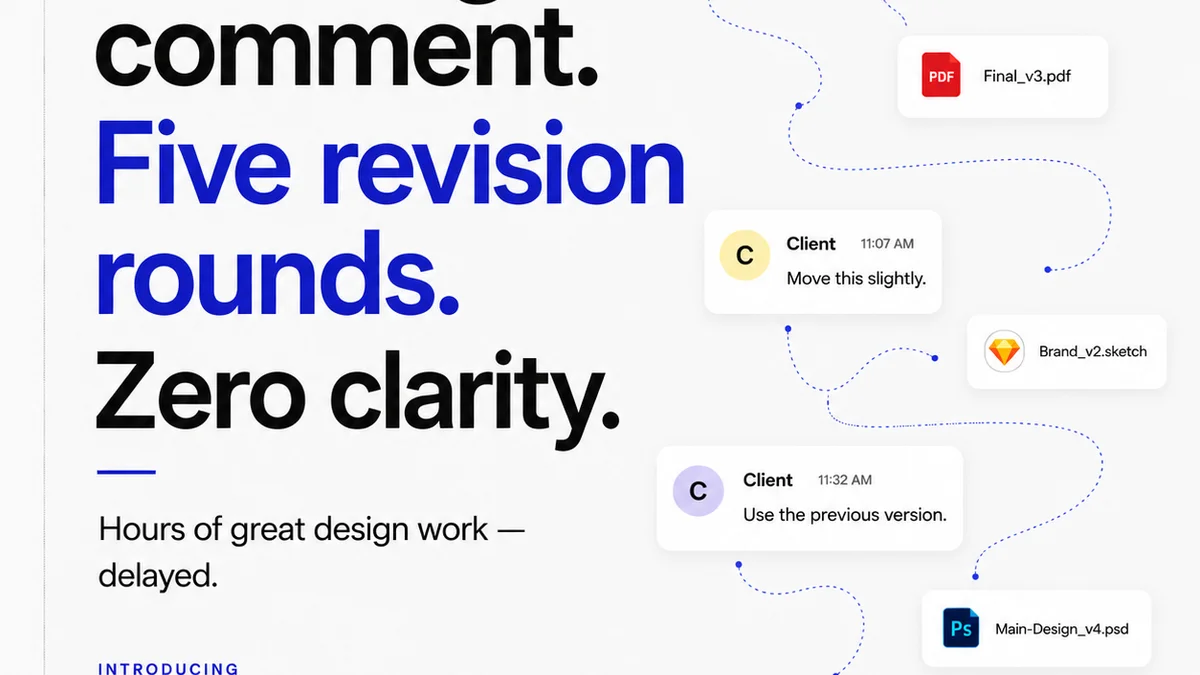
Most agencies think their Figma workflow is solid. They’ve got designers using it, clients giving feedback (somewhere), and handoffs happening. It feels like it’s working.
None of that is wrong. But it’s incomplete.
The hard truth? For a growing agency, a “working” Figma workflow is often a ticking time bomb. It’s the small, overlooked habits that turn into major bottlenecks when project volume and team size increase. You’re not slow because your designers aren’t skilled. You’re slow because your process is.
1. The "Just Share the File" Mentality
This is the most common starting point. A designer finishes a revision, and the simplest thing is to just share the latest Figma file. Or maybe a link to the canvas.
It feels efficient in the moment. Quick and dirty.
But here’s the operational drag: Every time a new file or link is shared, you lose version control. Which version is the latest? Where is the actual approved final asset? Who has access to which file?
The Downstream Chaos
- Endless back-and-forth emails or Slack messages trying to clarify which file is current.
- Designers working off outdated versions, leading to wasted effort.
- Clients seeing multiple versions and becoming confused, leading to scope creep or delayed decisions.
- Difficulty in tracking revision history and understanding the evolution of a design.
- Missed assets or incorrect versions being handed off to development or production.
This isn't just about keeping files tidy. It's about maintaining a single source of truth. Without it, you’re building complexity on a shaky foundation.
2. Feedback Living in a Black Hole (Email, Slack, or Comments)
Clients give feedback. That’s the job. But *where* that feedback lives is critical. Too often, it’s scattered across email threads, Slack channels, or even Figma comments that get lost in the noise.
The assumption is that the designer will just “see it” and incorporate it. It’s a direct line, right?
Wrong. This creates a massive disconnect between the feedback provider and the action taker, and it’s a recipe for missed details and duplicated effort.
The Cost of Disconnected Feedback
- Crucial details get missed because the feedback wasn’t captured in a structured way.
- Team members don’t have visibility into client comments, leading to misinterpretations.
- It’s impossible to track whether feedback was addressed, rejected, or requires clarification.
- The client has to repeat themselves, leading to frustration and a perception of unprofessionalism.
- You can’t easily reference past feedback when new issues arise.
This isn't just about client management. It’s about project accuracy and team alignment. When feedback is a ghost, so is clarity.
3. Treating Revisions as an Infinite Loop
Agencies often fall into the trap of offering “unlimited revisions” or simply not having a clear process for managing revision rounds. The Figma file becomes a digital ping-pong table.
The assumption is that clients will be happy with endless tweaks. It’s seen as good service.
The reality is that unstructured revisions kill profitability and team morale. Every extra tweak, every small change outside the original scope, erodes your margins.
The Revision Rabbit Hole
- Scope creep disguised as minor edits.
- Designers burning out on repetitive, non-strategic changes.
- Project timelines extending indefinitely, impacting other client commitments.
- Clients feeling empowered to ask for anything, regardless of impact.
- Difficulty in accurately quoting future projects when revision cycles are unpredictable.
You’re not just designing; you’re running a business. Uncontrolled revisions are a direct hit to your bottom line and your team’s well-being.
4. The Approval Black Box
How do you *really* know a design is approved? Is it an email saying “looks good”? A Slack emoji? A verbal nod on a call?
Most agencies operate on a handshake or a vague confirmation. It feels like the fastest way to move forward.
This ambiguity is a ticking clock. It means the “approved” design might not be truly signed off, leading to rework later when a stakeholder changes their mind or a new decision-maker steps in.
The Danger of Unclear Approvals
- Projects move forward based on assumed consent, not confirmed sign-off.
- Stakeholders can backtrack, claiming they never saw or approved a specific iteration.
- It’s hard to define the “final” version for handoff.
- Builds are based on potentially non-final designs, leading to costly changes.
- Lack of a clear audit trail for client decisions.
Clear approvals aren't just about documentation; they're about de-risking your project and protecting your agency.
5. Neglecting the Quality Check Handoff
The final step before sending assets to development or print often feels like a rush. The design is “done,” so it’s just a matter of exporting.
The assumption is that the designer has already caught everything. They made it, they know it.
But fatigue and tunnel vision are real. What looks perfect at pixel-level zoom might have alignment issues, missing states, or incorrect specifications when viewed holistically or by a fresh pair of eyes.
The Cost of Skipping QC
- Developers build based on incomplete or incorrect specs.
- Brand inconsistencies creep in due to overlooking guidelines.
- Assets are exported at the wrong resolution or format.
- UI elements are misaligned or have incorrect states (e.g., hover, active).
- Final deliverables don't match the agreed-upon vision, requiring emergency fixes.
A thorough quality check isn't a nice-to-have; it’s a non-negotiable step to prevent costly downstream errors.
Where Revue Fits In
These workflow breakdowns aren't about a lack of talent. They’re about a lack of structured process, especially as you scale.
Figma is a powerful tool for design creation. But managing feedback, revisions, and approvals *around* the design work requires a dedicated system.
Revue helps bridge that gap. It centralizes client feedback, providing a single, clear source of truth that designers and clients can reference. You can track every comment, every decision, and every approval, eliminating the “black hole” effect.
When feedback is structured and visible, revision rounds become more focused and efficient. You gain clarity on what’s approved and what’s not, cutting down on scope creep and endless tweaks.
And for that crucial final quality check? Having a clear audit trail of all feedback and approvals ensures everyone is aligned on the final deliverable, reducing the risk of errors before handoff.
It’s about turning your design process from a series of disconnected actions into a cohesive, trackable workflow.
Final Thought
Your agency is growing. Your processes need to grow with it. Relying on informal habits and scattered communication in Figma is a short-term fix that guarantees long-term pain. The real efficiency gains come not from faster clicking, but from smarter systems that manage the chaos of collaboration.
Frequently asked questions
What's the biggest mistake agencies make with Figma files?
The biggest mistake is the 'just share the file' mentality. This leads to lost version control, confusion over which file is current, and wasted design effort because people work off outdated versions.
How can I stop feedback from getting lost?
Don't let feedback live solely in email, Slack, or scattered Figma comments. Use a centralized system where all client feedback is logged, assigned, and tracked. This ensures crucial details aren't missed and everyone is aligned.
How do I manage revision rounds more effectively?
Implement a clear process for revision rounds. Define what constitutes a 'round,' set expectations with clients about the scope of changes, and ensure every revision is logged and approved. Avoid treating revisions as an infinite loop.
What's the best way to get clear design approvals?
Move beyond vague confirmations like 'looks good.' Establish a formal approval process where stakeholders explicitly sign off on specific design versions. This creates an audit trail and prevents costly backtracking later.