Everyone’s talking about the future of creative collaboration. They’ll point to remote teams, AI assistants, and a dizzying array of new software tools. None of that is wrong. But it’s incomplete.
The real future of creative collaboration in 2026 isn’t about *where* people work or *what* tools they use. It’s about how teams navigate the inherent friction in the creative process itself.
1. The Myth of Seamless Digital Workflows
The assumption is that technology has solved collaboration. Just plug in the right software, and everything flows. We’re told that asynchronous communication and cloud-based platforms make working together easier than ever.
This often overlooks the human element. Technology can facilitate, but it can’t eliminate the complexities of differing perspectives, subjective feedback, and the sheer messiness of creative iteration.
Creative work isn’t a linear production line. It’s a dynamic, often unpredictable journey.
The Friction Points Remain
Despite advanced tools, teams still grapple with:
- Misinterpreted feedback
- Lost context across communication channels
- Delays due to unclear approval processes
- Difficulty tracking revision history and rationale
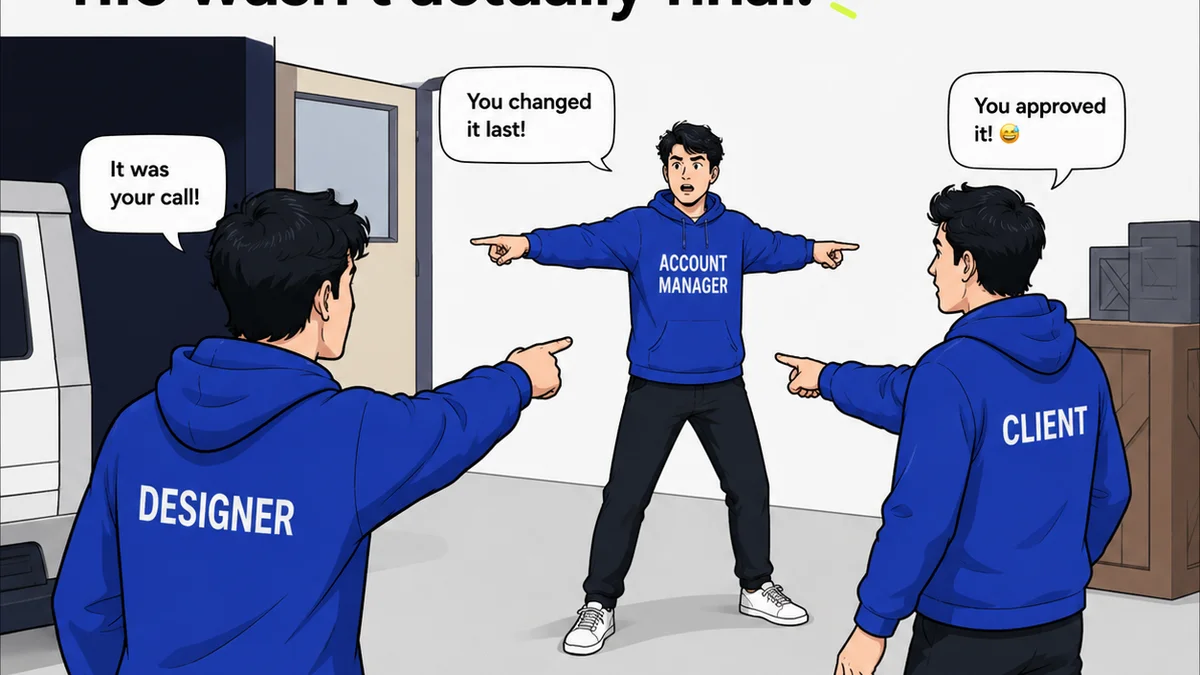
- Silos forming between different roles (e.g., creative, account, client)
- Burnout from constant context switching and digital noise
These aren't minor glitches. They are fundamental challenges that technology alone can't fully automate away. The future demands that we engineer better *processes* to manage this friction, not just better tools.
2. Mastering Asynchronous Nuance
Asynchronous work is here to stay. The key isn't just *allowing* it, but *mastering* it. This means getting better at capturing and conveying nuance when you’re not in the same room, or even online at the same time.
Think beyond just sending an email. It’s about providing comprehensive context with every piece of communication.
Context is King
What does this look like in practice?
- Detailed briefs: Clear objectives, target audience, key messaging, and desired outcomes.
- Annotated feedback: Directly on the creative asset, with clear explanations of *why* a change is needed, not just *what* change is needed.
- Video walkthroughs: For complex feedback or explaining design rationale.
- Centralized project documentation: A single source of truth for all project-related decisions and assets.
- Defined communication protocols: When to use chat, email, or a dedicated feedback platform.
The goal is to make information accessible and understandable to anyone, at any time, without requiring a real-time discussion.
3. The AI Augmentation, Not Replacement
AI is going to be a significant part of creative workflows. But its role in collaboration will be more about augmentation than outright replacement, at least in the near term.
Expect AI to handle the repetitive, the data-heavy, and the predictive tasks. This frees up human creatives to focus on the strategic, conceptual, and emotionally resonant aspects of their work.
AI's Collaborative Role
Consider these AI-powered enhancements:
- Automated content generation: First drafts of copy, image variations.
- Smart asset tagging and organization: Faster retrieval of files and assets.
- Predictive analytics: Identifying potential bottlenecks or suggesting optimal A/B test variations.
- Sentiment analysis of feedback: Helping to distill subjective client input into actionable items.
- Automated quality assurance checks: Flagging inconsistencies or adherence to brand guidelines.
The challenge for teams in 2026 will be integrating these AI capabilities seamlessly into existing human-led processes. It requires understanding AI's strengths and limitations, and ensuring human oversight remains paramount, especially for subjective creative decisions.
4. The Rise of the
Frequently asked questions
How will AI change creative collaboration by 2026?
AI will primarily augment human creativity by automating repetitive tasks, generating initial drafts, organizing assets, and providing data-driven insights. The focus will be on seamless integration with human oversight, not full replacement.
What is the biggest challenge in asynchronous creative collaboration?
The biggest challenge is maintaining nuance and context. Without real-time discussion, it's easy for feedback to be misinterpreted or for crucial details to be missed. Mastering asynchronous work means providing comprehensive context with every communication.
Is remote work the only factor shaping future collaboration?
No. While remote and hybrid models are significant, the future of collaboration is more about how teams manage the inherent friction in the creative process itself, regardless of location. This includes mastering asynchronous communication and integrating new technologies effectively.
How can agencies prepare for the future of creative collaboration?
Agencies should focus on refining their internal processes to manage feedback and revisions more effectively, invest in platforms that centralize communication and asset management, and train teams on how to leverage AI tools as collaborators, not just utilities.