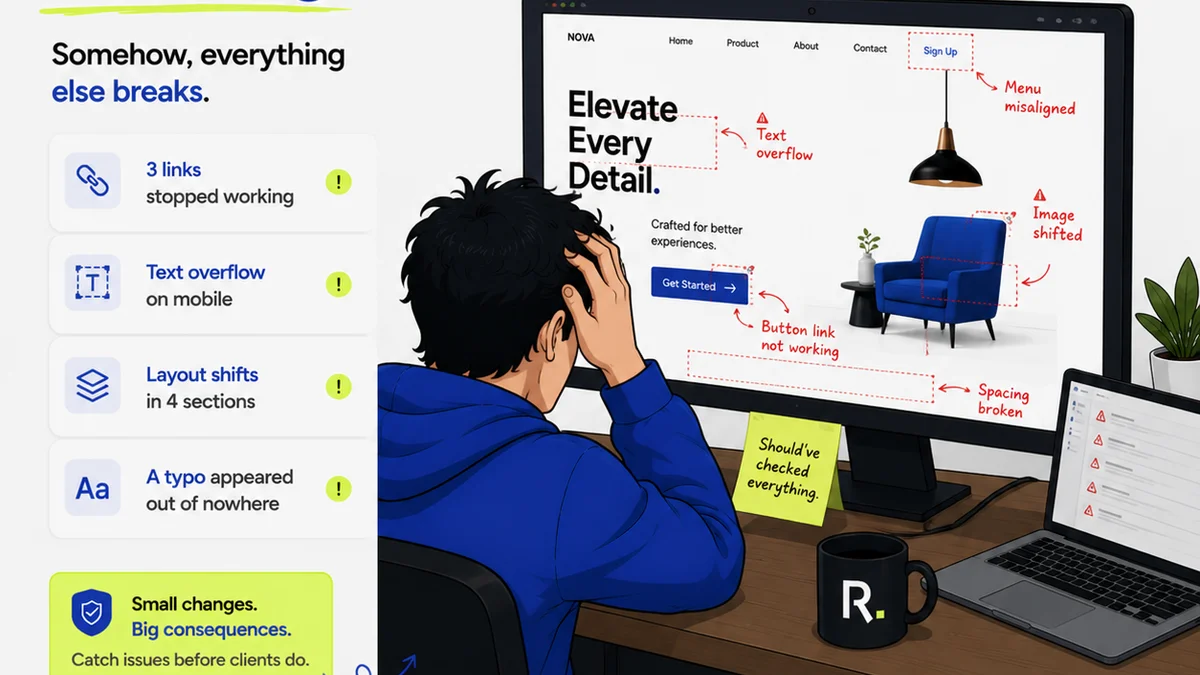
Everyone assumes design Quality Assurance (QA) is about finding bugs. Pixel perfection. Checking off a list of visual errors before launch. That's not wrong, but it's far from the whole story.
The hard truth? Design QA is evolving from a reactive checklist into a proactive, strategic function that impacts client relationships, project profitability, and the long-term health of your agency.
1. The Shifting Sands of Design QA
For years, QA meant one thing: spotting visual glitches. A misplaced button, a typo, a color that's slightly off. It was a necessary evil, often tacked on at the last minute.
But the digital landscape is more complex now.
The Rise of User Experience (UX)
Design isn't just about how something looks; it's about how it works. How it feels. This means QA needs to broaden its scope.
- Is the navigation intuitive?
- Are the calls to action clear?
- Does the user flow make sense?
- Is the entire experience accessible to all users?
This isn't just about aesthetics anymore. It's about usability and accessibility.
The Demand for Consistency
Brand consistency is non-negotiable. Clients expect their digital presence to be a seamless extension of their brand identity, across every touchpoint.
This means QA must ensure:
- Adherence to brand guidelines (colors, typography, imagery).
- Consistent application of UI elements.
- Uniformity across different devices and platforms.
Inconsistency erodes trust and dilutes brand impact.
The Pace of Iteration
Agile development and rapid prototyping mean designs change constantly. QA can't be a final gate; it must be integrated throughout the process.
This requires a more agile approach to quality checks themselves.
2. Beyond the Visual Audit: A Holistic Approach
If QA is more than just bug hunting, what is it? It's about safeguarding the entire project's success, from concept to delivery and beyond.
Usability Testing
This isn't just for UX researchers. Design QA should involve validating that the design actually works for real users.
This means:
- Observing users interacting with the design.
- Identifying points of confusion or frustration.
- Gathering feedback on ease of use.
A beautiful design that's impossible to use is a failed design.
Accessibility Compliance
Designing for everyone isn't just good ethics; it's good business and often a legal requirement. QA must include checks for accessibility standards.
This means:
- Ensuring sufficient color contrast.
- Testing keyboard navigation.
- Verifying proper alt text for images.
- Checking for screen reader compatibility.
Tools like the Web Content Accessibility Guidelines (WCAG) provide the framework.
Performance Considerations
A slow-loading website or app is a poor user experience, no matter how stunning the design. QA needs to consider performance implications.
This can include:
- Optimizing image file sizes.
- Ensuring efficient code structure (though this often overlaps with development QA).
- Testing load times across different network conditions.
A great design shouldn't be bogged down by technical debt.
Content Verification
Often overlooked, content is a critical part of the design. QA needs to ensure content is:
- Accurate and error-free.
- In the correct place and format.
- Appropriate for the context.
A typo in a headline or a misplaced paragraph can undermine the entire design's credibility.
3. Integrating QA into the Workflow
The biggest mistake agencies make is treating QA as an afterthought. It’s a bottleneck that causes delays and frustration.
The future is integrated QA.
Early and Often
Quality checks should start from the very first wireframe and continue through every iteration.
This means:
- Reviewing wireframes for structural integrity and user flow.
- Auditing mockups against design systems.
- Testing prototypes for interactive consistency.
- Checking development builds against design specifications.
Catching issues early saves significant time and resources.
Cross-Functional Collaboration
QA isn't just a designer's job, or a developer's job. It requires input from all sides.
This involves:
- Designers ensuring their vision is realized.
- Developers verifying technical feasibility and implementation.
- Project managers tracking scope and timelines.
- Client stakeholders providing functional and business-logic validation.
Open communication is key.
Leveraging Tools
Manual checks are time-consuming and prone to error. The right tools can streamline the process.
Consider tools for:
- Visual regression testing.
- Automated accessibility checks.
- Centralized feedback and annotation.
Technology can augment human oversight, not replace it.
4. Where Revue Fits In
Managing feedback, revisions, and approvals across multiple stakeholders, platforms, and project stages is a constant challenge. This is where a centralized system like Revue becomes invaluable for robust design QA.
Instead of scattered email threads, Slack messages, or endless annotation layers on static PDFs, Revue provides a single source of truth.
Centralized Feedback
All client feedback, designer comments, and stakeholder input live in one place, tied directly to the creative asset. This eliminates confusion about which version is current and what feedback applies to it.
Revision and Approval Visibility
Track the entire revision history of a design. See who approved what, when, and what changes were made between versions. This creates an undeniable audit trail, crucial for accountability and preventing scope creep.
Structured Quality Checks
Use Revue to conduct structured QA sessions. Assign specific tasks, flag issues for review, and ensure all necessary checks—visual, functional, content, and accessibility—are completed before final sign-off.
It transforms QA from a chaotic scramble into a systematic process.
5. The Strategic Impact of Proactive QA
When design QA is treated as a strategic function, the benefits ripple outwards.
Improved Client Relationships
Delivering high-quality, bug-free work builds trust. Clients appreciate agencies that are meticulous and proactive, reducing their own risk and workload.
Fewer last-minute surprises mean happier clients.
Increased Profitability
Every hour spent fixing a bug discovered late in the process eats into your margins. Integrated QA minimizes costly rework and reduces project overruns.
Efficiency directly impacts your bottom line.
Enhanced Brand Reputation
Consistently excellent work, from usability to aesthetics, strengthens your agency's reputation. You become known for reliability and quality.
This attracts better clients and more talented staff.
Reduced Technical Debt
By addressing usability, performance, and accessibility early, you prevent long-term issues that can plague a product post-launch. This makes future updates and maintenance far smoother.
It's an investment in the product's longevity.
Final Thought
The future of design QA isn't about more checklists; it's about a more integrated, strategic, and user-centric approach. It's about embedding quality into the very fabric of the creative process, from the initial concept to the final pixel. Are you ready to elevate your QA from a gatekeeper to a growth driver?
Frequently asked questions
What is the primary shift in modern design QA?
The primary shift is moving from a reactive, bug-hunting approach to a proactive, strategic function that encompasses user experience, accessibility, consistency, and performance throughout the entire design and development lifecycle.
How can agencies integrate QA earlier in the process?
Agencies can integrate QA by reviewing wireframes for structural integrity, auditing mockups against design systems, testing prototypes for interactive consistency, and checking development builds against design specifications, rather than waiting until the end.
What role does client feedback play in advanced design QA?
Client feedback is crucial. Advanced QA involves validating functional requirements and business logic with client stakeholders, ensuring the final product meets their business objectives and user needs. Centralized platforms help manage this feedback effectively.
How does improved design QA impact an agency's profitability?
Improved design QA increases profitability by minimizing costly rework and project overruns. Catching issues early saves significant time and resources, directly boosting project margins and overall efficiency.
What are the key benefits of a holistic approach to design QA?
The key benefits include improved client relationships due to consistent high quality, increased profitability from reduced rework, enhanced agency reputation, and reduced long-term technical debt for the product.