Everyone talks about the next big thing in publishing. AI-generated content, hyper-personalization, the metaverse. It’s easy to get caught up in the hype cycle.
But chasing the latest shiny object isn't a strategy.
It’s a distraction.
The real win isn't adopting every new tool. It's building a publication workflow that's fundamentally robust. One that can weather technological shifts, client demands, and internal growing pains. That’s how you future-proof your operation.
1. The Myth of the Static Workflow
Many agencies and creative teams operate with a workflow that feels solid today. They’ve optimized it for their current tools and processes. They have their checklists, their templates, their approval stages.
This is understandable. It’s efficient, for now.
But the assumption that a workflow is a fixed entity is where things start to break. The digital landscape moves too fast. Client needs evolve. Team members change. What worked perfectly last year can become a bottleneck tomorrow.
The hard truth? Your publication workflow isn't a finished product. It's a living system. It requires continuous attention and adaptation.
The Hidden Costs of Stagnation
When your workflow stagnates, the costs aren't always obvious. They creep up on you.
- Missed deadlines because of unexpected process jams.
- Increased errors and rework due to outdated review loops.
- Frustrated clients who experience delays or inconsistent quality.
- Burnout among your team members dealing with inefficient systems.
- Lost opportunities because you're too bogged down to pivot quickly.
These aren't minor inconveniences. They're direct threats to your profitability and reputation.
2. Deconstructing Your Core Publication Workflow
Before you can future-proof anything, you need to understand what you have. Most teams skip this step. They jump straight to implementing new software or methodologies.
Don't do that.
Start by mapping your current publication workflow from end to end. Get granular.
Map Every Step
This isn't just about the big milestones. It's about the tiny actions that make up the whole.
- Brief intake and understanding.
- Research and ideation.
- Content creation (writing, design, video, etc.).
- Internal reviews and edits.
- Client feedback rounds.
- Revision cycles.
- Final approvals.
- Quality assurance and checks.
- Publication and distribution.
- Performance monitoring.
For each step, document:
- Who is responsible?
- What tools are used?
- What are the inputs and outputs?
- How long does it typically take?
- What are the common pain points or bottlenecks?
Use flowcharts, process maps, or even just a detailed spreadsheet. The medium matters less than the thoroughness.
Identify Bottlenecks and Weaknesses
Once mapped, the inefficiencies become glaring. You'll see:
- Where feedback gets lost or misinterpreted.
- Which stages consistently cause delays.
- Where handoffs are clunky and error-prone.
- Which tasks are overly manual or repetitive.
- Where communication breaks down.
This diagnostic phase is critical. It’s the foundation for any meaningful improvement.
3. Building for Adaptability: The Pillars of a Future-Proof Workflow
Adaptability isn't a feature; it's a mindset. Your publication workflow needs to be built with flexibility at its core. This means focusing on a few key principles.
Modularity and Interoperability
Your workflow shouldn't be a monolithic, rigid structure. Think of it as a series of connected modules. Each module performs a specific function (e.g., feedback collection, version control, QA). These modules should be designed to connect and disconnect easily.
This means prioritizing tools and processes that integrate well with others. Avoid proprietary systems that lock you into a single ecosystem if possible. The goal is to swap out a module (like your project management tool) without dismantling the entire workflow.
This is where a well-defined API strategy, even for internal processes, can pay dividends.
Scalability
Can your workflow handle a sudden surge in projects? Or a significant increase in team size? Scalability means designing processes that can expand or contract without breaking.
This often involves automation for repetitive tasks and clear documentation for new team members. It also means having a flexible resource allocation plan.
Visibility and Transparency
Everyone involved needs to see where a project stands. This applies to internal teams and clients.
Lack of visibility breeds confusion, duplicate efforts, and missed expectations. A transparent workflow ensures that stakeholders have access to the information they need, when they need it.
This includes clear status updates, accessible feedback logs, and visible revision histories.
Data-Driven Iteration
How do you know if your workflow is actually improving? You measure it.
Collect data on key metrics: turnaround times, error rates, client satisfaction scores, team utilization. Use this data not just to report on performance, but to actively identify areas for iterative improvement.
Treat your workflow like a product that needs continuous refinement based on user (team and client) feedback and performance data.
4. Future-Proofing Against Specific Disruptors
Let's look at some common areas where workflows often fail to adapt, and how to preemptively strengthen them.
The AI Integration Challenge
AI tools are rapidly changing content creation and analysis. Your workflow needs to accommodate them, not fight them.
- Content Generation: Where does AI-assisted drafting fit? How is it reviewed and fact-checked? Who is accountable for AI-generated output?
- Data Analysis: Can AI tools help analyze content performance or audience feedback? How does this data feed back into your content strategy and workflow?
- Automation: What repetitive tasks can AI automate within your existing workflow (e.g., summarizing feedback, generating reports)?
The key is to integrate AI as a tool to augment human creativity and efficiency, not replace it wholesale. Define clear guidelines and quality control checkpoints for AI-assisted work.
Evolving Client Feedback Mechanisms
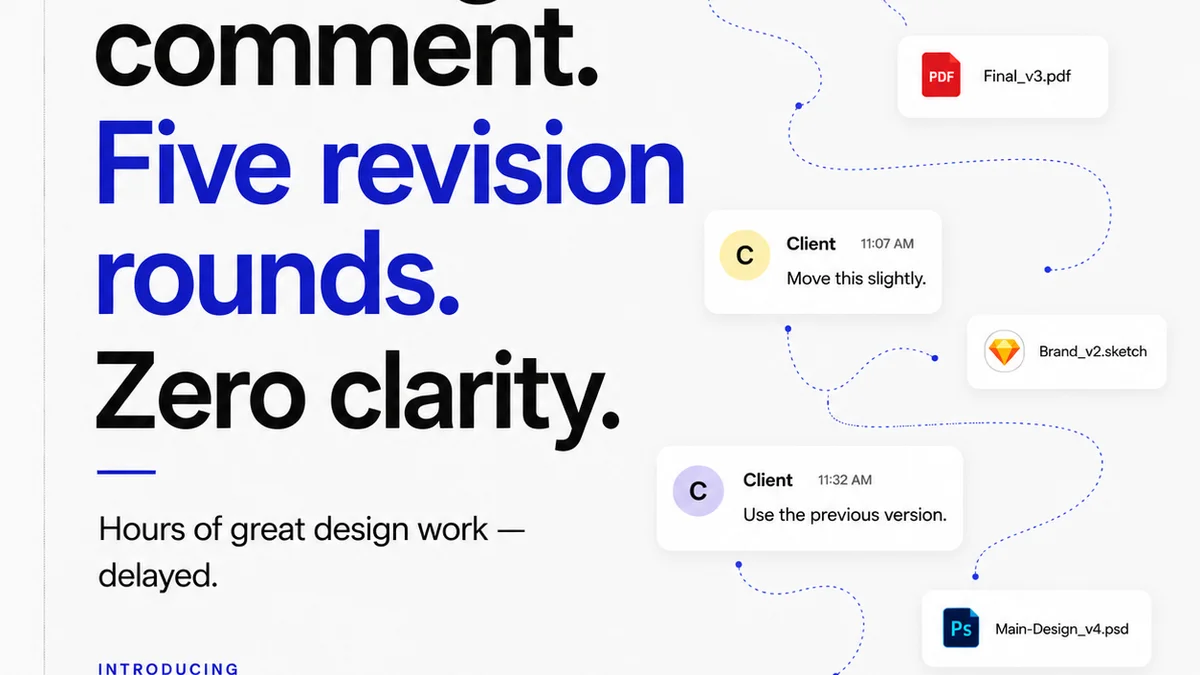
Clients are more connected than ever, but effective feedback remains a challenge. Email chains, scattered comments, and vague instructions are workflow killers.
A future-proof workflow needs a centralized, structured approach to feedback. This means:
- A single source of truth for all comments and revisions.
- Clear annotation tools that link feedback directly to the creative asset.
- Defined feedback stages and response protocols.
- Version control that tracks changes and preserves previous iterations.
The goal is to make feedback actionable, traceable, and efficient, reducing misunderstandings and speeding up approvals.
Remote and Hybrid Team Dynamics
The shift to remote and hybrid work isn't going away. Your workflow must support distributed teams effectively.
This requires robust digital infrastructure and clear communication protocols:
- Asynchronous Communication: Tools and processes that don't require everyone to be online simultaneously.
- Centralized Documentation: Easy access to briefs, assets, feedback, and project status for all team members, regardless of location.
- Virtual Collaboration Tools: Platforms that facilitate real-time and near-real-time collaboration on creative assets.
- Clear Role Definition: Ensuring everyone knows their responsibilities, especially when working across different time zones.
A workflow designed for in-person collaboration will falter in a distributed environment. Adapt now.
Quality Assurance in a Fast-Paced World
The pressure to publish faster often leads to QA being squeezed out. This is a critical mistake.
Future-proofing means embedding QA throughout the process, not just at the end.
- Automated checks for common errors (e.g., broken links, formatting issues).
- Standardized checklists for different publication types.
- Peer review stages focused on specific quality criteria.
- Clear acceptance criteria defined upfront.
High-quality output builds trust and reduces costly corrections post-publication. Don't sacrifice it for speed.
5. Where Revue Fits In
Building a future-proof publication workflow isn't about adopting one magic tool. It's about having a system that supports adaptability, visibility, and efficiency.
Revue is designed to address the core challenges of managing creative feedback and approvals, which are often the biggest choke points in a publication workflow.
By centralizing client feedback, you eliminate scattered emails and disparate comment threads. This provides a single source of truth for all stakeholders.
Revue's revision and approval tracking gives you clear visibility into the status of each asset. This streamlines communication and accountability.
Its integrated quality check features help ensure that standards are met before final publication.
Essentially, Revue helps you build a more resilient, transparent, and efficient core for your publication workflow, allowing you to adapt more readily to new tools and changing demands.
6. Final Thought
The publication landscape will continue to shift. New technologies will emerge, client expectations will evolve, and market demands will change.
Your workflow is your operational bedrock. If it's rigid, brittle, and resistant to change, you'll be constantly reacting, always playing catch-up.
But if you build a publication workflow strategy that prioritizes modularity, transparency, and continuous iteration, you won't just survive the future. You'll be positioned to shape it.
Are you building a workflow for today, or for the next decade?
Frequently asked questions
What is a publication workflow?
A publication workflow is the series of steps, processes, and tools used to create, review, approve, and distribute content. It encompasses everything from initial brief to final publication and performance monitoring.
Why is future-proofing a workflow important?
Future-proofing is crucial because the media landscape, technology, and client needs are constantly evolving. A static workflow quickly becomes inefficient, leading to delays, errors, increased costs, and missed opportunities. An adaptable workflow ensures sustained efficiency and quality.
How can I make my workflow more adaptable?
Focus on modularity (breaking processes into interchangeable parts), interoperability (ensuring tools work together), scalability (handling growth), transparency (clear visibility for all), and data-driven iteration (continuous improvement based on metrics).
How does AI impact publication workflows?
AI can automate tasks, assist in content generation, and provide data analysis. A future-proof workflow integrates AI tools thoughtfully, establishing clear guidelines for their use, accountability, and quality control, augmenting rather than replacing human oversight.
What role does client feedback play in workflow design?
Effective client feedback is critical. A future-proof workflow incorporates structured, centralized feedback mechanisms with clear annotation and version control, transforming feedback from a bottleneck into an efficient, traceable part of the revision process.