Most agency owners know their headline numbers.
They know monthly revenue. They know payroll. They know what they billed last quarter. They know which client pays on time and which one drags invoices. They know whether the pipeline feels healthy or weak.
What many of them don’t know — at least not clearly enough — is where profit is actually disappearing inside the business.
Not in a dramatic way. Not through one catastrophic mistake. Not through a giant failed project.
It disappears quietly through operations.
A designer spends 45 minutes figuring out which feedback is final. An account manager sits on three calls to clarify comments that should have been consolidated earlier. A founder rechecks the same deck before it goes to the client because nobody trusts the review process. A team resends work because the wrong version was approved. A project drifts by two days because one stakeholder didn’t respond on time. A creative lead fixes alignment, copy, and spacing issues manually before every delivery because the team has no real quality control system.
None of these moments look fatal in isolation.
Together, they are one of the biggest reasons creative agencies feel overworked, under-scaled, and less profitable than they should be.
That’s the hidden operational cost of running a creative agency: small inefficiencies repeated across every project become a structural drag on margin, output, and team capacity.
The worst part is that agencies often normalize this chaos. It starts to feel like “just how creative work works.” Fast-moving, messy, collaborative, subjective. But a lot of what agencies call the natural messiness of creativity is actually just weak operations.
And weak operations are expensive.
Agencies Don’t Only Sell Creativity. They Sell Operational Execution.
This is the first mindset shift agency leaders need to make.
An agency does not just sell ideas, design, strategy, or production. It sells the ability to repeatedly move creative work from brief to delivery without breaking quality, timelines, or team sanity along the way.
That second part is operational.
Because a campaign does not reach the client through talent alone. It moves through:
project intake
briefing
task allocation
file creation
internal reviews
stakeholder feedback
revisions
approvals
quality checks
exports
handoffs
final delivery
If those layers are messy, the agency is not just “a little disorganized.” It is structurally making each project more expensive to deliver than it should be.
This is why two agencies can charge similar fees but end up with very different profitability. One has a repeatable operating system. The other has talented people compensating for broken workflows.
One scales.
The other stays busy.
What “Hidden Operational Costs” Actually Means
Hidden operational costs are not always visible on a P&L as a neat line item.
They show up as:
extra hours that were never scoped
slower project turnaround
underutilized team capacity
senior people doing low-leverage coordination work
repeated errors and corrections
lower margins on fixed-fee projects
delayed launches and client frustration
burnout from avoidable chaos
difficulty scaling output without adding headcount
These costs are “hidden” because they’re spread across dozens of micro-failures in the workflow. No one event is large enough to trigger panic. But together, they create a major financial drag.
If you want to understand where agency profitability really goes, stop looking only at client acquisition and billable rates. Start looking at how much operational friction your team is absorbing every week.
The Biggest Hidden Operational Costs in Creative Agencies
Let’s break down the biggest ones.
1. Scattered Feedback Across Multiple Channels
This is one of the most common and most expensive agency problems.
Feedback comes through:
email
Slack
WhatsApp
PDF comments
screenshots
live calls
voice notes
random messages from internal stakeholders
Now someone has to consolidate all of it.
That person is often an account manager, project lead, designer, or founder. They spend time gathering comments, interpreting vague language, reconciling conflicting inputs, and turning fragmented feedback into something actionable.
That work is rarely scoped, rarely measured, and rarely billed. But it happens on almost every project.
The agency thinks it’s doing “one round of revisions.” In reality, it’s also paying for feedback management, translation, and clarification labor.
This is exactly why agencies start looking for:
creative feedback management software
design review tools for agencies
proofing software for creative teams
client feedback software for agencies
creative workflow software
Not because software is trendy, but because scattered feedback creates operational waste at scale.
2. Revision Loops That Never Properly Close
Most agencies underestimate how much money revisions consume because they only think about the visible design changes.
They don’t count:
the time spent waiting for feedback
the time spent clarifying comments
the time spent comparing versions
the time spent reopening old files
the time spent fixing new mistakes introduced during revisions
the time spent getting internal sign-off before resending
A “small revision” is rarely small once you look at the full chain of labor around it.
When revision rounds are undefined, approvals are weak, and feedback isn’t consolidated, the same project keeps pulling time from the team long after it should have been operationally closed.
That means the agency is not just losing time. It’s losing capacity that could have been used on another project, another client, or another billable opportunity.
3. Weak Version Control and Duplicate Work
Every agency has seen some variation of this:
the client comments on an outdated file
the internal team edits the wrong version
someone uses an older copy deck by mistake
a stakeholder approves a draft that wasn’t actually final
the team has to compare multiple exports to understand what changed
This is not a harmless admin issue. It creates duplicate labor.
Someone has to trace the latest file. Someone has to reapply changes. Someone has to explain the confusion. Someone has to check whether the right version has all approved edits. All of that is labor with no strategic upside.
Agencies often think cloud storage or naming conventions are enough to solve this. They’re not. Storage is not workflow control. File naming is not version governance.
If your agency still relies on “Final_v3_UseThisOne_ACTUALFINAL,” you don’t have version control. You have wishful thinking.
4. Manual Quality Checks Before Every Delivery
This is one of the most invisible operational costs in creative work.
Before a file goes out, someone usually checks:
spelling
alignment
spacing
typography consistency
image placement
missing elements
CTA accuracy
dimensions
export issues
brand consistency
The problem is not that quality checks exist. The problem is that in many agencies, they live entirely in human memory and manual effort.
So a senior designer, founder, creative director, or account lead becomes the last defensive layer before delivery. They manually review work because the agency doesn’t trust the workflow enough to let it move without intervention.
That creates two problems:
it consumes senior time on repetitive low-leverage tasks
it still remains error-prone because manual checking under deadline pressure is imperfect
This is where design quality control software, creative QA systems, and more structured review workflows become commercially relevant. Not as “nice-to-have tools,” but as margin protection.
5. Senior People Acting as Human Glue
This is one of the most dangerous patterns in agencies because it often gets mistaken for leadership.
The founder remembers the client history.
The creative director catches the weak layouts.
The senior designer knows the brand nuances.
The account lead knows which stakeholder actually has decision power.
The project manager knows which file is the real final one.
In other words, the agency is not running on process. It’s running on people carrying undocumented context in their heads.
That works while the agency is small. It collapses when volume increases.
Why? Because those people become bottlenecks.
Instead of focusing on high-value work — strategy, client growth, quality direction, team development — they spend huge chunks of time resolving avoidable operational ambiguity:
clarifying briefs
checking outputs
mediating feedback
chasing approvals
locating files
correcting preventable mistakes
That is not leverage. That is expensive dependency.
6. Approval Delays That Stretch Project Timelines
A lot of agencies think delays are just part of client service.
They’re not. Many delays are workflow failures.
If the agency doesn’t define who approves what, by when, and at which stage, work sits idle. A client reviews late. An internal stakeholder jumps in too late. A founder wants one more pass. A marketing lead asks for strategic changes after design approval. Production waits for sign-off. The delivery date slips.
The cost of delay is not just timeline slippage. It affects:
team scheduling
resource allocation
launch timing
project profitability
client confidence
opportunity cost for upcoming work
One delayed approval can create a chain reaction across multiple active projects. Agencies often feel “at capacity” not because they have too much work, but because too much work is stuck in limbo.
7. Poor Handoffs Between Teams or Functions
Creative work often moves between:
strategy and design
copy and design
design and motion
account management and creative
internal team and client
creative team and development team
Every handoff is a risk point.
If the brief is incomplete, the context is missing, the file structure is unclear, the feedback isn’t documented, or the deliverables aren’t defined, the receiving team has to reconstruct the missing information.
That means rework.
The designer waits for copy.
The developer asks for the right assets again.
The motion designer doesn’t know which static version was approved.
The account team sends back comments that should have been addressed upstream.
Handoffs are where creative momentum dies if the workflow isn’t designed carefully.
8. Underpriced Coordination Work
Agencies are usually better at pricing deliverables than pricing coordination.
They price:
logo design
website screens
social media posts
campaign concepts
brochures
decks
packaging
But they rarely price the operational labor wrapped around those deliverables:
project management
revision management
stakeholder alignment
file prep
quality checks
feedback consolidation
internal review rounds
final delivery packaging
So the agency keeps doing real work that never shows up clearly in the commercial model.
That creates a dangerous illusion: the project looks profitable based on the deliverables, but the actual cost of getting those deliverables out the door is much higher than expected.
9. Tool Sprawl Without Workflow Clarity
A lot of agencies try to solve operational pain by adding tools:
Notion for docs
Slack for communication
Google Drive or Dropbox for files
Trello, Asana, or ClickUp for tasks
Frame.io for review in some cases
Zapier for automation
None of these tools are bad. Many are excellent. The problem is that agencies often stack tools without fixing the underlying workflow.
So instead of one broken process, they now have a broken process spread across six platforms.
The team still doesn’t know:
where final feedback lives
which version is approved
when QC happens
who owns sign-off
what stage the project is in
whether the comments in Slack override the comments in the PDF
Tool sprawl without process clarity doesn’t solve operational cost. It distributes it.
10. Burnout from Preventable Friction
This is the cost agencies don’t model well enough.
When a team constantly works in fragmented systems, they don’t just lose time. They lose energy.
Designers get tired of endless cleanup.
Account managers get exhausted by follow-ups and clarification loops.
Founders get pulled into project rescue mode.
Creative leads lose time to operational babysitting instead of craft and direction.
That lowers:
output quality
speed of execution
morale
retention
willingness to take on more work
the overall resilience of the team
Operational friction doesn’t just reduce efficiency. It changes how the agency feels to work inside. And over time, that becomes a talent problem too.
The Real Cost: Agencies Become Busier Without Becoming Better
This is the core problem.
Poor operations create the illusion of activity.
The team is always doing something.
Projects are always moving.
Messages are always flying.
Reviews are always happening.
Founders are always involved.
From the outside, the agency looks busy.
But busyness is not operational health.
A healthy agency should be able to increase output without increasing confusion at the same rate. It should be able to onboard work without every project turning into a custom coordination exercise. It should be able to deliver quality without depending on heroics from senior people every single time.
If that’s not happening, the business doesn’t just need more sales. It needs a better operating system.
How Agencies Reduce Hidden Operational Costs
The fix is not “work harder” or “communicate better.” Those are vague, low-quality answers.
The fix is to build structure around the parts of creative work that repeatedly create waste.
That means:
1. Centralize Creative Feedback
Comments should live in one review environment attached to the creative, not scattered across chats, calls, and emails.
2. Define Review and Approval Stages
Concept review, content review, design review, final approval — each stage should have clear owners and closure rules.
3. Standardize Version Tracking
Everyone should know what’s current, what changed, what’s approved, and what’s archived.
4. Build QC Into the Workflow
Don’t rely only on senior people to catch preventable errors manually at the end.
5. Reduce Dependency on Memory
If your agency depends on specific people remembering context, the process is weak.
6. Audit Coordination Time
Measure how much non-design, non-strategy time the team spends on chasing feedback, clarifying requests, and managing approvals. That’s where hidden cost lives.
7. Separate Creative Work from Creative Operations
Treat operational flow as its own system to be designed, improved, and measured — not as background admin.
Where Revue Fits In
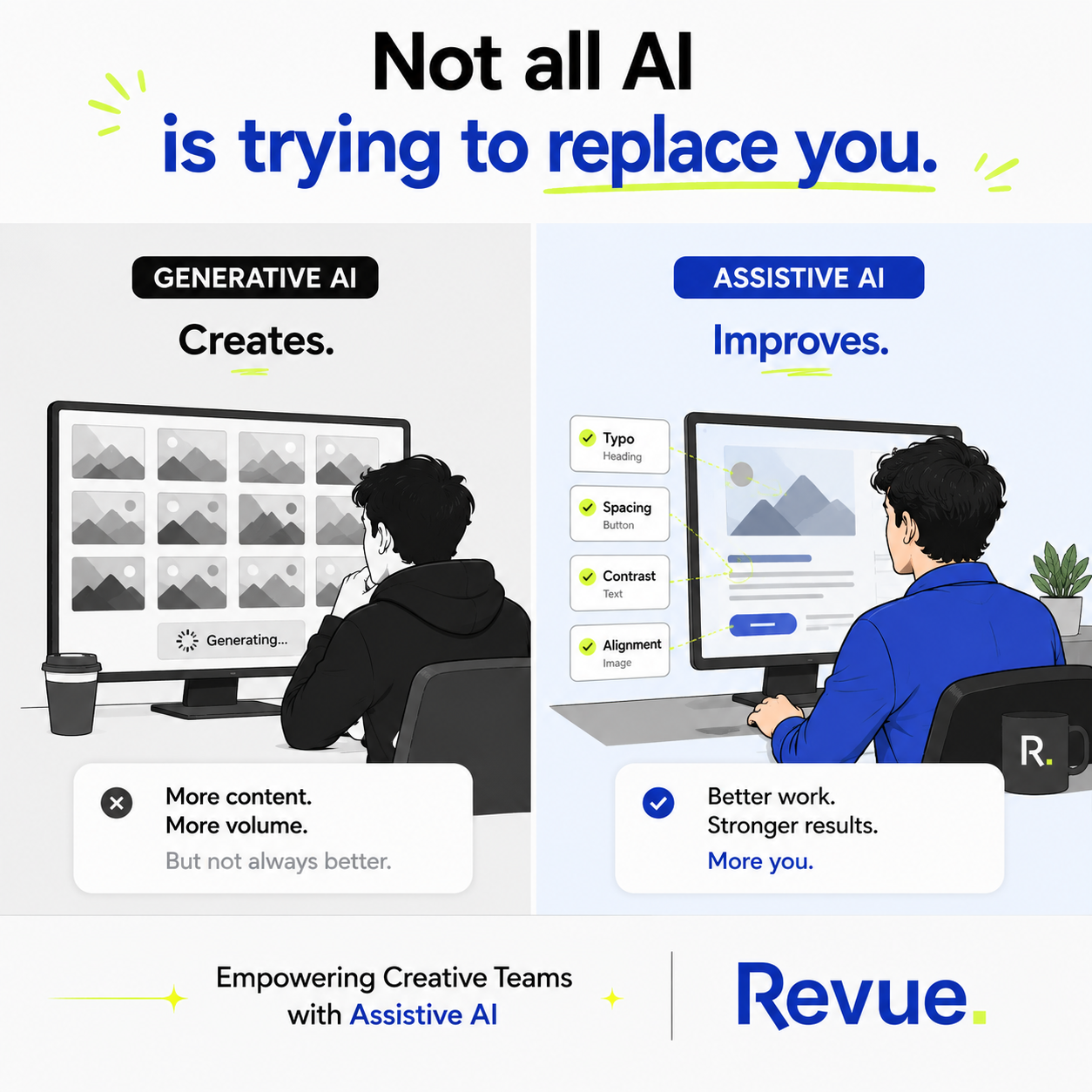
Revue is relevant because the biggest operational leak in creative agencies usually happens in the review layer: the space between draft and approval.
That’s where feedback gets scattered, versions get confused, comments get missed, approvals stay ambiguous, and manual quality checking slows everything down.
Revue is built to reduce that friction by helping teams create more structure around:
feedback and annotations
creative review workflows
visibility across revisions
version clarity
quality checks for static creatives
smoother movement from draft to approval
In other words, it helps agencies operationalize the messiest part of creative delivery.
And that matters because agencies don’t just need better creative work. They need a better system for getting creative work approved and out the door profitably.
Final Thought: The Agency Isn’t as Efficient as It Feels
That’s the uncomfortable conclusion.
A lot of agencies are not under-earning because their work is weak. They’re under-earning because too much of their team’s energy is being consumed by operational waste that nobody fully sees, measures, or fixes.
The agency may not need more clients first.
It may not need more designers first.
It may not need more hours first.
It may need fewer invisible costs.
Because every time feedback is scattered, approvals are vague, versions are messy, QC is manual, and senior people rescue broken workflows, the agency is paying an operational tax on every project.
And the longer that tax goes unaddressed, the harder it becomes to scale profitably.
Creative agencies do not become more profitable just by doing more work.
They become more profitable when they stop losing money in the gaps between the work.
Frequently asked questions
1. What are hidden operational costs in creative agencies?
Hidden operational costs are the non-obvious time and resource drains inside agency workflows, such as scattered feedback, repeated revisions, approval delays, manual QA, version confusion, and coordination overhead.
2. Why do creative agencies struggle with profitability even when revenue looks strong?
Because revenue can hide operational inefficiency. Agencies may bill well but still lose margin through rework, unpriced coordination, slow approvals, duplicated effort, and senior people spending time on preventable operational cleanup.
3. What is the biggest operational cost in creative agencies?
There usually isn’t just one, but the most common major costs are revision chaos, scattered feedback, weak version control, and manual quality checks before delivery.
4. How do approval delays hurt agency operations?
Approval delays block project flow, disrupt resource planning, push delivery timelines, create scheduling conflicts, and reduce how many profitable projects the team can handle at once.
5. Why is manual quality control expensive for agencies?
Manual QA consumes senior time, is hard to scale, and still leaves room for human error. When every file depends on someone manually checking spacing, copy, alignment, and consistency, delivery becomes slower and more fragile.
6. Can project management tools alone fix agency operational issues?
Not necessarily. Tools help, but if the agency doesn’t define a clear workflow for feedback, approvals, version control, and quality checks, tool sprawl can actually make the process more fragmented.
7. How can agencies reduce hidden operational costs?
Agencies can reduce hidden costs by centralizing feedback, defining approval stages, improving version control, building quality checks into the workflow, documenting handoffs, and auditing coordination time across projects.