Creative momentum is fragile.
A designer solving a complex layout.
A copywriter refining a campaign message.
A strategist connecting customer insights.
A creative director shaping a brand narrative.
Great work often emerges when people can stay focused long enough to connect ideas.
Yet many agencies unintentionally destroy this momentum every day.
Not because of poor talent.
Not because of insufficient resources.
But because communication is scattered everywhere.
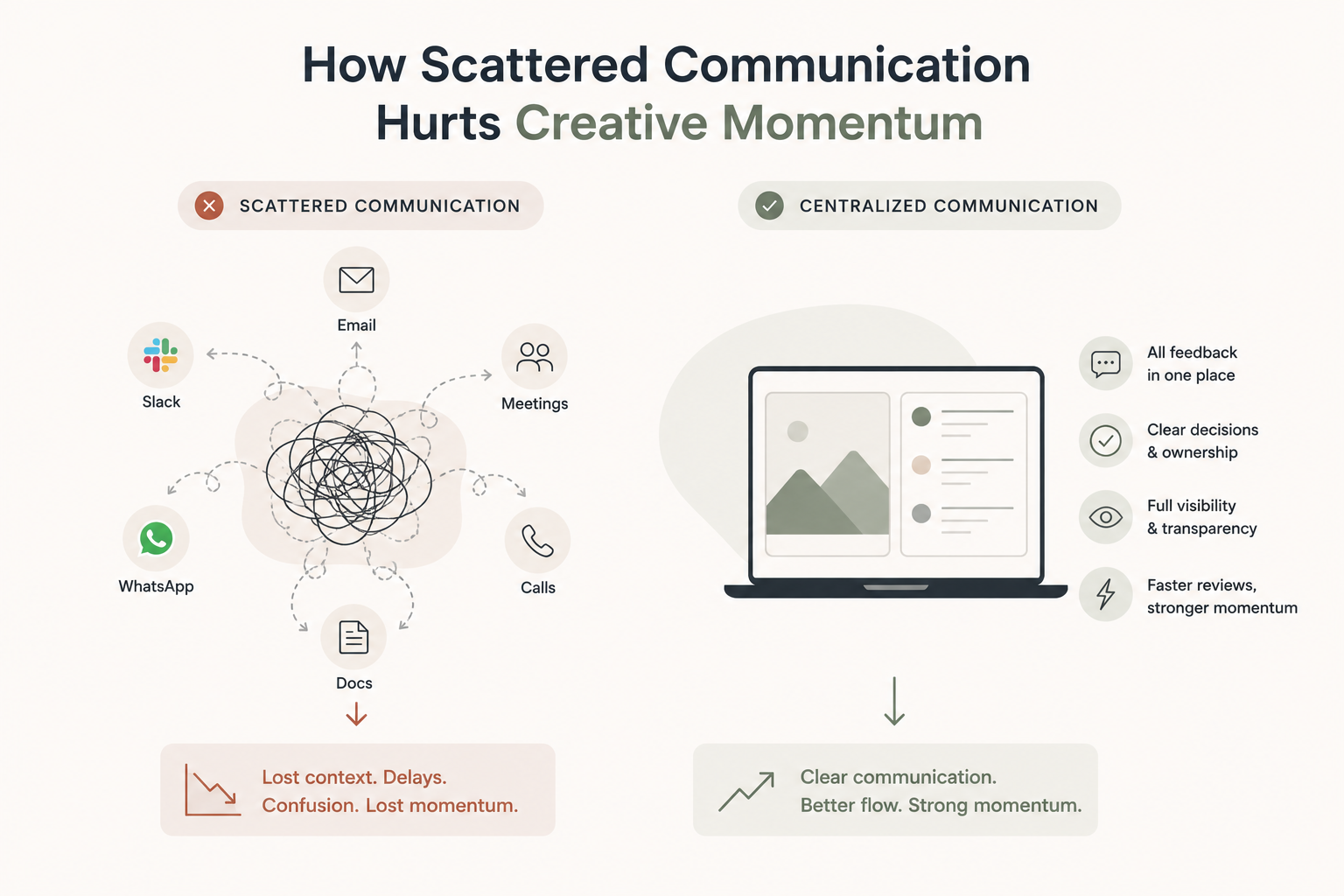
A comment in Slack.
Feedback in email.
A decision made during a meeting.
A request sent through WhatsApp.
A revision discussed on a call.
A stakeholder message buried in a project management tool.
The result is predictable:
Creative work slows down.
Communication Has Become the Hidden Workflow Problem
Most agencies don't realize how much time is spent simply locating information.
A project may involve:
Email conversations
Chat messages
Video meetings
Project management comments
Shared documents
Client calls
Every platform contains part of the project story.
No platform contains the complete picture.
As communication becomes fragmented, clarity disappears.
Why Creative Momentum Matters
Momentum is one of the most valuable assets in creative work.
When teams maintain momentum:
Ideas evolve faster
Decisions happen quicker
Reviews become smoother
Delivery speeds improve
When momentum breaks:
Context gets lost
Thinking resets
Energy drops
Productivity declines
Creative work rarely suffers from a lack of effort.
It suffers from interruption.
The Cost of Context Switching
Imagine a designer working on a website homepage.
Halfway through:
A Slack notification arrives
An email requires clarification
A meeting starts
A stakeholder sends feedback through WhatsApp
The designer now spends time:
Switching tools
Searching for information
Interpreting comments
Rebuilding focus
The interruption may take minutes.
Recovering concentration often takes much longer.
This is known as context switching.
And it is one of the biggest threats to creative productivity.
How Scattered Communication Creates Delays
Communication fragmentation creates bottlenecks throughout a project.
Feedback Gets Lost
Comments arrive through multiple channels.
Important requests are overlooked.
Projects move forward based on incomplete information.
Decisions Become Invisible
A decision made during a call may never be documented.
Days later, nobody remembers exactly what was agreed upon.
The conversation happens again.
Stakeholders Operate on Different Information
Different people reference different versions of discussions.
Confusion increases.
Alignment decreases.
Teams Spend Time Searching Instead of Creating
The more communication channels involved, the more time teams spend hunting for answers.
Productive work gets replaced by administrative work.
Why More Communication Doesn't Mean Better Communication
Many organizations assume communication problems can be solved by communicating more.
The opposite is often true.
More messages create:
More noise
More interruptions
More ambiguity
More duplicated discussions
Effective communication isn't about volume.
It's about clarity.
The best teams communicate less frequently but more effectively.
The Revision Loop Problem
Scattered communication often creates revision cycles.
Here's a common example:
Client provides feedback through email.
Additional comments arrive in Slack.
New suggestions emerge during a meeting.
A stakeholder sends another request through WhatsApp.
The team attempts to combine everything.
Conflicts appear.
Clarifications become necessary.
More revisions follow.
The project slows.
Not because the work is difficult.
Because the communication is fragmented.
Why Growing Agencies Feel This Problem More
Small teams can often manage informal communication.
As agencies grow:
More stakeholders become involved
More projects run simultaneously
More feedback enters the system
Communication complexity increases exponentially.
What worked for a team of three often fails for a team of twenty.
Without structured systems, growth creates operational chaos.
The Hidden Impact on Creativity
Scattered communication doesn't just affect efficiency.
It affects creative quality.
Creative thinking requires:
Focus
Reflection
Deep work
Continuous problem-solving
Constant interruptions force teams into reactive mode.
Instead of exploring ideas, people spend their time responding to messages.
The work becomes more operational and less creative.
The Signs Your Agency Has a Communication Problem
Many agencies recognize these symptoms:
Endless Follow-Ups
People repeatedly ask:
"Did anyone see that feedback?"
Frequent Clarification Meetings
Meetings exist primarily to explain previous conversations.
Conflicting Instructions
Different stakeholders provide different directions.
Delayed Approvals
Important decisions become buried inside communication threads.
Growing Revision Cycles
Projects revisit issues that were supposedly resolved.
How High-Performing Agencies Protect Creative Momentum
The best agencies understand that communication should support creativity, not interrupt it.
Centralize Feedback
All project communication exists in one place.
Everyone references the same information.
Document Decisions
Important decisions become visible and searchable.
Teams avoid repeated conversations.
Reduce Communication Channels
Fewer systems create less confusion.
Consistency improves alignment.
Define Ownership
Teams know:
Who reviews
Who approves
Who implements changes
Decision-making becomes faster.
Separate Communication From Creation
Designers shouldn't spend half their day managing messages.
The best workflows allow creators to remain focused while communication remains organized.
The Role of Creative Workflow Tools
Modern creative teams increasingly use review and collaboration platforms to consolidate communication.
These systems help agencies:
Centralize feedback
Track revisions
Manage approvals
Document decisions
Improve project visibility
The goal is simple:
Reduce communication friction so creative work can move forward uninterrupted.
Why Communication Systems Are Competitive Advantages
Many agencies compete on:
Talent
Creativity
Strategy
Design quality
Increasingly, they also compete on operational efficiency.
Clients notice when projects:
Move faster
Require fewer revisions
Maintain clarity
Deliver consistently
Strong communication systems make these outcomes possible.
Conclusion
Creative momentum is difficult to build and easy to lose.
Every time information becomes scattered across emails, meetings, chats, and messages, teams spend less time creating and more time searching, clarifying, and coordinating.
The problem isn't communication itself.
It's fragmented communication.
The agencies that consistently produce great work aren't necessarily communicating more than everyone else.
They're communicating through systems that preserve focus, maintain clarity, and protect creative momentum.
Because creativity thrives when communication becomes organized—not when it becomes louder.
Frequently asked questions
1. What is scattered communication in creative projects?
Scattered communication occurs when project information, feedback, decisions, and approvals are spread across multiple platforms such as email, chat apps, meetings, calls, and project management tools.
2. How does scattered communication affect creative momentum?
It creates interruptions, context switching, lost information, and repeated discussions. Creative professionals spend more time searching for information and less time focusing on meaningful work.
3. Why does fragmented communication lead to more revisions?
When feedback is spread across different channels, teams often miss comments, misunderstand priorities, or receive conflicting instructions, resulting in additional revision cycles.
4. How can agencies reduce communication chaos?
Agencies can centralize feedback, document decisions, reduce communication channels, create structured review workflows, and define clear ownership for approvals and revisions.
5. How do communication systems improve project delivery?
Strong communication systems improve visibility, reduce confusion, accelerate decision-making, shorten review cycles, and help teams maintain creative momentum throughout the project lifecycle.