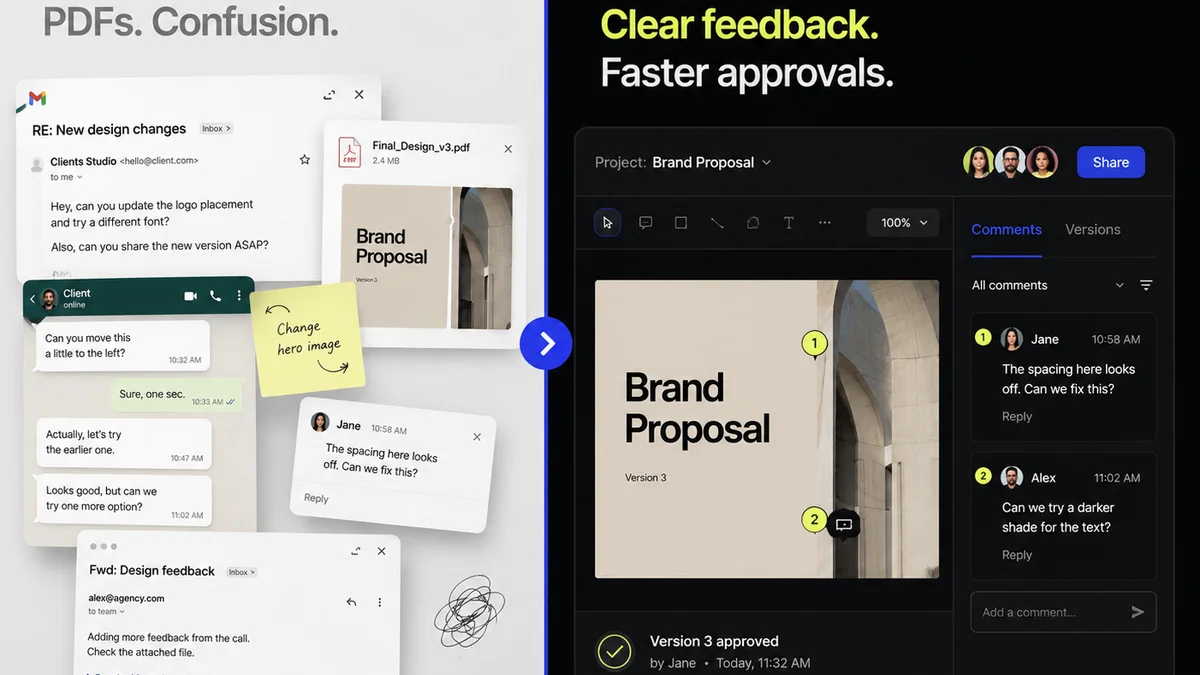
The narrative around AI in creative agencies is often framed as a battle: Human ingenuity versus algorithmic efficiency. We hear a lot about AI replacing designers, writers, and strategists. That's a compelling story, and there's a kernel of truth in it.
But it’s incomplete.
The real operational challenge isn't whether AI can *do* the creative work. It's how your agency integrates these new tools into existing, often messy, human workflows without breaking everything you’ve built.
The Hard Truth: Automation Amplifies Existing Processes
Intelligent automation, whether it's generative AI for concepting or AI-powered project management, doesn't magically fix broken processes. It makes them faster. If your feedback loop is chaotic, AI will just make the chaos more efficient. If your revision tracking is a mess, automated outputs will be equally messy, just quicker.
The critical insight here is that automation is a powerful amplifier. It magnifies what's already there. This means the focus shouldn't be on the AI itself, but on the underlying human processes it interacts with.
1. Generative AI and the Concepting Bottleneck
The Assumption: AI Replaces Ideation
Many believe AI will churn out final concepts, rendering human brainstorms obsolete. This is a misunderstanding of where AI excels and where humans remain indispensable.
The Reality: AI as an Idea Multiplier
Generative AI is fantastic at exploring variations, generating raw material, and overcoming the blank page. It can produce dozens of visual styles, taglines, or campaign angles in minutes. This isn't replacement; it's augmentation.
Your team's role shifts from *generating* every single idea from scratch to:
- Prompt Engineering: Crafting precise instructions to guide AI toward relevant and high-quality outputs.
- Curation and Selection: Identifying the most promising AI-generated concepts based on strategic goals and client understanding.
- Refinement and Humanization: Taking AI outputs and injecting the nuance, emotion, and strategic depth that only human experience can provide.
- Strategic Integration: Ensuring the AI-assisted ideas align with the broader client brief and brand strategy.
The bottleneck isn't the *creation* of ideas anymore; it's the *selection* and *refinement* of those ideas. And that requires human judgment, taste, and strategic thinking.
2. Automation in Project Management: Efficiency or Entanglement?
The Assumption: AI Will Streamline Everything
There's a pervasive belief that AI-powered project management tools will automatically untangle complex agency schedules, resource allocation, and communication. Plug it in, and problems disappear.
The Reality: Data Quality is Paramount
AI in project management relies heavily on data. If the data fed into the system is inaccurate, incomplete, or outdated, the AI's outputs will be equally flawed. Automated scheduling that's based on bad time estimates is just faster bad scheduling.
Consider these workflow friction points that AI can't solve on its own:
- Inaccurate Time Tracking: If your team doesn't log hours accurately, AI won't know true project costs or timelines.
- Ambiguous Task Definitions: Vague task descriptions lead to AI-generated plans that lack clarity, causing confusion down the line.
- Siloed Communication: If project updates aren't consistently entered into the system, the AI has an incomplete picture.
- Manual Data Entry Errors: Even with automation, human error in inputting project scope, client feedback, or deliverable dates persists.
The effectiveness of AI in project management hinges on disciplined human input and process adherence. The tool automates tasks, but it doesn't automate the *discipline* required to use it effectively.
3. AI in Client Feedback and Revisions: Clarity or Confusion?
The Assumption: AI Will Interpret and Organize Feedback
Some envision AI reading client comments, summarizing key points, and even automatically generating revision requests. This promises an end to wading through endless email chains and confusing annotations.
The Reality: Nuance, Context, and Intent are Human
Client feedback is rarely straightforward. It's laden with subtext, personal preferences, and sometimes, outright contradictions. AI can identify keywords and sentiment, but it struggles with the deeply human elements of intent and strategic implication.
What AI often misses:
- The 'Why' Behind the 'What': An AI might see
Frequently asked questions
Can AI truly replace human creativity in agencies?
AI can augment and accelerate many creative tasks, like generating variations or initial concepts. However, it lacks the nuanced understanding, strategic insight, emotional intelligence, and subjective taste that are core to human creativity and essential for high-level client work.
What is the biggest challenge when integrating AI into creative workflows?
The primary challenge isn't the AI technology itself, but the agency's existing human processes. AI amplifies current workflows; if processes are inefficient or unclear, AI will make them more efficient but still flawed. Disciplined data input and clear operational procedures are crucial.
How does AI affect client feedback management?
AI can help organize and summarize feedback by identifying keywords and sentiment. However, it struggles to interpret the 'why' behind feedback, understand subtext, or reconcile contradictory requests. Human oversight is vital for accurately interpreting client intent and managing revisions effectively.
What are the key benefits of using AI in project management for agencies?
AI can streamline task allocation, optimize scheduling, predict potential bottlenecks, and improve resource management. However, these benefits are only realized if the AI is fed accurate and complete data, requiring human diligence in tracking and input.