Everyone thinks more people means better quality. More eyes on the work, right? More capacity for reviews, more time for checks.
None of that is wrong. But it’s incomplete.
The hard truth is that simply adding headcount to a broken process doesn't fix quality. It just adds more people to the same mess.
You can achieve higher quality, faster, and with fewer errors, without hiring a single new person. It’s about optimizing your existing workflow. It’s about smart processes, not just more hands.
1. Audit Your Current Quality Control Process
Before you can improve anything, you need to know where the friction points are. Most agencies stumble here. They assume they know where the problems lie, but they’re often guessing.
A true audit looks at the entire lifecycle of a project, from brief to final delivery. Where do errors creep in? When are stakeholders confused? When does work get held up waiting for approval?
Identify Bottlenecks
Bottlenecks are the enemy of quality and speed. They’re points in your workflow where work piles up, delaying everything downstream.
- Client feedback loops that stretch for days.
- Internal review rounds that require multiple back-and-forths.
- QA checks that happen too late in the process.
- Hand-offs between teams that are unclear or incomplete.
These aren't just minor annoyances. They're critical failure points where mistakes are made and quality suffers.
Map the Workflow
Grab a whiteboard or a digital tool and map out your *actual* process. Not the idealized version, but how things *really* get done. Highlight every step where quality is supposed to be checked or maintained.
Be brutally honest.
Where do things fall through the cracks?
Gather Data (Even Anecdotal)
What are the common types of errors you see? Are they typos? Brand guideline violations? Functional bugs in a website? Misinterpretations of the brief?
Talk to your team. They know where the pain points are. They’re the ones in the trenches.
2. Centralize and Standardize Feedback
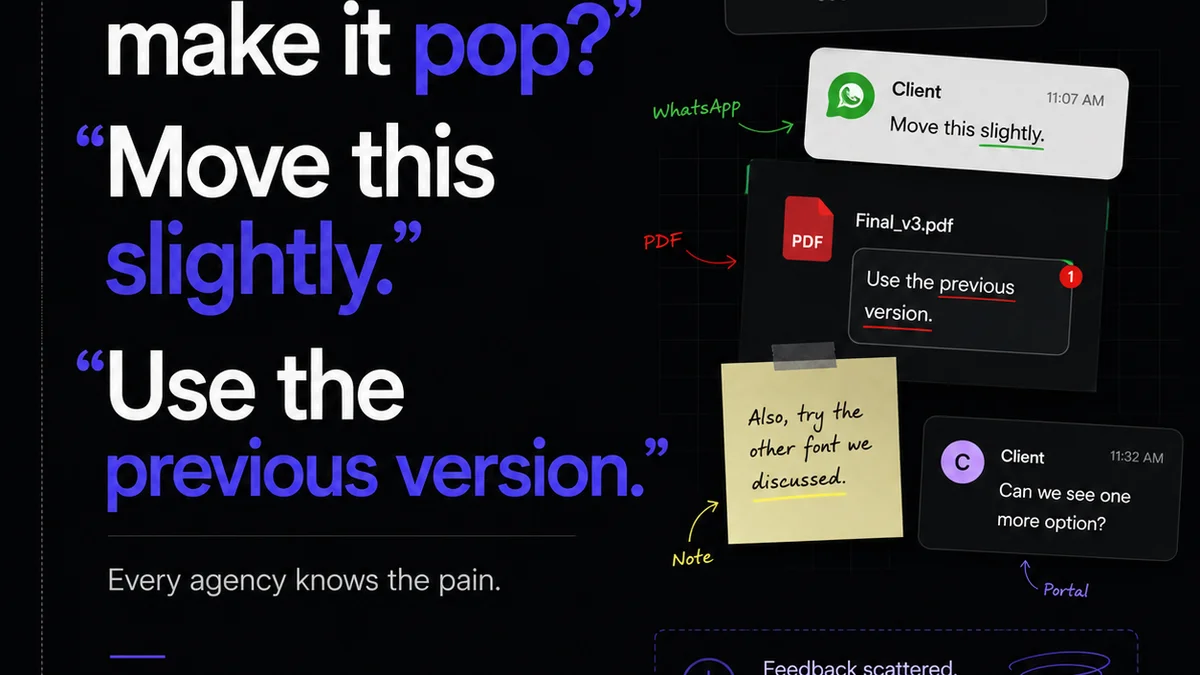
Scattered feedback is chaos. When client notes come in via email, Slack, Google Docs comments, and carrier pigeon, you’re setting yourself up for disaster.
This isn't just about organization; it’s about clarity. Ambiguous, buried, or conflicting feedback is a direct path to missed requirements and wasted revisions.
The Email Black Hole
Email threads are terrible for tracking feedback. They get long, lose context, and it’s easy to miss crucial instructions buried in a hundred replies.
“Did they say blue or teal?”
“Was that comment for V2 or V3?”
This uncertainty kills quality.
The Slack Wild West
Instant messaging is great for quick chats, but it’s a terrible place for formal feedback or tracking decisions. Important feedback gets lost in the noise, and there’s no clear record.
A quick Slack message might be forgotten by the next day.
Establish a Single Source of Truth
You need one place where all client feedback lives. One system that captures every comment, every revision request, and every approval. This ensures nothing gets lost and everyone is working from the same set of instructions.
This single source eliminates the guesswork and reduces misinterpretations.
3. Implement Structured Revision and Approval Workflows
Revision rounds shouldn't be an endless game of whack-a-mole. Approvals shouldn't be a bottleneck that paralyzes your team.
If your process for handling changes and getting sign-offs is ad-hoc, you’re guaranteeing quality issues and delays.
The “Just Make It Pop” Problem
Vague feedback like “make it better” or “I don’t like it” is impossible to act on effectively. It leads to endless, unfocused revisions that drain time and morale.
This is not constructive criticism; it’s a sign of a broken feedback loop.
Clear Stages, Clear Responsibilities
Define the stages of revision. What’s a minor tweak? What requires a full redesign? What needs client sign-off before proceeding?
Make it clear who is responsible for providing feedback, who is responsible for implementing it, and who has the final say.
Time-Bound Expectations
Set clear expectations for feedback turnaround times and approval times. If clients know they have 48 hours to respond, and your team has 24 hours to implement approved changes, you create a predictable rhythm.
Unpredictable timelines breed rushed work and errors.
4. Automate Quality Assurance Checks
Manual QA is prone to human error and fatigue. Even the most diligent QA specialist can miss things after hours of staring at the same screen.
This is where technology can significantly boost your quality without adding staff.
Checklists Are Not Enough
While checklists are a good start, they’re often treated as a formality rather than a rigorous process. They can be easily skipped or followed without true diligence.
A checkbox doesn't guarantee accuracy.
Leverage Technology
What parts of your QA can be automated? For web development, this could be automated testing for broken links, browser compatibility, or responsiveness.
For design, automated checks for brand consistency, color palettes, or font usage can flag deviations instantly.
Even for copy, automated grammar and style checkers are essential.
These tools catch the obvious errors, freeing up your team to focus on the nuanced aspects of quality that only humans can assess.
5. Foster a Culture of Quality Ownership
Ultimately, quality isn't just the responsibility of a QA department or a project manager. It needs to be ingrained in every team member.
When quality is seen as everyone's job, it gets done.
Empower Your Team
Give your team the tools and the permission to flag issues, even if they’re not directly responsible for that part of the process. Encourage a proactive approach to identifying potential problems.
A culture where it's safe to speak up about quality concerns is invaluable.
Continuous Improvement Mindset
Regularly review your processes and outcomes. What worked well? What didn’t? How can you prevent similar issues from recurring?
This isn’t a one-time fix; it’s an ongoing commitment.
Define
Frequently asked questions
How can I identify bottlenecks in my agency's quality management process?
Map your entire project workflow from brief to delivery. Identify stages where work piles up or delays occur, such as lengthy feedback loops, multiple internal review rounds, or late-stage QA checks. Talking to your team about their pain points is also crucial.
What's the best way to manage client feedback to ensure quality?
Centralize all feedback into a single, definitive source. Avoid using fragmented channels like email or Slack for formal feedback. A dedicated platform ensures clarity, context, and that no instructions are lost, reducing errors and misunderstandings.
Can automation truly improve quality without more staff?
Yes. Automated QA checks for common errors like broken links, browser compatibility, or brand consistency can catch mistakes instantly. This frees up your human team to focus on more nuanced quality aspects that require human judgment.
How do I create a culture where quality is everyone's responsibility?
Empower your team to flag issues proactively, regardless of their role. Foster an environment where it's safe to speak up about quality concerns. Encourage a continuous improvement mindset, where processes are regularly reviewed and refined.