Everyone talks about agency ROI in terms of billable hours. More hours logged, more revenue. Simple, right?
None of that is wrong. But it’s incomplete.
Focusing solely on billable hours misses the bigger picture: operational efficiency. The real ROI driver isn't just *how much* you bill, but *how effectively* you manage the work that gets billed.
This is the hard truth: Your agency's profitability hinges on its operational backbone, not just its sales pipeline. Poor project management, inefficient workflows, and hidden bottlenecks bleed money faster than any lack of billable hours.
1. The Myth of the Billable Hour as the Sole ROI Metric
It’s the agency owner’s mantra: Keep the team busy. Log more hours. But what if those hours are spent inefficiently? What if revisions spiral out of control, or communication breaks down, leading to wasted time and duplicated effort?
That’s not profitable. That's just busywork.
True ROI comes from delivering high-quality work within scope, on time, and with minimal internal friction. It’s about maximizing the value generated from every hour worked, not just the number of hours logged.
The Hidden Costs of Inefficiency
- Scope creep disguised as “client collaboration.”
- Endless, unproductive revision cycles.
- Team members waiting on feedback or approvals.
- Rework due to miscommunication or missed details.
- Poor resource allocation leading to burnout or idle time.
These aren't minor annoyances; they are direct drains on your profit margin.
2. Mastering Project Scope and Client Expectations
Too many agencies let scope creep erode their profits. It starts small: a minor tweak here, an extra asset there. Before you know it, you’re delivering work far beyond what was agreed upon, for free.
This isn't good client service; it's poor business management.
Effective scope management starts with crystal-clear proposals and contracts. Define deliverables precisely. Outline the revision process upfront.
Setting the Stage for Success
- Detailed SOWs: Be explicit about what's included and, crucially, what's not.
- Phased Approvals: Break down projects into stages with defined sign-offs. This catches issues early.
- Change Order Process: Formalize how out-of-scope requests are handled, including pricing and timelines.
- Client Education: Help clients understand the impact of their requests on timelines and budgets.
When clients understand the process and the implications of their changes, they are more likely to respect the agreed-upon scope.
3. Streamlining the Creative Workflow
The creative process is inherently iterative, but it doesn't have to be chaotic. A well-defined workflow minimizes friction and ensures everyone knows their role and the next step.
Think of it like an assembly line for creativity, but with room for inspiration.
Key Workflow Components
- Onboarding: A structured client and project kickoff process.
- Briefing: Ensuring all necessary information is gathered and understood before work begins.
- Internal Reviews: Establishing clear checkpoints for feedback and quality assurance *before* client submission.
- Client Feedback: Centralizing all client comments to avoid confusion and ensure comprehensive review.
- Revisions: Managing the iteration process efficiently, tracking changes and approvals.
- Final Approval: A clear gate for project sign-off.
- Handover: Smooth delivery of final assets.
Each stage needs clear ownership and defined outputs. Bottlenecks here kill productivity and, therefore, profitability.
4. The Power of Centralized Feedback and Approvals
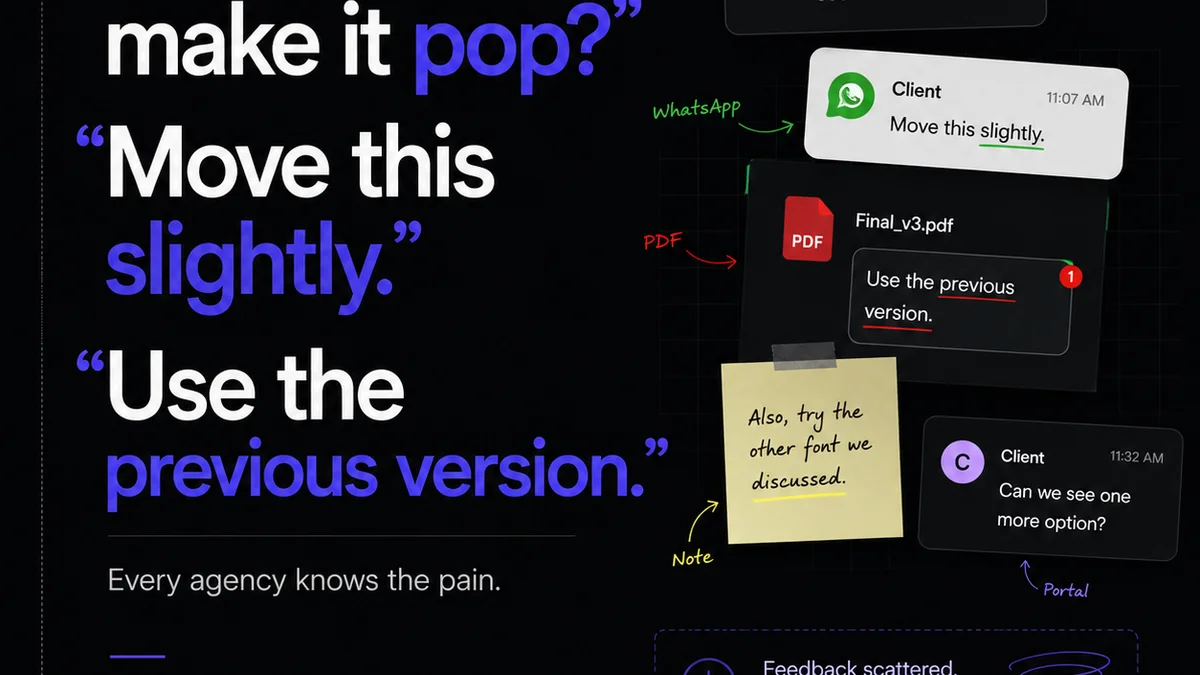
Email chains. Slack messages. Scrawled notes on PDFs. This is how agencies invite chaos and misinterpretation.
Client feedback should be a clear, actionable directive, not a guessing game.
When feedback is scattered across multiple platforms and formats, it's easy for crucial details to get lost. This leads to missed revisions, duplicated work, and frustrated clients.
Why Centralization Matters
- Single Source of Truth: All feedback and revisions live in one place.
- Clarity: Comments are tied directly to the creative asset, eliminating ambiguity.
- Accountability: Easily track who provided what feedback and when it was actioned.
- Efficiency: Reduces time spent searching for comments or clarifying requests.
- Audit Trail: Provides a clear history for reference and dispute resolution.
This isn't about being rigid; it's about being organized and ensuring accuracy.
5. Where Revue Fits In
Managing feedback, revisions, and approvals is a constant challenge. You need a system that keeps the creative process moving forward without sacrificing clarity or accuracy.
Revue provides that system.
It centralizes all client feedback directly on your creative assets. No more digging through endless email threads or Slack channels. Every comment, every revision, is logged and actionable, right where it belongs.
This visibility ensures that your team is always working from the latest version with the clearest instructions. It streamlines the back-and-forth, reduces misinterpretations, and cuts down on wasted time spent chasing down information.
With clear revision tracking and approval workflows, you gain control over the project lifecycle, ensuring that scope is respected and that you're billing accurately for the work delivered.
6. Measuring What Actually Matters
Beyond billable hours, what metrics truly indicate your agency's health and ROI?
Focus on indicators of operational excellence.
Key Performance Indicators (KPIs) for Operational ROI
- Project Profitability: The actual profit margin on completed projects, accounting for all hours and expenses.
- On-Time Delivery Rate: Percentage of projects completed by the deadline.
- Revision Cycle Time: Average time taken for feedback and revisions per project.
- Client Satisfaction Scores: Direct feedback on the project experience.
- Resource Utilization: How effectively your team’s time is being used on billable vs. non-billable tasks.
- Scope Creep Percentage: Tracking the amount of work delivered outside the original scope.
These metrics tell a far more compelling story about your agency’s efficiency and profitability than raw billable hours alone.
7. Final Thought
Are you running a creative agency, or a time-tracking exercise?
The most profitable agencies aren't necessarily the ones that bill the most hours. They are the ones that manage their operations with precision, deliver exceptional value within scope, and eliminate internal friction.
It’s time to look beyond the billable hour and focus on the operational backbone that truly drives your agency’s ROI.
Frequently asked questions
What is the primary driver of ROI for a creative agency?
While billable hours contribute to revenue, the primary driver of true ROI for a creative agency is operational efficiency. This includes effective project scope management, streamlined workflows, efficient feedback and revision processes, and accurate resource allocation, all of which minimize wasted time and maximize profitability.
How can agencies combat scope creep and protect their ROI?
Agencies can combat scope creep by establishing detailed Statements of Work (SOWs) that clearly define deliverables and exclusions, implementing a formal change order process for out-of-scope requests, and educating clients on the impact of their requests on timelines and budgets. Centralized feedback systems also help ensure all requests are captured and evaluated against the original scope.
Why is centralized feedback crucial for agency profitability?
Centralized feedback creates a single source of truth for all client comments and revision requests, directly on the creative asset. This eliminates confusion, reduces the risk of missed instructions or duplicated work, and provides a clear audit trail. By minimizing miscommunication and rework, it directly contributes to improved project profitability and client satisfaction.
What are some key metrics to track for operational ROI beyond billable hours?
Beyond billable hours, agencies should track Project Profitability, On-Time Delivery Rate, Revision Cycle Time, Client Satisfaction Scores, Resource Utilization, and Scope Creep Percentage. These metrics provide a clearer picture of operational efficiency and overall business health.