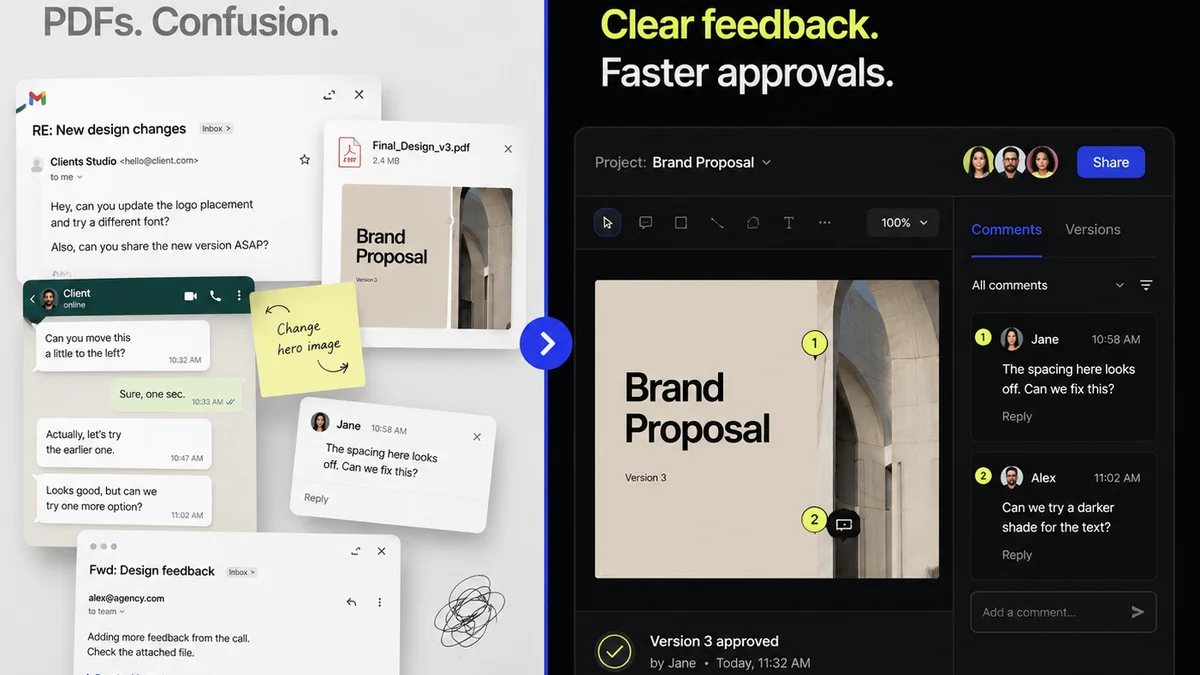
Everyone talks about boosting designer productivity. Usually, that means giving them faster computers or fancier software. That’s not wrong. But it’s incomplete.
The hard truth for enterprise creative teams is that productivity isn’t just about tools. It’s about workflow. It’s about clarity. It’s about removing the friction that grinds innovation to a halt.
Enterprise environments are complex. They have more stakeholders, more layers of approval, and more legacy systems than smaller shops. These factors create unique bottlenecks that impact designer output. Ignoring them is a direct hit to your bottom line.
1. The Illusion of 'More Tools'
The assumption: More software equals more efficiency. For enterprise teams, this often leads to a sprawling, disconnected tech stack. Each tool might be best-in-class for its specific function, but their integration is often an afterthought.
Think about it:
- Designers switching between 5+ tools for a single project.
- Assets scattered across cloud storage, local drives, and email threads.
- Version control nightmares that lead to wasted hours recreating work.
- Onboarding new designers into a complex toolchain that takes weeks, not days.
This isn't efficiency. It's chaos disguised as progress. The real productivity gain comes from streamlining, not just accumulating.
The Cost of Context Switching
Every time a designer has to stop designing to search for a file, log into another system, or decipher conflicting feedback, their focus is broken. This context switching is a silent killer of deep work.
Studies, like those from Nielsen Norman Group, show how costly interruptions are for knowledge workers. For creatives, who rely on sustained flow, it’s even more damaging.
2. Clarifying the Feedback Loop
Feedback is essential. But in large organizations, it’s often a bottleneck. Unclear, conflicting, or delayed feedback forces designers into a guessing game.
What does 'make it pop' actually mean when it comes from three different VPs?
Who owns the final decision when legal, marketing, and product all chime in?
The Dangers of Ambiguity
Ambiguous feedback leads to:
- Endless revision cycles that drain designer energy and project timelines.
- Work that misses the mark, requiring significant rework.
- Frustration and disengagement among the creative team.
Frequently asked questions
How can enterprise teams improve designer productivity?
Enterprise teams can improve designer productivity by focusing on workflow optimization, clear feedback processes, streamlined approvals, and integrated tools, rather than solely relying on faster hardware or software.
What are common productivity bottlenecks for enterprise designers?
Common bottlenecks include excessive tool switching, scattered assets, version control issues, ambiguous or conflicting feedback, lengthy approval chains, and lack of clear project briefs.
How does feedback impact designer productivity?
Ambiguous, conflicting, or delayed feedback leads to endless revision cycles, wasted effort, frustration, and a significant drain on designer time and energy, directly hindering productivity.
Can centralized feedback tools really help?
Yes, centralized feedback tools can significantly help by consolidating comments, providing clear version history, and streamlining the review process, reducing confusion and speeding up revisions.