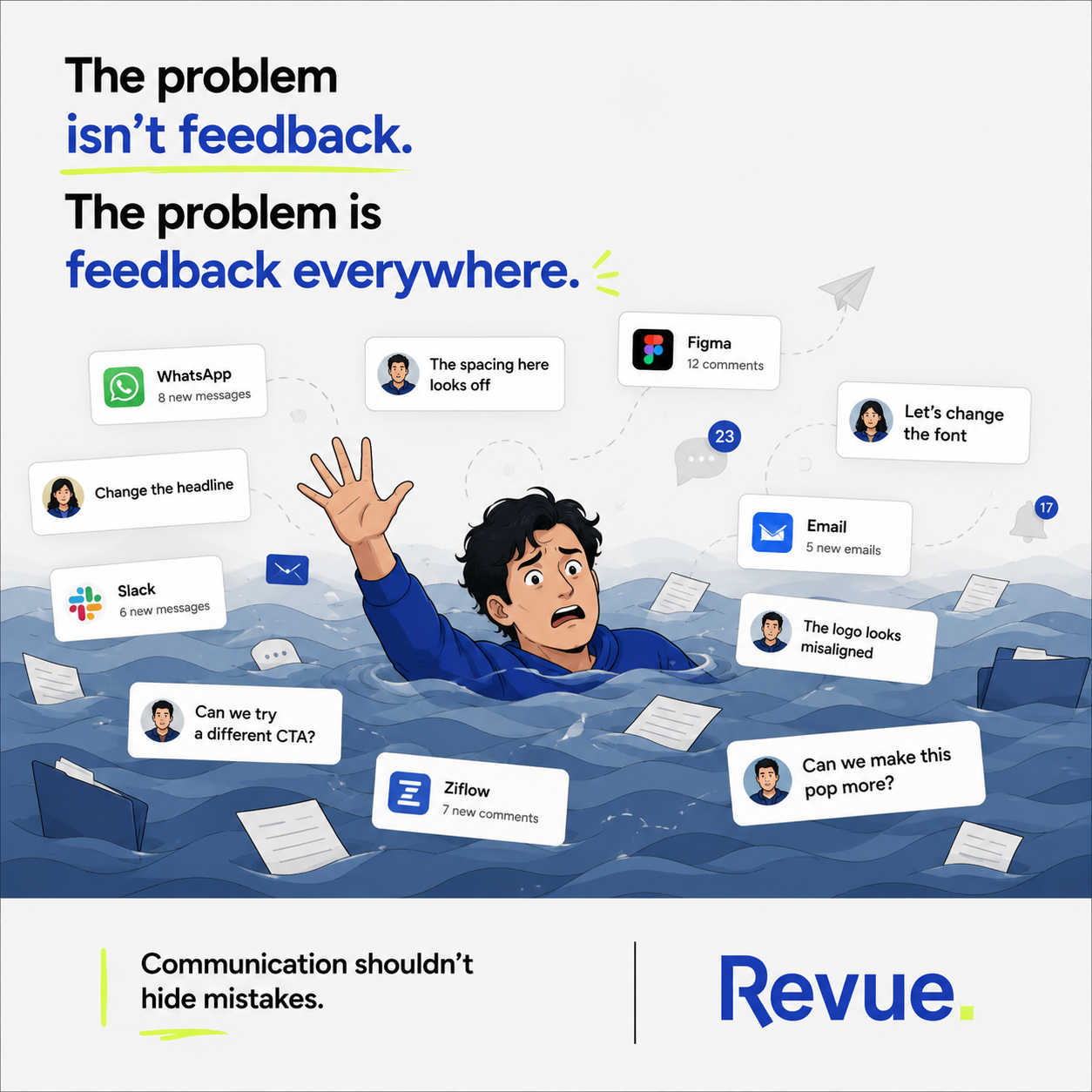
When creative teams start falling behind, the first explanation is usually simple: there’s too much work.
The team is overloaded.
Clients are demanding.
Deadlines are tight.
The creative pipeline is full.
People need to move faster.
Sometimes that’s true.
But a lot of the time, creative teams are not slow because the workload is impossible. They’re slow because the workflow is full of invisible friction.
That friction doesn’t usually show up as one dramatic failure. It shows up as small interruptions, repeated clarifications, unnecessary revisions, approval delays, context switching, file confusion, and manual cleanup work that keeps stealing time from actual creative output.
A designer loses 20 minutes figuring out which version is current.
An account manager spends half an hour translating feedback from three channels into one coherent task list.
A creative lead rechecks a deck because no one trusts the final review process.
A campaign gets delayed because one stakeholder gave feedback too late.
A team reopens already-approved work because a “small change” arrived after handoff.
None of these moments feel catastrophic on their own.
That’s what makes them dangerous.
Because when this kind of friction is built into the daily workflow, it becomes part of the team’s operating environment. People stop noticing how much time, focus, and momentum it’s consuming. They just feel that work takes longer than it should, projects feel heavier than they should, and the team is somehow always busy without moving as cleanly as expected.
That is the real cost of invisible friction.
Creative teams do not slow down only because there is too much to do. They slow down because too much of their energy is being burned on work around the work.
If you want to understand why a talented team still feels slower than it should, you need to look beyond workload and start examining the friction built into the system itself.
Creative Teams Don’t Just Need Capacity. They Need Clean Movement.
This is the shift most leaders miss.
When a team feels slow, the instinct is to think in terms of output capacity:
Do we need more designers?
Do we need another project manager?
Should we reduce the number of active projects?
Are deadlines too aggressive?
Those are valid questions. But they don’t go far enough.
Because a team’s speed is not determined only by how many hours it has. It’s also determined by how cleanly work moves through the system.
That means asking:
How much time is lost to clarification?
How much effort goes into chasing approvals?
How often does work get reopened after it should have been closed?
How often do people need to stop what they’re doing to reconstruct context?
How much mental energy is being spent on coordination instead of creation?
If the answers are ugly, then the team doesn’t just have a workload problem. It has a friction problem.
And friction is expensive because it compounds.
What Invisible Friction Actually Looks Like
Invisible friction is the set of operational obstacles that don’t look serious enough to be flagged individually but repeatedly slow down execution across the team.
It usually sounds like:
“Can someone send the latest version?”
“Wait, which comments are final?”
“I thought this was already approved.”
“Can we jump on a quick call to clarify feedback?”
“The client added two more changes after sign-off.”
“I didn’t realize that copy changed in the resized version.”
“Can you re-export this with the latest updates?”
“Let’s hold this until leadership reviews it again.”
These are not just annoying moments. They are signs that work is not flowing cleanly.
And when they repeat across multiple projects, they create a hidden tax on the team’s speed.
The Biggest Sources of Invisible Friction in Creative Teams
Let’s break down the most common ones.
1. Scattered Feedback Across Too Many Channels
This is one of the biggest and most persistent sources of drag in creative work.
Feedback comes through:
Slack
email
WhatsApp
calls
PDFs
screenshots
voice notes
side conversations after meetings
Now someone has to consolidate all of it.
That work is rarely treated as a real cost, but it is. Designers, project managers, account leads, and creative directors spend time gathering comments, figuring out which feedback is current, reconciling contradictions, and translating vague requests into actionable changes.
That means the team isn’t just doing creative work. It’s also doing feedback reconstruction work.
And that slows everything down.
This is exactly why agencies and internal creative teams start looking for:
creative feedback management software
design review tools
proofing software for creative teams
client feedback tools for agencies
creative workflow software
Not because they need another platform for the sake of it, but because scattered feedback creates repeated operational friction.
2. Weak Approval Systems That Keep Work in Limbo
A lot of teams think work is “approved” when someone said yes on a call or dropped a thumbs-up in chat.
That is not an approval system. That is informal optimism.
Real approval systems answer:
Who has final sign-off authority?
At what stage is feedback still welcome?
What counts as approval?
What happens if changes are requested after sign-off?
When can the team safely move on without expecting the work to reopen?
If those questions are fuzzy, projects get stuck in limbo.
The work looks finished, but no one fully trusts that it’s finished.
The team wants to move on, but keeps holding mental space for the possibility of more changes.
A file gets sent, but another stakeholder jumps in later.
A campaign is approved, but someone higher up wants “one more look.”
This slows the team down because closure never feels real.
And when closure is weak, the workflow stays soft and unstable.
3. Version Confusion That Creates Duplicate Work
Few things drain momentum faster than not knowing which file is actually current.
The wrong version gets reviewed.
An outdated deck gets exported.
A designer edits the previous file because the latest update wasn’t clear.
A client comments on an older creative.
A stakeholder compares the wrong versions and creates confusion about what changed.
Now the team has to stop and untangle it.
That means:
checking file histories
comparing versions manually
reapplying changes
clarifying what’s approved
resending updated work
None of that improves the idea. It just repairs the workflow.
Version confusion is especially dangerous because it looks like admin overhead, but it behaves like a major productivity leak.
4. Last-Minute Changes That Reopen Closed Work
Creative teams don’t just lose time on the change itself. They lose time on everything the change reactivates.
A file that was ready to go now needs another edit.
A version that was approved now needs another export.
A campaign adaptation that was already complete now needs to be updated everywhere.
A creative lead has to recheck the revised output.
An account manager has to reshare the file and get sign-off again.
This is why last-minute changes are so destructive: they don’t just add work. They reverse closure.
And every time closure gets reversed, the team loses momentum.
5. Manual Quality Checks Before Delivery
A lot of teams still rely on a few responsible people to catch mistakes at the end:
typos
spacing issues
missing updates
wrong copy
inconsistent typography
brand mistakes
incorrect exports
The issue isn’t that quality checks exist. The issue is that they’re often handled manually, inconsistently, and late in the workflow.
So senior people become human error filters.
That creates friction in two ways:
delivery slows down because work waits for manual review
senior people spend time on repetitive checking instead of higher-value work
It also creates risk. Because under deadline pressure, manual QA is exactly where preventable errors slip through.
6. Unclear Briefs That Create Avoidable Rework
A weak brief doesn’t just make the first draft harder. It creates friction throughout the entire project.
When the brief is vague, incomplete, or strategically fuzzy:
the creative direction is less clear
feedback becomes more subjective
stakeholders interpret the goal differently
the first round misses the mark more often
revisions become more expensive because the team is correcting bad input, not just refining good work
This is one of the most frustrating forms of friction because it front-loads confusion and then makes the rest of the workflow pay for it.
The team may look slow. But often they’re not slow—they’re spending time repairing ambiguity that should have been resolved before the work started.
7. Too Much Context Switching Between Projects
Creative teams rarely work on one thing at a time.
They jump between:
a social campaign for Client A
a deck for Client B
revisions on yesterday’s ad creatives
a rush request from internal marketing
a founder review for another pitch deck
follow-ups on feedback from two other live projects
That’s normal to some extent.
The problem is when the workflow keeps forcing people to switch contexts more than necessary because work is poorly structured:
feedback arrives unpredictably
approvals come in bursts
late changes reopen old work
status isn’t visible, so people get interrupted for updates
tasks aren’t packaged clearly, so people have to mentally reload the project every time they return
Context switching is one of the most invisible forms of drag because it doesn’t show up in a project timeline. But it absolutely shows up in execution speed and cognitive fatigue.
8. Repeated Coordination Work That Nobody Prices or Tracks
This is the hidden labor layer in most creative teams.
Someone has to:
chase the missing approval
summarize the client’s call notes
explain the latest feedback to the designer
ask whether the updated copy has been applied everywhere
confirm whether the new export is the one being shared
check if the file is ready for review
remind the client that they still haven’t signed off
All of that is real work. It just doesn’t look like “creative output,” so it often gets ignored.
But when a team spends large parts of the day on this kind of coordination, it becomes one of the biggest reasons the work itself moves more slowly.
Why Invisible Friction Is So Dangerous
If a workflow problem is obvious, teams usually try to fix it.
Invisible friction is different because it hides inside normal operations.
People get used to it.
They stop questioning it.
They build habits around it.
They compensate with effort.
They assume the team just needs to work harder or hire more people.
That’s why invisible friction is so damaging.
It doesn’t just slow projects down. It distorts how leaders diagnose the problem.
Instead of seeing the system leak, they see only the symptom:
“the team is slow”
“we need more capacity”
“people need to be more careful”
“we need to push harder on deadlines”
Sometimes the team does need more capacity. But if friction is the real problem, adding more people into a messy system just creates more expensive chaos.
How Creative Teams Reduce Invisible Friction
You don’t remove friction by asking people to be more disciplined in the abstract. You remove it by designing the workflow more deliberately.
That means:
1. Centralize Feedback
One review environment. One visible feedback trail. Less reconstruction.
2. Define Approval Stages Clearly
Concept approval, content approval, design approval, final sign-off. Each stage needs clear owners and closure rules.
3. Improve Version Visibility
Everyone should know what’s current, what changed, and what is safe to send.
4. Build Quality Checks Into the Workflow
Don’t depend only on manual end-stage heroics to catch preventable errors.
5. Strengthen Briefing Upfront
A better brief reduces downstream confusion, revisions, and wasted effort.
6. Reduce Reopened Work
If projects keep getting pulled backward after approval, the team will always feel slower than it should.
7. Audit Coordination Time
Look at how much time is being spent on chasing, clarifying, summarizing, and rechecking. That is where hidden drag lives.
Where Revue Fits In
Revue is relevant here because a huge amount of invisible friction in creative teams lives in the review-and-approval layer.
That’s where:
feedback gets scattered
revisions get messy
version confusion creates rework
approvals stay ambiguous
quality checks happen too late
teams lose time in avoidable coordination
Revue helps reduce that friction by giving creative teams more structure around:
centralized annotations and feedback
clearer review workflows
visibility across revisions and approvals
quality checks for static creative work
a cleaner path from draft to sign-off
It doesn’t remove creative complexity. It removes a lot of the avoidable operational drag wrapped around it.
Final Thought: Your Team May Not Be Slow. Your Workflow May Be Heavy.
That’s the question leaders need to sit with.
If talented people keep feeling busy, overloaded, and slower than they should be, the answer is not always more effort, more pressure, or more headcount.
Sometimes the real issue is that the workflow is quietly taxing them in a hundred small ways every week.
And because those costs are distributed, they’re easy to ignore.
But the team feels them.
The deadlines feel them.
The margins feel them.
The quality feels them.
The culture eventually feels them too.
So if you want creative teams to move faster, don’t just ask how to increase output.
Ask what invisible friction you’ve normalized that is quietly slowing everything down.
That’s where the real speed gains are hiding.
Frequently asked questions
1. What is invisible friction in creative teams?
Invisible friction is the collection of small workflow problems—like scattered feedback, unclear approvals, version confusion, rework, and manual QA—that quietly slow down creative execution.
2. Why do creative teams feel busy but still move slowly?
Because a lot of their time gets consumed by work around the work: clarifying feedback, chasing approvals, fixing preventable errors, reopening files, and reconstructing project context.
3. How does scattered feedback slow creative teams down?
It forces designers, project managers, and creative leads to gather comments from multiple channels, reconcile contradictions, and translate vague feedback into actionable changes, which wastes time and breaks focus.
4. Why are weak approval systems a source of friction?
When approval rules are unclear, work stays in limbo. Teams don’t know what’s truly final, what can still change, or who has authority to sign off, which leads to delays and reopened work.
5. How do last-minute changes create invisible friction?
They reverse closure by reopening work that was already reviewed, approved, or handed off, which triggers extra revisions, exports, reviews, and coordination work.
6. What role does manual quality checking play in slowing teams down?
Manual QA often depends on senior people catching mistakes late in the process. That slows delivery, creates bottlenecks, and still leaves room for preventable errors under deadline pressure.
7. How can creative teams reduce invisible friction?
They can reduce it by centralizing feedback, clarifying approval stages, improving version control, strengthening briefs, building QA into the workflow, and auditing coordination time across projects.