Everyone’s talking about DesignOps. It’s the hot new thing in creative agencies and in-house teams. You’ve probably heard it’s about streamlining workflows, standardizing tools, and fostering collaboration. And none of that is wrong.
But it’s incomplete.
The hard truth is that without clear, measurable Key Performance Indicators (KPIs), your DesignOps initiative risks becoming an expensive, time-consuming exercise in busywork. You’ll be tweaking processes for the sake of tweaking, without ever knowing if you’re actually improving anything.
DesignOps isn't just about making things *look* more organized. It's about making your design team demonstrably more effective, more efficient, and more valuable to the business.
Here’s how to measure that.
1. Throughput and Velocity: How Much Are We Actually Producing?
This is the most obvious place to start, but it’s often misunderstood. Throughput isn't just about raw numbers; it’s about consistent, predictable output that meets quality standards.
Project Completion Rate
What percentage of projects initiated actually reach final approval and delivery within a given timeframe? This KPI cuts through the noise of tasks started and tasks finished. It’s about end-to-end success.
- Track projects by type (e.g., website redesign, social campaign, branding package).
- Measure against initial timelines.
- Identify bottlenecks causing projects to stall.
Cycle Time
How long does it take for a project, or a specific phase of a project, to move from start to finish? Reducing cycle time means faster delivery, quicker iteration, and happier clients.
This isn't about rushing; it's about removing friction.
Design Handoff Efficiency
How quickly and smoothly does design work get handed off to development or other teams? Measure the time spent clarifying requirements or fixing issues that arise *after* the design is considered 'done'.
A smooth handoff is a sign of well-defined processes and clear communication.
2. Quality and Client Satisfaction: Are We Doing Good Work?
Efficiency is useless if the quality of the work suffers. DesignOps should *elevate* quality, not compromise it. This is where client-facing metrics become critical.
Revision Rounds
How many rounds of revisions does a typical project require? A high number often signals misaligned expectations, unclear feedback, or a design process that isn't hitting the mark early on.
Fewer, more productive revision rounds are the goal.
Client Approval Time
Once presented, how long does it take for clients to provide feedback and sign off? Long delays can indicate issues with the clarity of the presentation, the feedback process itself, or client engagement.
This KPI directly impacts project timelines and cash flow.
Client Satisfaction Scores (CSAT) / Net Promoter Score (NPS)
While broader, these can be segmented. Ask clients specifically about their experience with the design process, communication, and the final deliverables. Are they delighted, or just satisfied?
This is the ultimate test of whether your operational improvements translate to client value.
3. Team Health and Engagement: Is Our Team Thriving?
A stressed, disengaged team will never produce its best work, no matter how optimized the tools. DesignOps must support the people doing the work.
Team Utilization Rate
Are designers consistently busy, or are there periods of burnout followed by downtime? This isn't about maximizing hours worked, but about a sustainable, balanced workload.
High utilization that leads to burnout is a failure, not a success.
Employee Retention/Turnover Rate
Are your best designers sticking around? High turnover is incredibly costly, both in recruitment and the loss of institutional knowledge. A well-run DesignOps system should make your agency a place designers *want* to stay.
This is a lagging indicator, but a powerful one.
Feedback Loop Effectiveness
How often do team members provide feedback on processes, and how often is that feedback acted upon? A healthy DesignOps culture encourages continuous improvement from the ground up.
Measure the *action* taken on team feedback, not just the feedback itself.
4. Financial Impact: Is DesignOps Driving Profitability?
Ultimately, operational improvements need to impact the bottom line. DesignOps isn't a cost center; it's an investment in profitability.
Project Profitability
Are projects that go through the DesignOps framework more profitable than those that don't? Track billable hours against project revenue, factoring in the efficiency gains (or losses).
This ties all other KPIs back to business value.
Reduction in Rework Costs
Quantify the cost savings from reducing unnecessary revisions, fixing errors earlier, and avoiding scope creep due to unclear processes.
This is often a hidden cost that DesignOps can bring to light and reduce.
Resource Allocation Accuracy
How accurately can you forecast the resources (time, people, budget) needed for a project? Better predictability means better client pricing and better profitability.
Accurate forecasting is a hallmark of mature operations.
Where Revue Fits In
Implementing DesignOps is a journey, and the right tools are crucial. You need systems that support, rather than hinder, your efforts to track these KPIs.
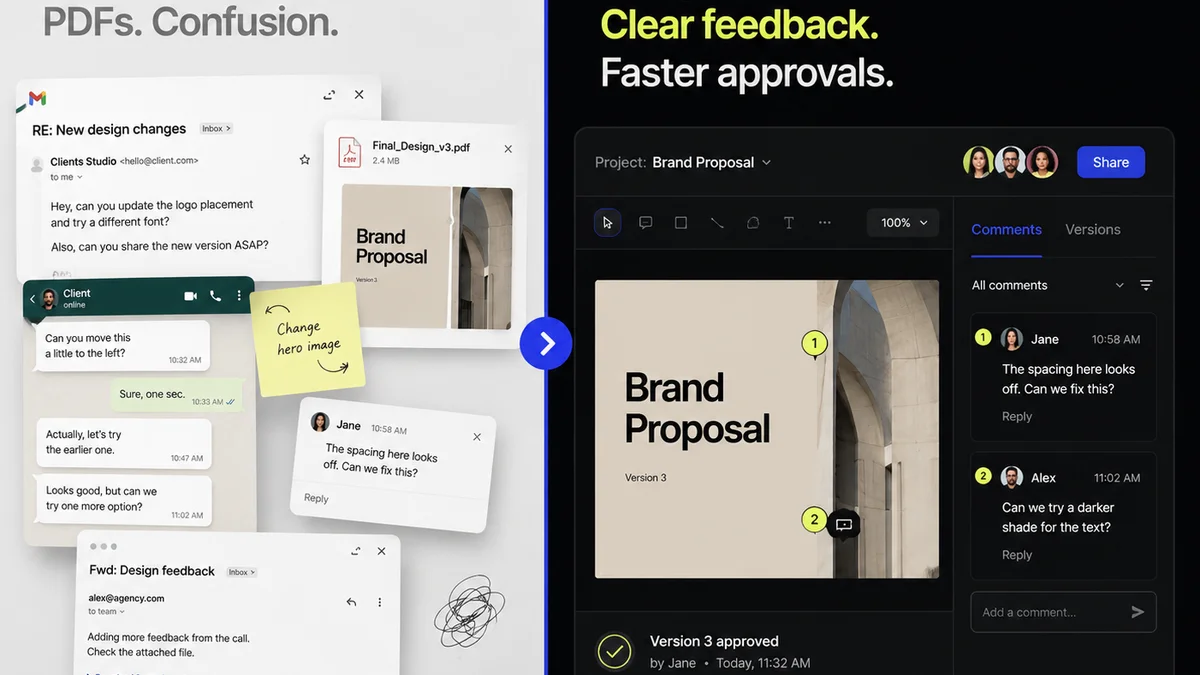
Centralizing client feedback in a tool like Revue is fundamental. When feedback is scattered across emails, Slack channels, and random documents, you lose visibility. You can't track revision rounds accurately, you can't measure approval times effectively, and you certainly can't quantify the cost of chasing down feedback.
Revue provides a single source of truth for feedback and approvals. This clarity directly impacts your ability to measure:
- Revision Cycles: See every comment, every change, every approval in one place. No more guessing how many rounds it took.
- Approval Timelines: Track exactly when feedback was requested and when it was given, revealing bottlenecks.
- Quality Checks: Ensure all stakeholders have seen and signed off on the final work, reducing post-launch issues.
- Project Velocity: By reducing friction in feedback and approvals, you directly speed up the project lifecycle.
When your team isn’t bogged down by administrative overhead or the chaos of disorganized feedback, they can focus on what they do best: creating great work. And that focus is what ultimately drives better KPIs.
Final Thought
DesignOps isn't a destination; it's a continuous process of refinement. The real goal isn't just to implement a system, but to cultivate a culture of measurable improvement.
Are you measuring the right things? And more importantly, are those measurements actually driving meaningful change in your agency's performance?
Frequently asked questions
What is the main goal of DesignOps KPIs?
The main goal of DesignOps KPIs is to move beyond simply implementing processes and tools, and instead, to measure the tangible impact of DesignOps on your team's effectiveness, efficiency, and the agency's overall business performance and profitability.
How can I track project completion rate effectively?
Track projects from initiation to final approval and delivery within a specific period. Segment this by project type and compare against initial timelines to identify where projects are getting stalled or delayed.
Why is team health an important KPI for DesignOps?
A team that is burnt out or disengaged cannot produce high-quality work, regardless of operational efficiency. KPIs like retention rate and utilization rate (balanced against burnout) indicate whether DesignOps is fostering a sustainable and positive work environment.
How does client satisfaction relate to DesignOps KPIs?
Client satisfaction, measured through CSAT, NPS, or specific feedback on the design process, is a critical indicator. It shows whether operational improvements are translating into a better client experience and, ultimately, more value delivered.
Can DesignOps directly impact agency profitability?
Yes. By improving throughput, reducing rework, optimizing resource allocation, and shortening cycle times, DesignOps initiatives can lead to more predictable project delivery, better client retention, and increased project profitability. Measuring these financial impacts is key.