Everyone's talking about AI, remote work, and the metaverse. They'll tell you managing creative teams in 2030 means mastering holographic collaboration tools and prompting LLMs like a pro. That's all true, in a way.
But it’s incomplete.
The real challenge—and the real opportunity—for creative leaders in 2030 isn't about the technology itself. It's about the human element, amplified and complicated by that technology. It's about building resilience, fostering genuine connection, and maintaining quality when the boundaries of work continue to blur.
1. The Myth of the Fully Remote Creative Nirvana
The assumption: Fully remote creative teams are the ultimate in flexibility and talent access. Everyone gets to work from their dream location, and agencies can hire the best globally.
The hard truth: While remote work is here to stay, the fully remote model for creative teams has significant hidden costs. Spontaneity suffers. Onboarding becomes a challenge. The subtle, crucial osmosis of creative culture is lost.
In 2030, the dominant model won't be purely remote or purely in-office. It will be hybrid, but with a crucial distinction: intentionality.
The Hybrid Paradox
Hybrid models are inherently more complex to manage. They require deliberate effort to ensure equity between remote and in-office staff. The accidental hallway conversations that spark ideas need to be replicated deliberately.
- Information Silos: Risk of in-office teams having access to information or spontaneous decisions that remote team members miss.
- Perception Gaps: Remote workers can feel overlooked for opportunities or promotions compared to their in-office counterparts.
- Culture Dilution: Building and maintaining a strong, cohesive team culture becomes exponentially harder.
Success in 2030 means architecting a hybrid environment where presence is purposeful, not passive. It means treating remote work as a strategic advantage, not just a default setting.
2. The AI Co-Pilot: Augmentation, Not Automation
The assumption: AI will automate most creative tasks, leaving humans to oversee and approve.
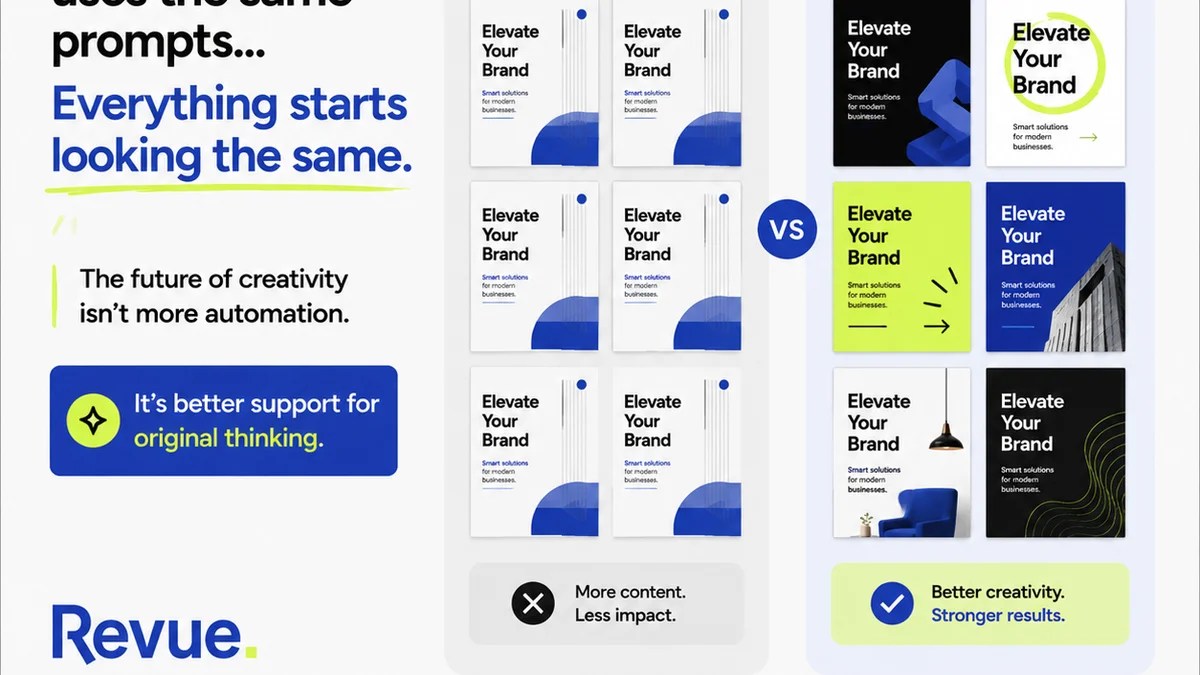
The hard truth: AI is a powerful co-pilot, an enhancer of human creativity, not a replacement. The truly valuable creative work in 2030 will be about leveraging AI to push boundaries, not just to speed up existing processes.
Think of AI as a tireless junior designer, a lightning-fast researcher, or an infinitely patient editor. It can generate variations, analyze data, and perform repetitive tasks at scale. But it lacks judgment, context, and that spark of human insight.
Skill Shifts for Creatives
The skills that will be most in-demand are those that AI cannot replicate:
- Strategic Thinking: Defining the 'why' behind creative work.
- Conceptualization: Developing original, groundbreaking ideas.
- Emotional Intelligence: Understanding audience sentiment and human connection.
- Critical Judgment: Evaluating AI outputs and making informed decisions.
- Prompt Engineering & Curation: Effectively guiding AI and selecting the best results.
Agencies in 2030 will thrive by integrating AI as a tool to augment their human talent, freeing them up for higher-level strategic and conceptual work. This requires new training and a reframing of roles.
3. The Feedback Loop: From Chaos to Clarity
The assumption: Clients will adapt to whatever feedback system you put in place.
The hard truth: Client feedback is, and always will be, a bottleneck. The complexity of managing feedback across multiple stakeholders, platforms, and project stages only intensifies with new technologies and distributed teams.
In 2030, efficient, transparent feedback management isn't a nice-to-have; it's a core operational necessity. The ability to capture, centralize, and act on feedback without losing context or introducing errors will differentiate leading agencies.
The Cost of Unmanaged Feedback
Poor feedback processes lead to tangible losses:
- Extended Timelines: Endless revision cycles eat into project schedules.
- Budget Overruns: Wasted hours translate directly to lost profit.
- Team Burnout: Frustration from unclear or conflicting direction drains morale.
- Client Dissatisfaction: Misunderstandings and delays erode trust.
The tools and processes you use to manage creative approvals and revisions become critical infrastructure. They need to be intuitive for clients and powerful for your team.
4. Talent Management: Nurturing the Whole Creative
The assumption: Managing creatives is about assigning tasks and hitting deadlines.
The hard truth: The most successful creative leaders in 2030 will be exceptional talent cultivators. They understand that creativity thrives on psychological safety, continuous learning, and a sense of purpose.
The lines between work and life will continue to blur. Employees will expect greater flexibility, more personalized development, and a stronger connection to the company's mission. The
Frequently asked questions
How will AI impact creative roles by 2030?
AI will act as a powerful co-pilot, augmenting human creativity rather than replacing it. Roles will shift towards strategic thinking, conceptualization, and critical judgment, leveraging AI for generation and analysis. Proficiency in prompt engineering and curation will become essential.
What is the biggest misconception about remote creative teams in the future?
The biggest misconception is that a fully remote setup is inherently optimal. While offering flexibility, it poses challenges for spontaneity, onboarding, and culture building. The future points towards intentional hybrid models that balance remote flexibility with in-person collaboration.
How can agencies ensure equity in hybrid work environments?
Equity in hybrid environments requires deliberate effort. This includes standardizing communication channels, ensuring remote team members have equal access to information and opportunities, and actively replicating spontaneous collaboration through structured virtual or in-person sessions.
Why is feedback management so critical for creative teams in 2030?
As projects and teams become more distributed, managing feedback effectively becomes crucial for efficiency. Unclear or unmanaged feedback leads to extended timelines, budget overruns, team burnout, and client dissatisfaction. Streamlined, transparent feedback processes are operational necessities.