The Assumption: Revisions are Just Part of the Job
Everyone knows design revisions are inevitable. Clients will always want changes. It’s the cost of doing business, right?
None of that is wrong. But it’s incomplete.
The hard truth is that many agencies treat revisions like an unavoidable headache, rather than a process to be engineered. This approach leads to scope creep, missed deadlines, frustrated teams, and ultimately, unhappy clients who pay less and refer less.
The real differentiator isn’t avoiding revisions – it’s mastering them. It’s about building a system so robust, so clear, that revisions become a predictable, manageable, and even profitable part of your workflow.
1. Define the Scope (Before the First Pixel is Touched)
This sounds obvious, but it’s where most agencies stumble. The assumption is that a brief is enough. It’s not.
A brief is a starting point. A scope of work is the actual contract for what you’ll deliver. And it needs to be brutally specific about revisions.
The “Revision Allowance”
Your SOW must clearly state:
- The number of revision rounds included for each deliverable.
- What constitutes a “round.” (e.g., one round of feedback consolidation, not 10 individual emails).
- What’s out of scope. (e.g., significant strategic shifts, new creative directions not implied by the brief).
- The cost of additional revisions beyond the allowance.
This isn’t about nickel-and-diming clients. It’s about setting expectations and protecting your team’s time and sanity.
Client Responsibilities
Make it clear that timely, consolidated feedback is crucial. Unclear, piecemeal, or delayed feedback directly impacts timelines and budgets.
Internal Sign-offs
Define your internal review process. Who signs off before client delivery? This prevents internal disagreements from becoming client revision cycles.
2. Centralize Feedback (End the Email Chaos)
The biggest drain on revision management isn’t the changes themselves; it’s the *process* of getting and implementing them.
Scattered feedback via email chains, Slack messages, and random Word docs is a recipe for disaster. It’s impossible to track, easy to miss, and ripe for misinterpretation.
The Single Source of Truth
You need one place where all feedback lives, is organized, and is actionable. This isn’t just about convenience; it’s about accuracy.
Imagine a client says, “Make the logo bigger.” Okay, how much bigger? In what context? Was that the feedback from Tuesday or Thursday?
A centralized system allows:
- Visual annotations directly on the design.
- Clear, timestamped comments linked to specific elements.
- Status tracking for each piece of feedback (e.g., Open, In Progress, Resolved, Approved).
- Version control, so everyone is looking at the latest iteration.
This eliminates guesswork and ensures the *right* feedback is acted upon, the *first* time.
3. Streamline the Revision Workflow (From Feedback to Final)
Once feedback is centralized, the next step is making the actual revision process efficient.
This means having clear internal procedures and tools that support them.
The Handoff Process
How does feedback get from the client into the hands of the designer? Is it a passive download, or an active briefing?
A structured handoff ensures clarity:
- Design lead reviews consolidated client feedback.
- Briefs the relevant designer with context, not just a list of tasks.
- Estimates time and flags potential issues before work begins.
Prioritization is Key
Not all feedback is created equal. A good system helps you and the client prioritize:
- Must-haves: Critical changes required for functionality or core strategy.
- Should-haves: Important but not essential changes.
- Nice-to-haves: Minor aesthetic tweaks or optional additions.
This conversation, guided by your SOW, prevents scope creep disguised as “small tweaks.”
Design System Discipline
If you’re using a design system, revisions become exponentially easier. Changes adhere to established patterns, reducing the risk of introducing visual inconsistencies.
4. Master the Approval Process (Get the Green Light, For Real)
Revisions aren’t truly done until they’re approved. And the approval process itself is often a hidden bottleneck.
Clients might say “Looks good” but then come back later with more changes. This is often because the approval wasn’t a formal, definitive step.
Formal Sign-off Points
Build explicit approval stages into your project plan:
- Concept approval
- Mid-fidelity approval
- Final artwork approval
Each stage should require a clear, documented sign-off from the authorized client stakeholder.
The “Final” Final Approval
Even after final approval, things can slip through. Have a process for final QA before delivery.
This involves:
- A checklist for technical specifications (e.g., file formats, resolution, color profiles).
- A final visual sweep for any missed errors or inconsistencies.
- A clear statement that once this final QA is passed and files delivered, any further changes will be billable.
This protects against the dreaded “Oh, I just noticed…” email after the project is technically complete.
5. Measure and Optimize (Turn Data into Improvement)
You can’t improve what you don’t measure. The assumption is that tracking revisions is too much hassle. The reality is, the hassle of *not* tracking them is far greater.
Key Metrics to Track
Start simple:
- Number of revision rounds per project/client.
- Time spent on revisions vs. initial creation.
- Types of feedback causing the most churn (e.g., strategic, aesthetic, technical).
- Client satisfaction scores related to the revision process.
Use this data to identify patterns.
Identify Bottlenecks
Are revisions consistently getting stuck at a certain stage? Is a particular client consistently requiring excessive revisions?
This data informs process improvements, SOW adjustments, and even client selection.
Where Revue Fits In
Managing revisions effectively is an operational challenge. It requires systems, clarity, and discipline.
Revue is built to address these exact pain points.
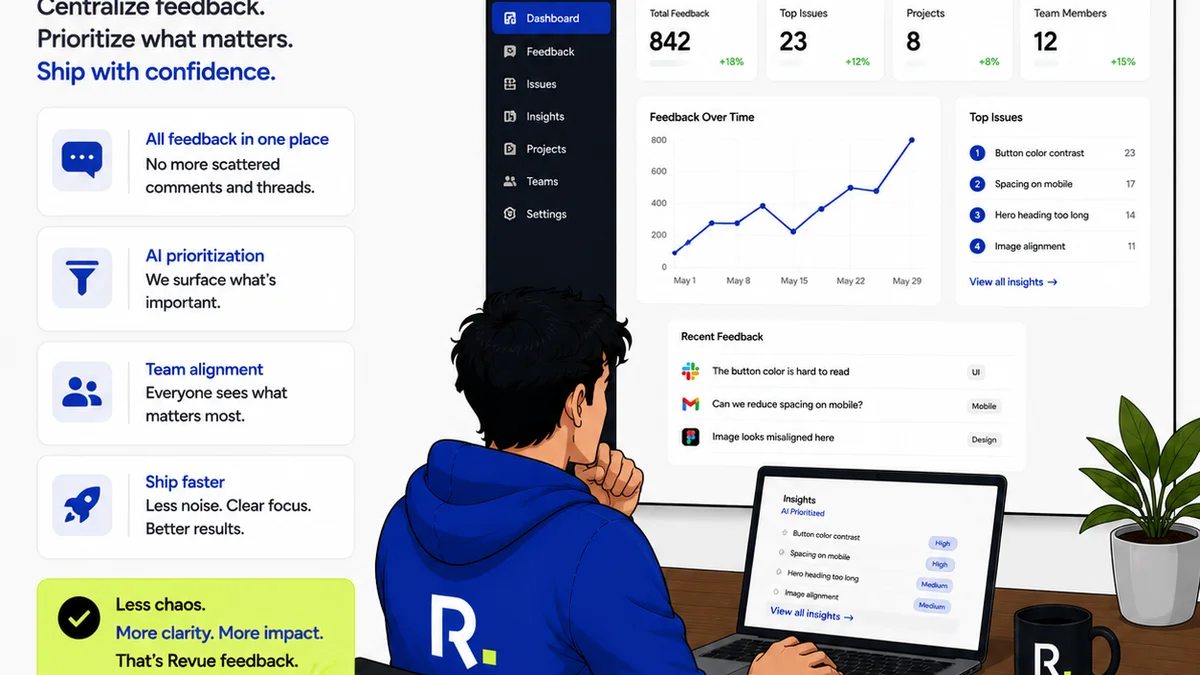
It provides a centralized platform for all client feedback, eliminating the chaos of scattered communication. Visual annotations and clear comment threads mean feedback is precise and actionable.
The revision and approval workflow is built-in. You can track the status of each feedback item, see version history at a glance, and manage the sign-off process with confidence.
This visibility ensures that your team is always working on the latest approved version, and that clients clearly understand what they are approving. It turns a messy, unpredictable process into a streamlined, auditable workflow.
Final Thought
Revisions aren't a sign of failure. They're an opportunity to refine, clarify, and ultimately deliver better work.
But that opportunity is lost when revisions become a black hole of miscommunication and scope creep.
Are you treating design revisions as an unavoidable cost, or as a critical process to engineer for efficiency and client satisfaction?
Frequently asked questions
How many revision rounds should be included in a project?
The number of revision rounds should be clearly defined in your Scope of Work (SOW). Typically, 1-3 rounds are standard for many projects, but this depends heavily on project complexity and client engagement. Crucially, define what constitutes a 'round' to avoid scope creep.
What's the best way to handle conflicting client feedback?
Establish a clear point of contact for final decisions on the client side. If feedback is conflicting, bring it to their attention, explain the implications of each direction, and ask them to consolidate their decision before you proceed. Your SOW should also outline how conflicting feedback is managed.
How can I prevent scope creep during revisions?
Clearly define what's in and out of scope for revisions in your SOW. Use a centralized feedback tool to track all requests and easily identify when new requests go beyond the agreed-upon scope. Have a process for quoting additional work when necessary.
What is the role of a design system in managing revisions?
A design system provides pre-approved components and guidelines. When revisions involve elements covered by the design system, changes are faster, more consistent, and less prone to errors. It significantly reduces the time and effort needed for many types of revisions.