Everyone's talking about AI, VR, and the metaverse reshaping creative workflows by 2030. They paint a picture of holographic design reviews and AI-generated concepts on demand.
None of that is wrong. But it’s incomplete.
The real challenge for managing enterprise creative teams in 2030 isn't adopting the next big tech. It's about mastering the operational fundamentals that have always driven creative success, amplified by new complexities. The hard truth is that the core of effective creative management remains human: clear communication, streamlined processes, and visible progress. Technology is an enabler, not a silver bullet.
1. The Illusion of Seamless Remote Collaboration
The pandemic accelerated remote work, and by 2030, hybrid and fully remote models will be the norm for many enterprise creative departments. The assumption is that with the right tools – Slack, Teams, Zoom, Miro – collaboration is inherently seamless.
This couldn't be further from the truth.
The reality is that distributed teams introduce friction. Asynchronous communication leads to delays. Lack of spontaneous hallway conversations means missed context. Managing creative output across different time zones and home environments requires deliberate structure.
The Hidden Costs of Distributed Work
- Increased time spent clarifying requests.
- Difficulty in gauging team morale and individual workload.
- Slower decision-making due to communication lags.
- Potential for siloed work and lack of cross-pollination of ideas.
- Challenges in maintaining a cohesive team culture.
Effective management means building systems that compensate for physical distance. This involves over-communicating, documenting everything, and creating predictable touchpoints for feedback and alignment. It's about intentionality, not just technology.
2. AI as a Co-Pilot, Not an Autopilot
By 2030, AI will be deeply integrated into creative toolkits. Think AI-assisted ideation, automated asset generation, and predictive analytics for campaign performance. The assumption might be that AI will largely automate creative tasks, freeing up teams for higher-level strategy.
It’s more nuanced than that.
AI will undoubtedly augment creative capabilities, but it won't replace the human element of creativity, critical thinking, and strategic oversight. The real management challenge will be integrating AI tools effectively and ethically, ensuring they enhance, rather than hinder, the creative process.
Navigating the AI Integration
Managing a creative team in 2030 means understanding where AI excels and where human judgment is indispensable. It requires:
- Defining clear roles for AI in the workflow (e.g., AI for initial drafts, humans for refinement and strategic direction).
- Establishing ethical guidelines for AI usage, particularly concerning originality and intellectual property.
- Training teams not just on *how* to use AI tools, but *when* and *why*.
- Developing processes for reviewing and validating AI-generated output.
- Fostering a mindset that views AI as a powerful collaborator, not a replacement.
The enterprise creative director of 2030 will need to be as adept at managing AI workflows as they are at managing human talent.
3. The Evolving Role of Feedback and Approval
Client feedback loops and internal approvals are perennial bottlenecks in creative agencies and enterprise teams. The assumption is that advanced project management software and digital proofing tools will solve this by 2030.
While tools improve, the fundamental human dynamics of feedback remain.
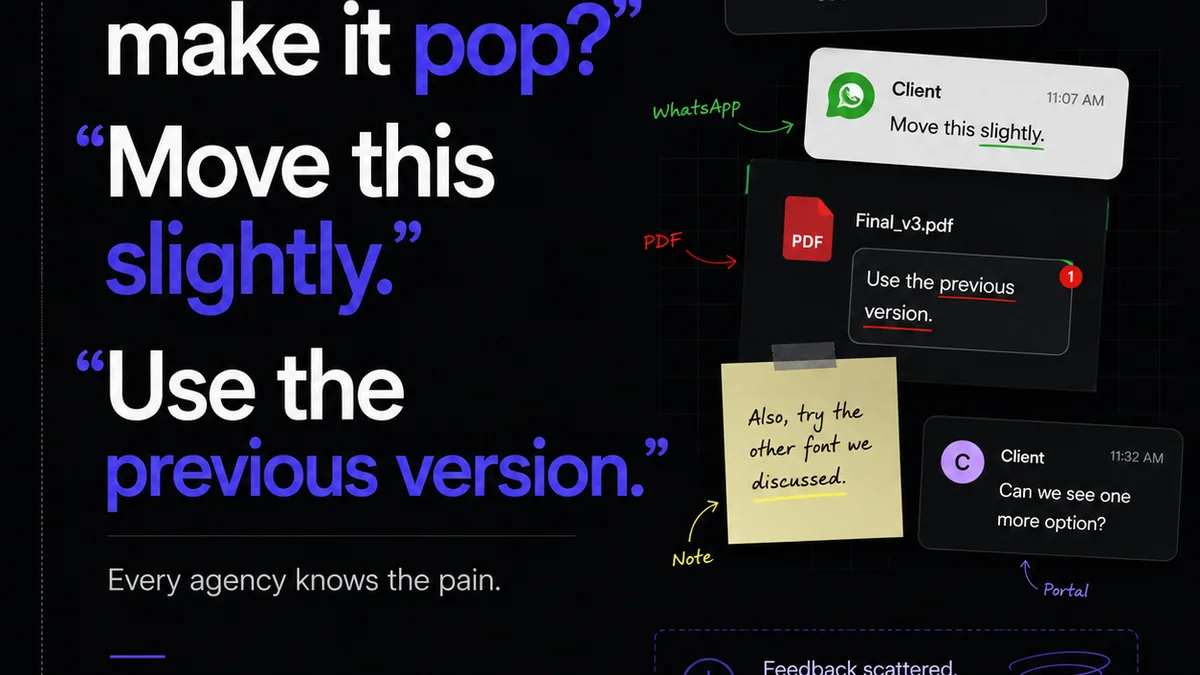
The problem isn't a lack of digital channels; it's the quality and clarity of the feedback itself, and the lack of a centralized system to track it. Unclear, subjective, or conflicting feedback, regardless of the platform, will continue to derail projects.
Taming the Feedback Beast
By 2030, managing creative feedback effectively will require a multi-pronged approach:
- Structured Feedback Frameworks: Implementing templates or guidelines for providing constructive, actionable feedback.
- Centralized Commenting: Ensuring all feedback resides in a single source of truth, preventing version control issues and lost comments.
- Clear Ownership: Designating specific individuals responsible for providing and consolidating feedback.
- Defined Revision Cycles: Setting clear expectations for the number and scope of revisions.
- Visual Annotation Tools: Leveraging tools that allow for precise, contextual feedback directly on creative assets.
The goal is to move beyond simply collecting comments to actively managing the *dialogue* around creative work, ensuring it leads to improvement, not just churn.
4. Quality Assurance in a Hyper-Accelerated World
As creative cycles shorten and output demands increase, maintaining quality becomes paramount. The assumption is that automated QA tools will catch most errors.
Automated checks are essential, but they can't replace human oversight for strategic and brand alignment.
By 2030, enterprise creative teams will face immense pressure to deliver high volumes of content across numerous platforms. This velocity can easily lead to errors in branding, messaging, or even basic usability if not managed rigorously.
Building a Culture of Quality
Effective QA in 2030 involves:
- Multi-Layered Checks: Combining automated testing (e.g., for code, accessibility standards like WCAG) with human review.
- Brand Consistency Audits: Regular checks to ensure all output adheres to brand guidelines.
- User Experience (UX) Reviews: Evaluating how creative assets perform from an end-user perspective.
- Cross-Functional Collaboration: Involving marketing, legal, and product teams early in the QA process.
- Post-Launch Monitoring: Tracking performance and user feedback to identify and address issues proactively.
QA is not an endpoint; it's an integrated part of the entire creative lifecycle.
Where Revue Fits In
Managing enterprise creative teams in 2030 is fundamentally about bringing order to complexity. It requires robust systems for communication, feedback, and quality control, especially in distributed environments.
This is where tools like Revue become critical.
Revue provides a centralized hub for managing creative projects. It consolidates client feedback, making it visible and actionable, eliminating the chaos of scattered email chains and chat messages. The platform streamlines revision and approval workflows, ensuring everyone is aligned and progress is tracked transparently. Crucially, it enables rigorous quality checks by keeping all project assets and feedback in one place, reducing the risk of errors and ensuring brand consistency.
By centralizing these core functions, Revue helps enterprise teams navigate the complexities of modern creative production, allowing them to focus on strategic execution rather than operational friction.
Final Thought
The year 2030 will undoubtedly bring technological advancements that sound like science fiction today. But will managing creative teams be radically different at its core?
Or will the greatest leap forward be in our ability to master the timeless principles of clear communication, efficient process, and human-centered collaboration, amplified by smarter tools?
The operational discipline you build today will define your team's success tomorrow.
Frequently asked questions
What is the biggest misconception about managing creative teams in 2030?
The biggest misconception is that advanced technology like AI and VR will solve all management challenges. The reality is that mastering fundamental operational principles like clear communication, structured feedback, and robust QA processes remains paramount, even with new tech.
How will AI impact enterprise creative teams by 2030?
AI will act as a co-pilot, augmenting human capabilities in areas like ideation and asset generation. The management challenge will be integrating AI tools effectively and ethically, ensuring they enhance, rather than replace, human creativity and strategic oversight.
What are the key challenges of remote creative collaboration in 2030?
Challenges include communication lags, difficulty gauging team morale, slower decision-making due to asynchronous work, and maintaining team culture. Effective management requires deliberate systems for over-communication, documentation, and predictable touchpoints.
How can creative teams improve feedback and approval processes by 2030?
Teams can implement structured feedback frameworks, use centralized commenting tools for a single source of truth, define clear ownership for feedback, establish defined revision cycles, and leverage visual annotation tools for precise, contextual feedback.