Everyone agrees marketing asset quality assurance (QA) is important. You need to catch typos. Ensure brand consistency. Make sure the CTA button works. None of that is wrong. But it’s incomplete.
The real reason marketing asset QA matters isn't about catching minor errors. It's about preventing operational breakdown. It’s about stopping the endless churn of revisions, the missed deadlines, and the client calls that start with, “Wait, that’s not what we approved.”
1. The Myth of the 'Final' Asset
We treat marketing assets like they’re finished products at the end of a linear process. They’re not. They’re living documents in a perpetually unfinished state.
Think about it. A campaign launches. Early performance data comes in. You need to tweak the ad copy. The landing page needs an update. A social post needs to be resized for a new platform. Suddenly, that 'final' asset is back in play.
This is where most QA processes break down. They assume a single point of approval, a static end-state. They don't account for the iterative nature of modern marketing.
The Symptoms of a Broken QA Mindset
- Endless rounds of minor copy edits late in the process.
- Assets going live with incorrect links or tracking codes.
- Brand elements subtly shifting from one asset to another.
- Confusion over which version is the most current.
- Client complaints about details that were supposedly signed off.
These aren't just 'oops' moments. They're signals of a deeper problem: a lack of clarity on what 'done' really means, and who is truly responsible for the final check.
2. Beyond Proofreading: The Scope of Marketing Asset QA
True marketing asset QA is more than just a final read-through. It’s a multi-faceted check that touches on:
Brand Integrity
Is the logo used correctly? Are the brand colors within spec? Is the tone of voice consistent with brand guidelines? This isn't just about aesthetics; it's about reinforcing brand recognition and trust.
A quick check against your brand guidelines can prevent costly mistakes.
Technical Accuracy
This is where things get tricky. For digital assets, QA means checking:
- Link functionality and correct UTM parameters.
- Image and video resolution and file formats.
- Responsiveness across different devices and screen sizes.
- Accessibility standards (e.g., alt text for images, sufficient color contrast).
- Loading speeds for web assets.
For print, it involves:
- Correct bleed and trim specifications.
- Color profiles (CMYK vs. RGB).
- Font embedding.
Functional Correctness
Does the call-to-action actually lead somewhere? Does the form submit correctly? Does the video play without errors? Does the discount code work?
This sounds obvious, but it’s frequently overlooked in the rush to launch.
Strategic Alignment
Does the asset still serve the original marketing objective? Is the messaging clear and persuasive? Does it target the intended audience effectively?
This is the hardest part to QA, as it requires understanding the campaign strategy, not just the asset itself.
3. Who Owns the Final Check? The Accountability Gap
The biggest operational hurdle in marketing asset QA is accountability. Who is ultimately responsible for signing off?
Is it the designer who created it? The copywriter who wrote the text? The project manager who oversaw the process? The marketing manager who owns the campaign? The client?
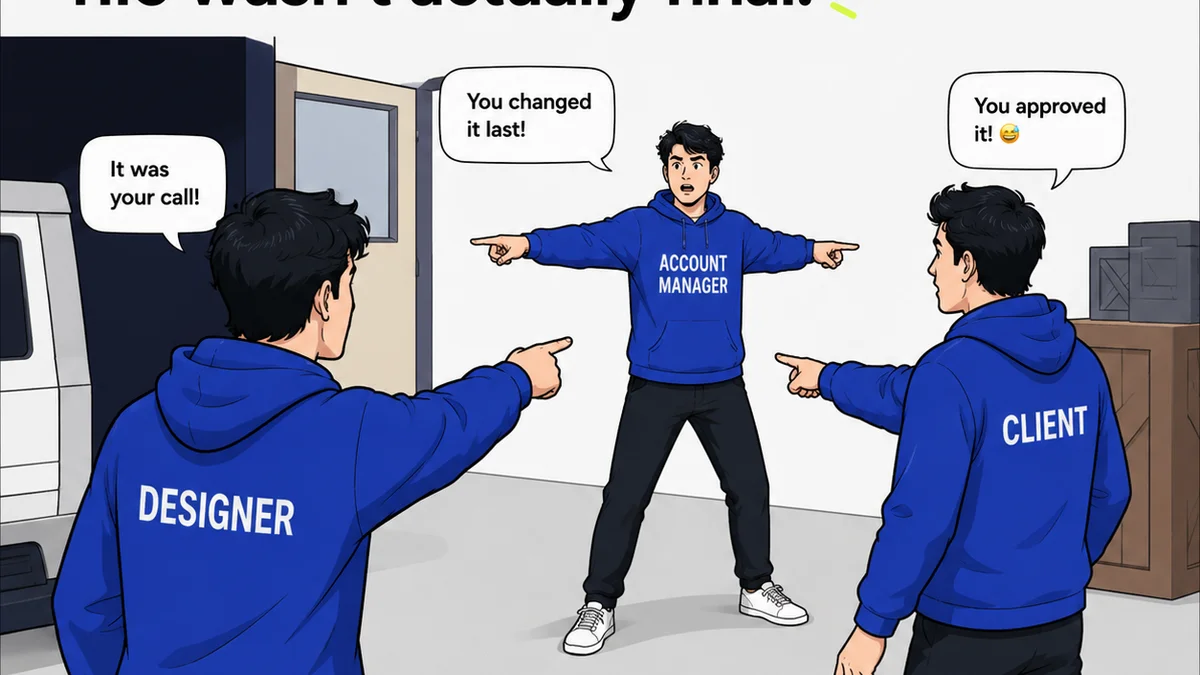
Often, responsibility is diffused. Everyone assumes someone else is doing the final check. This is a recipe for disaster.
Common Accountability Pitfalls
- The 'Client Will Catch It' Fallacy: Relying on the client to be your QA team is a high-risk strategy. It erodes trust and leads to scope creep.
- The 'Designer Knows Best' Trap: While designers have a keen eye, their focus is often on execution, not necessarily strategic or technical accuracy across all touchpoints.
- The 'PM is the Gatekeeper' Illusion: Project managers are crucial, but they are process facilitators, not typically domain experts in design, copy, or technical implementation.
You need a clear, documented process that designates specific QA roles and responsibilities at different stages. This isn't about blame; it's about ensuring thoroughness.
4. Building a Robust QA Workflow
A strong marketing asset QA process isn't an afterthought; it's integrated into the workflow.
It starts with clear briefs and continues through every revision cycle.
Key Stages for Integrated QA
- Briefing: Define clear objectives, target audience, and technical specs upfront. Include QA requirements in the brief.
- Internal Creative Review: The creative team self-checks against the brief and brand guidelines before submitting for broader review.
- Cross-Functional Review: Have someone from a different discipline (e.g., a copywriter reviews a design, a marketer reviews technical specs) provide a fresh perspective.
- Client Review: This should be for strategic and high-level feedback, not nitpicking typos. Provide clear feedback instructions.
- Final QA Check: A designated person or small team performs a last-pass check against all requirements before launch. This is the final gate.
Use checklists. They standardize the process and ensure nothing slips through the cracks. Tailor checklists to asset types (e.g., social ad checklist, email template checklist, website banner checklist).
Where Revue Fits In
Managing feedback and approvals across multiple stakeholders is where most QA processes falter. Emails get lost, comments are ambiguous, and it's hard to track what's been revised and what hasn't.
Revue acts as a central hub for all creative feedback and approvals. Instead of sifting through endless email chains or Slack messages, all stakeholders can comment directly on the asset within Revue.
This provides:
- Centralized Feedback: One source of truth for all comments and discussions.
- Version Control: Clear visibility into revision history, so you always know which version is current.
- Approval Tracking: Explicit sign-offs that eliminate ambiguity about what's been approved.
- Streamlined QA: The clarity provided by centralized feedback and approvals makes the final QA step much more efficient and effective.
When feedback is organized and actionable, your QA process becomes less about chasing down stray comments and more about confirming that the right decisions were made.
5. The Cost of Cutting Corners
Skipping or rushing QA might feel like a time-saver in the short term. It’s not.
The cost of a single mistake can far outweigh the time invested in proper QA.
Consider:
- Brand damage from a public error.
- Lost revenue due to broken links or incorrect offers.
- Wasted ad spend on assets that need to be pulled or corrected.
- Client dissatisfaction and potential loss of business.
- Internal team frustration and burnout from constant firefighting.
These aren't theoretical. They happen every day in agencies and marketing departments that don't prioritize QA.
Final Thought
Is your marketing asset QA process designed to catch typos, or is it built to prevent chaos? The distinction is critical. It determines whether your team is reacting to problems or proactively ensuring quality and efficiency. Think about the last time an asset went live with a critical error. What broke down? And how can you ensure it never happens again?
Frequently asked questions
What's the difference between proofreading and marketing asset QA?
Proofreading focuses on surface-level errors like typos and grammar. Marketing asset QA is a broader process that includes proofreading but also checks for brand consistency, technical accuracy (links, formats, responsiveness), functional correctness, and strategic alignment.
Who should be responsible for final marketing asset QA?
Responsibility should be clearly defined and assigned. It's often best handled by a dedicated QA specialist, a project manager with a strong checklist, or a senior team member not directly involved in the asset's creation to ensure an objective review.
How can I make QA more efficient for my marketing team?
Integrate QA into the workflow from the start. Use standardized checklists tailored to asset types. Centralize feedback and approvals using tools like Revue to avoid confusion and ensure all stakeholders have visibility. Automate checks where possible (e.g., link checkers).
What are the biggest risks of poor marketing asset QA?
The biggest risks include brand damage, lost revenue from errors, wasted ad spend, client dissatisfaction, and internal team burnout. These operational failures can significantly outweigh any perceived time savings from skipping QA.