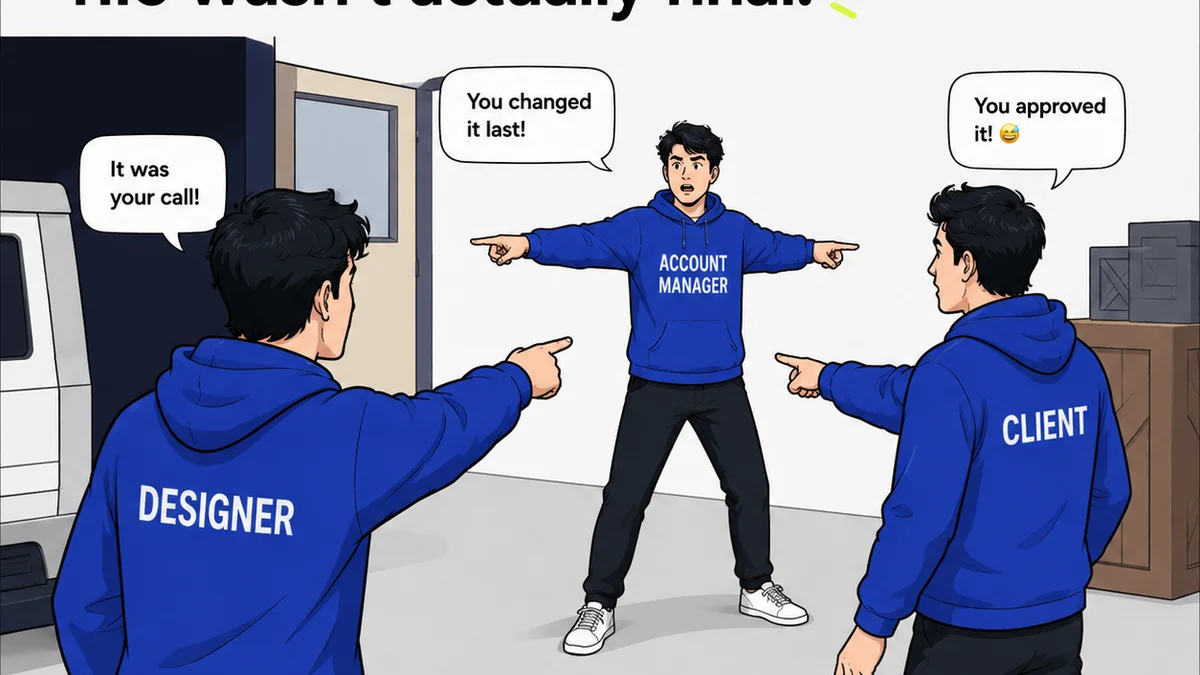
Everyone agrees that marketing design is hard. Clients want stunning visuals that drive ROI. Designers need clarity and time to create. The gap between expectation and reality often feels like a chasm.
You might think the core issues are vague client briefs, impossible deadlines, or subjective feedback. None of that is wrong. But it’s incomplete.
The real problems in marketing design aren't about the creative output itself. They’re rooted in the operational chaos that surrounds it.
1. The Myth of the Perfect Brief
We’re told a good brief is the bedrock of good design. And it is. But how many briefs you’ve seen are truly perfect? They’re rarely complete, often contradictory, and almost always open to interpretation.
The deeper truth? A perfect brief is an ideal, not a reality for most busy agencies and in-house teams. The real challenge is building a process that can handle imperfect briefs and still deliver.
Relying on the Brief Alone
A static document can’t capture the nuance of a client’s evolving needs or the unspoken context of a campaign. It’s a starting point, not an end-all-be-all.
The Cost of Misinterpretation
When briefs are vague, designers guess. When designers guess, they often guess wrong. This leads to:
- Wasted design hours
- Frustrated clients
- Delayed timelines
- Compromised creative quality
The Operational Fix: Iterative Clarity
Instead of demanding perfect briefs upfront, build systems for ongoing clarification. This means:
- Scheduled check-ins specifically to unpack the brief.
- Using visual tools to get alignment before deep design work begins.
- Creating a clear point person for questions, rather than letting them scatter.
Don’t just ask for a better brief. Build a better process for clarifying the one you have.
2. The Feedback Loop Black Hole
Client feedback is essential. Everyone knows this. But how many times has feedback landed in your inbox like a cryptic message from another dimension?
The hard truth is that feedback, as it’s typically handled, is a primary driver of inefficiency and creative degradation.
The Problem with Email Chains and PDFs
Endless email threads bury crucial comments. PDFs get annotated, but the context is lost. Different stakeholders give conflicting notes, and no one knows which to prioritize.
This isn’t just annoying. It’s a workflow killer.
- Key decisions get lost.
- Revisions are based on incomplete or misunderstood feedback.
- Designers spend more time deciphering notes than designing.
- Disputes arise over what was actually said.
The Illusion of Control
Clients often feel they’re providing feedback, but the lack of a structured system means their input isn’t actionable. You have the feedback, but you lack the control to use it effectively.
The Operational Fix: Centralized, Actionable Feedback
You need a single source of truth for all feedback. This means moving away from scattered communication channels.
- Use a dedicated platform where comments are linked directly to the design asset.
- Implement a clear review and approval workflow.
- Define roles: who provides feedback, who consolidates, who approves.
The goal isn’t to stop feedback. It’s to make it organized, visible, and actionable.
3. The Revision Round Roulette
Design revisions are part of the process. No one expects the first draft to be perfect. But the sheer volume and scope of revisions can cripple a project.
The assumption is that revisions are just the cost of doing business. The reality is that uncontrolled revisions are a symptom of deeper process failures.
Scope Creep Masquerading as Revisions
Often, what looks like a revision is actually a scope change. A minor tweak request can balloon into a fundamental shift in direction if not managed properly.
This isn’t about being difficult; it’s about protecting project health.
The Time Sink
Each revision round eats up valuable designer time. Multiply that by multiple rounds, and you’re looking at significant delays and increased costs.
- Designers get stuck in a loop of minor, unsatisfying changes.
- Morale plummets.
- Profitability erodes.
The Operational Fix: Structured Revision Management
Treat revisions with the same rigor as the initial design phase. This requires:
- Clearly defined limits for revision rounds in your SOW.
- A process for evaluating the scope of requested revisions.
- Using version control to track changes and prevent accidental overwrites.
- Implementing clear approval gates before proceeding to the next revision.
Manage revisions proactively, not reactively.
4. The Quality Control Conundrum
You’ve got the design, the client signed off. Great. But is it truly ready for market? Often, the final output has errors that a more rigorous check could have caught.
The assumption is that once the client approves, the job is done. The hard truth is that client approval is not a guarantee of quality.
The Blind Spots of Approval
Clients approve based on their understanding and priorities. They might miss technical specs, brand guideline inconsistencies, or accessibility issues. Designers, deep in the creative process, can also develop blind spots.
The Risk of Rushing
Pressure to launch often means quality checks are skipped or rushed. This leaves the door open for costly mistakes.
- Inconsistent typography
- Incorrect sizing or resolution for different platforms
- Broken links or interactive elements
- Brand guideline violations
- Accessibility oversights
The Operational Fix: Systematic Quality Assurance
Build quality control into your process, not as an afterthought. This means:
- Developing a comprehensive checklist for final review.
- Assigning a dedicated reviewer (or team) who wasn’t involved in the day-to-day design.
- Using tools for automated checks where possible (e.g., spell check, link validation).
- Ensuring a final human review against brand standards and project requirements.
Your final output reflects on your agency. Ensure it’s polished, not just approved.
Where Revue Fits In
These challenges – vague briefs, scattered feedback, uncontrolled revisions, and quality gaps – are fundamentally workflow problems. They’re solvable with the right operational framework.
Revue is built to address these exact pain points. It centralizes client feedback, making it visible and actionable, eliminating the feedback loop black hole. You can track revisions, manage approvals, and ensure everyone is working from the same, up-to-date version of the creative asset.
This means fewer misinterpretations, less wasted time deciphering emails, and a clearer path from initial concept to final, high-quality deliverable. It brings order to the chaos, allowing your team to focus on what they do best: creating great marketing design.
Final Thought
Is the biggest bottleneck in your marketing design process a lack of talent, or a lack of process? When you strip away the excuses, the most successful teams aren’t just more creative; they’re more organized. They’ve built systems that elevate their creative output, rather than allowing chaos to diminish it. What operational improvements could unlock your team’s true potential?
Frequently asked questions
What is the biggest operational challenge in marketing design?
The biggest operational challenge is often the lack of a structured system for managing feedback and revisions. This leads to miscommunication, wasted time, and scope creep, rather than a lack of creative talent.
How can I ensure client feedback is actionable?
Centralize feedback in a dedicated platform where comments are linked directly to the design asset. Establish clear roles for who provides feedback, who consolidates it, and who makes final decisions. Schedule specific times to discuss and clarify feedback, rather than relying on scattered emails.
What's the difference between a revision and a scope change?
A revision is a modification within the agreed-upon scope of work, addressing minor adjustments or refinements. A scope change involves a significant shift in direction, adding new requirements, or expanding the project's objectives beyond the original agreement. Managing revisions requires clear communication and evaluation to prevent them from becoming uncontrolled scope creep.
How can agencies improve quality control in design?
Implement systematic quality assurance by developing comprehensive checklists, assigning dedicated reviewers, and using automated checks where possible. Ensure a final human review against brand standards and project requirements before final delivery to catch errors that clients or designers might miss.