You probably think marketing operations is about spreadsheets, project management software, and maybe a few internal process docs. Something for the sales team or the finance department, right?
None of that is wrong. But it’s incomplete.
For a growing design agency, marketing operations is the secret sauce that turns creative talent into predictable revenue and repeatable client success. It’s not just admin; it’s the strategic backbone that enables scale without sacrificing quality.
The Hard Truth: Growth Exposes Your Weakest Links
Every agency owner dreams of growth. More clients, bigger projects, a stellar reputation. But growth isn’t linear. It’s messy.
As you scale, the cracks in your operational foundation start to show. What worked for five clients breaks down with twenty. What was manageable for a team of three becomes chaos for ten.
Suddenly, you’re drowning in:
- Missed deadlines
- Scope creep that kills profitability
- Client feedback loops that go nowhere
- Internal communication breakdowns
- Team members burning out
- Inconsistent project quality
- Difficulty forecasting revenue
This isn’t a talent problem. It’s an operations problem.
1. Defining Marketing Operations for Creatives
Let’s clarify what we mean by marketing operations in the context of a creative agency. It’s not just about marketing *for* your agency. It’s about the operational processes that make your *delivery* of creative services efficient, scalable, and profitable.
Think of it as the engine room. The creative team is the talent on deck, the clients are the destination, but operations is what powers the ship and keeps it on course.
The Core Pillars
Marketing operations for a design agency typically encompasses:
- Process Standardization: Documenting and refining how work gets done, from initial brief to final delivery.
- Technology Integration: Ensuring your tools (CRM, project management, communication, feedback platforms) work together seamlessly.
- Data & Analytics: Tracking key metrics to understand performance, profitability, and client satisfaction.
- Resource Management: Optimizing the allocation of people, time, and budget.
- Quality Assurance: Implementing checks and balances to ensure creative output meets standards.
It’s about building systems that support, not stifle, creativity.
2. Why Standard Processes Are Your Best Friend
Creatives often chafe at the idea of “process.” It feels restrictive, like a cage for innovation. But the reality is the opposite.
Well-defined processes free up creative energy. They remove the guesswork and the friction points that drain time and morale.
The Onboarding Black Hole
Consider client onboarding. Without a clear process, it’s a scramble. Initial calls, discovery documents, contract approvals, kickoff meetings – each step can be a potential point of failure.
A standardized onboarding process means:
- Every client gets the same high-touch, professional experience.
- Key information is captured consistently.
- The project team is aligned from day one.
- Kickoff is smooth and efficient, not a chaotic information dump.
Revision Roundabout
Client feedback is notorious for being vague, contradictory, or just plain wrong. Without a process for managing it, your team wastes hours chasing ghosts.
A good feedback process includes:
- Clear channels for feedback submission.
- Defined roles for who provides feedback.
- A system for categorizing and prioritizing feedback.
- A method for tracking revisions and approvals.
This isn't about arguing with clients; it's about creating clarity and accountability.
3. The Tech Stack That Actually Works
Many agencies have a graveyard of unused software. We buy into the promise of efficiency, but without integration and a clear strategy, it’s just more noise.
Effective marketing operations requires a tech stack that talks to itself. Your CRM should feed into your project management tool, which should integrate with your communication platform.
Beyond the Basics
You likely have:
- A CRM (like HubSpot, Salesforce)
- A project management tool (like Asana, Monday, Jira)
- Communication tools (like Slack, Teams)
But are they talking to each other? Is client data flowing automatically?
The real win comes from tools that specifically address creative workflows:
- Centralized Feedback Platforms: Tools that allow clients to comment directly on visuals, videos, and websites, consolidating all feedback in one place.
- Version Control: Systems to manage different iterations of creative assets easily.
- Digital Asset Management (DAM): A single source of truth for all your final creative files.
The goal is to reduce manual data entry, eliminate version confusion, and ensure everyone is working from the latest approved assets.
4. Data: Your Crystal Ball for Profitability
Gut feeling is a terrible business strategy. Growing agencies need data to make informed decisions.
What are your most profitable client types? Which services have the best margins? Where are projects consistently going over budget?
Key Metrics to Track
Operations data can illuminate these questions. Start tracking:
- Project Profitability: Actual revenue vs. actual cost for each project.
- Billable Utilization Rate: Percentage of time your team spends on billable client work.
- Client Lifetime Value (CLV): The total revenue a client is expected to generate over the relationship.
- Sales Cycle Length: How long it takes to close a new client.
- Client Satisfaction Scores (CSAT/NPS): Direct feedback on client happiness.
This data isn’t just for reporting. It’s for identifying bottlenecks, optimizing resource allocation, and making strategic decisions about which clients and projects to pursue.
5. Resource Management: The Art of Balancing Peaks and Valleys
Creative agencies are notorious for feast-or-famine cycles. You’re either swamped or desperately searching for the next project.
Good operations smooths these peaks and valleys.
Capacity Planning
It starts with understanding your team’s capacity. How many hours does each team member have available? What’s their current workload?
By mapping out project timelines against team availability, you can:
- Avoid overcommitting your team.
- Identify potential resource shortages *before* they become crises.
- Make more accurate sales promises.
- Ensure a more sustainable work-life balance for your staff.
This requires visibility. You need to know who is working on what, for how long, and when they’ll be available.
Where Revue Fits In
Operationalizing your creative agency workflow doesn’t have to mean building custom software or adopting clunky enterprise solutions. It means using the right tools to solve specific problems.
Revue is built for creative teams. It tackles the core operational challenges that hinder growth:
- Centralized Feedback: Consolidate all client comments, annotations, and approvals directly on creative assets. No more digging through endless email chains or Slack messages.
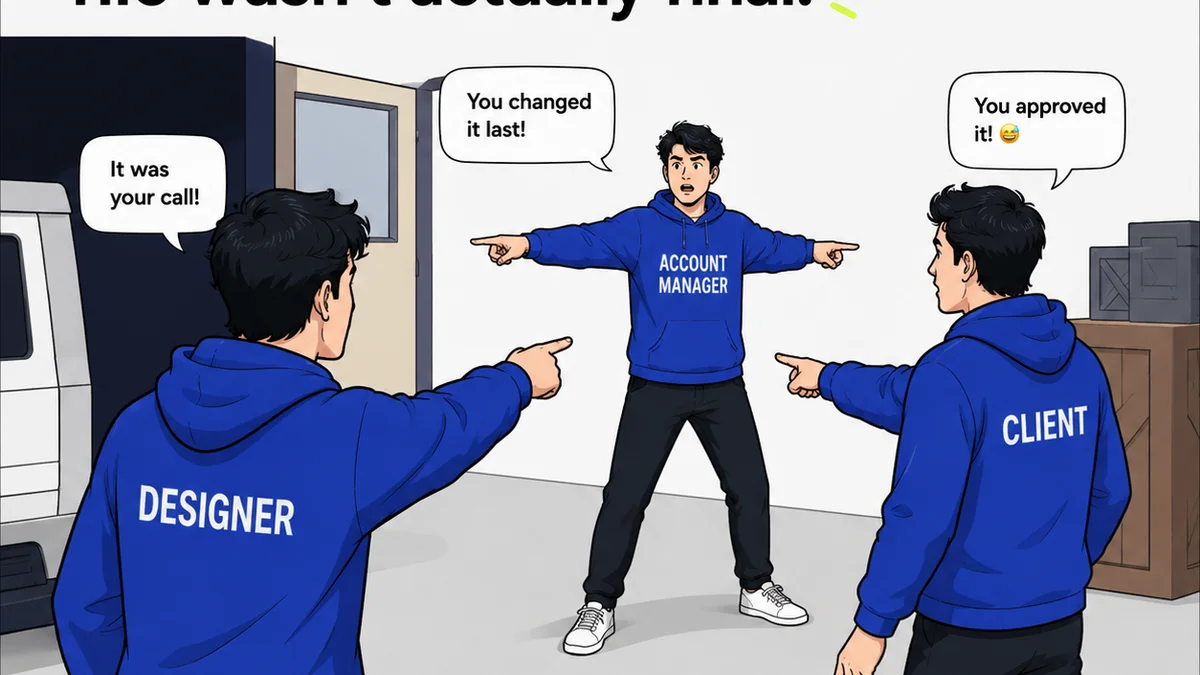
- Revision & Approval Visibility: Track every version, every comment, and every approval status in one clear, auditable trail. Your team knows exactly where things stand, and clients can’t claim they never saw a change.
- Quality Assurance: By having a single source of truth for feedback and approvals, you inherently build in a quality check. The final approved version is the one everyone agreed upon.
Revue helps close the gap between creative execution and client sign-off, reducing ambiguity and speeding up the entire revision process. It brings order to the often-chaotic world of client collaboration.
Final Thought
Is your agency’s growth being held back by operational friction? Or are you proactively building systems that allow your creative talent to shine, predictably and profitably?
The difference between a chaotic, stressful agency and a thriving, scalable one often comes down to the strength of its operations. It’s time to look beyond the pretty pixels and focus on the engine that drives your business forward.
Frequently asked questions
What is marketing operations for a creative agency?
For a creative agency, marketing operations refers to the strategic processes, technologies, and data that enable the efficient and scalable delivery of creative services. It's about building systems that support creative workflows, manage client feedback, ensure quality, and drive profitability, rather than just administrative tasks.
How does operations help a growing agency?
As agencies grow, operational inefficiencies become major bottlenecks. Strong marketing operations standardize processes, improve communication, manage resources effectively, and ensure consistent quality, preventing chaos and enabling sustainable growth without sacrificing creative excellence.
Why do creatives resist process?
Creatives often fear that processes stifle innovation. However, well-designed operational processes actually free up creative energy by removing guesswork, reducing administrative burdens, and clarifying project goals. This allows creatives to focus on their core work.
What are the key benefits of good operations for an agency?
Key benefits include increased profitability through better resource management and reduced scope creep, improved client satisfaction due to clearer communication and faster revisions, enhanced team morale via reduced burnout, and the ability to scale operations reliably as the agency takes on more work.