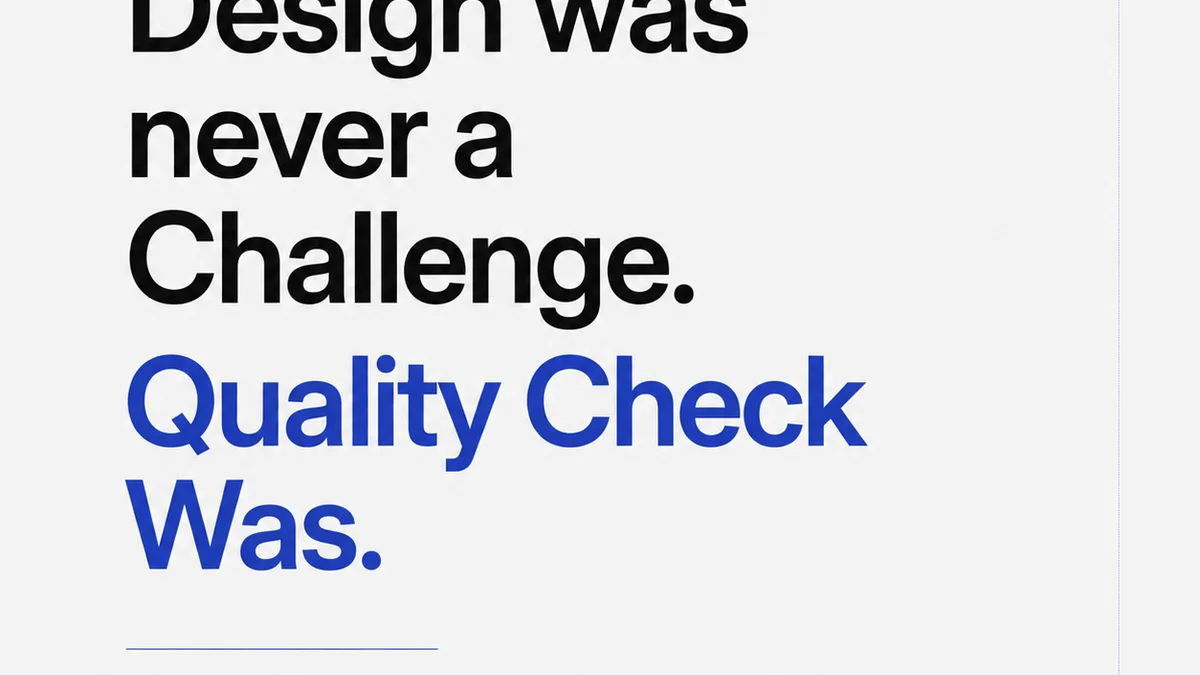
Everyone thinks leading agencies nail UI/UX because they have the best designers. That they hire the most expensive talent, give them infinite creative freedom, and voilà – magic happens.
None of that is wrong. But it’s incomplete.
The hard truth? Exceptional UI/UX isn't a magical outcome. It’s the result of disciplined processes, ruthless efficiency, and a deep understanding of client needs that goes far beyond aesthetics.
1. Beyond Pretty Pixels: The Strategic Foundation
Many teams get caught up in the visual layer. They focus on making things look good, on the latest design trends, on the 'wow' factor. But the most successful agencies understand that UI/UX is fundamentally about solving problems for users and businesses.
It starts long before the first wireframe is drawn.
Understanding the Real Problem
This means digging deep into user research, market analysis, and business objectives. It's about asking the hard questions:
- Who is the *actual* user? What are their pain points?
- What business goal does this interface need to achieve?
- What are the technical constraints?
- What does success *look* like, and how will we measure it?
This strategic groundwork is non-negotiable. Without it, even the most beautifully designed interface will fail to deliver real value.
Defining the User Journey
Leading agencies map out the entire user journey. Not just the happy path, but all the edge cases, error states, and moments of friction. This is where true usability is forged.
- Visualize the steps a user takes.
- Identify potential roadblocks.
- Design for clarity and ease at every touchpoint.
This holistic view prevents costly rework later.
2. The Power of Process: From Concept to Launch
Design talent is crucial, but it needs a framework to thrive. Agencies that excel in UI/UX have robust, repeatable processes that guide projects from inception to delivery.
This isn't about stifling creativity; it's about channeling it effectively.
Systematic Ideation and Wireframing
Before pixels fly, there's a period of intense ideation and low-fidelity prototyping. This is where concepts are tested rapidly and cheaply.
- Brainstorming sessions with cross-functional teams.
- Rapid sketching and paper prototyping.
- Iterative wireframing based on early feedback.
This stage is about exploring possibilities, not perfecting details.
User Testing: The Unvarnished Truth
You can't guess what users want. You have to watch them. Leading agencies embed user testing throughout the design process, not just at the end.
Early and frequent testing with real users reveals flaws you'd never spot otherwise. It's about getting honest, often brutal, feedback and acting on it.
- Usability testing on wireframes.
- Prototype testing with interactive mockups.
- Beta testing with a select group of users.
This iterative feedback loop is the engine of user-centric design.
Design Systems: Scalability and Consistency
For any serious UI/UX work, especially at scale, a design system is paramount. It's not just a style guide; it's a living library of reusable components and guidelines.
This ensures consistency across products and platforms, speeds up development, and reduces design debt.
- Component library: buttons, forms, navigation, etc.
- Style guidelines: typography, color, spacing.
- Usage patterns and best practices.
A well-maintained design system is the backbone of efficient, high-quality UI/UX delivery.
3. Collaboration as a Superpower
Great UI/UX is rarely the work of a single designer in a vacuum. It requires seamless collaboration between design, development, product management, and the client.
The best agencies foster an environment where these disciplines work in lockstep.
Bridging the Design-Development Divide
One of the biggest friction points in digital product development is the gap between design and development. Leading agencies actively work to close this gap.
- Involve developers early in the design process.
- Provide clear, detailed design specifications.
- Use tools that facilitate handoff and communication.
When designers and developers speak the same language, magic truly happens.
Client Alignment: Managing Expectations
Clients are stakeholders, not just recipients of work. Effective UI/UX requires deep client involvement and buy-in at every stage.
This means transparent communication, managing expectations realistically, and educating clients on the process and the 'why' behind design decisions.
- Regular check-ins and progress updates.
- Presenting rationale, not just aesthetics.
- Collaborative workshops and feedback sessions.
When clients are partners, the end product is always stronger.
4. Iteration and Optimization: The Long Game
Launching a product is not the finish line. For leading agencies, it’s just the beginning of the UI/UX lifecycle.
Continuous improvement is key.
Data-Driven Decisions
Post-launch, the focus shifts to performance. This means leveraging analytics, user feedback, and A/B testing to identify areas for improvement.
- Tracking key UX metrics (conversion rates, task completion, bounce rates).
- Gathering qualitative feedback through surveys and interviews.
- Running A/B tests on design variations.
Data provides the roadmap for future iterations.
Adapting to Change
User behavior, technology, and market trends are constantly evolving. Agencies that master UI/UX are agile and prepared to adapt.
This requires a culture that embraces change and sees iteration as an ongoing opportunity, not a chore.
Where Revue Fits In
Managing the complexities of UI/UX projects, from initial concept through iterative improvements, demands efficient workflows and clear communication.
This is where a centralized platform like Revue becomes indispensable.
Think about it: How many hours are lost chasing feedback across scattered email threads, Slack channels, and random documents? How much confusion arises from unclear revision histories or missed client approvals?
Revue streamlines these critical operational aspects:
- Centralized Feedback: All client comments, stakeholder input, and internal reviews live in one place, linked directly to the creative assets. No more hunting for that one crucial piece of feedback buried in an inbox.
- Revision Visibility: Track every version, every change, and every approval. This clarity prevents scope creep and ensures everyone is working from the latest approved iteration.
- Quality Assurance: Use the platform to conduct thorough QA checks, ensuring designs meet specifications and user experience standards before they go live.
By bringing order to the chaos of creative feedback and approvals, Revue empowers agencies to focus on what they do best: delivering exceptional UI/UX.
Final Thought
The agencies that consistently deliver outstanding UI/UX aren't just design powerhouses. They are operational powerhouses.
They've built systems, embraced collaboration, and prioritized clarity. They understand that the 'how' of design is just as important as the 'what'.
So, the next time you admire a beautifully crafted interface, don't just praise the pixels. Consider the disciplined process and operational rigor that made it possible.
Frequently asked questions
What's the biggest mistake agencies make with UI/UX?
Focusing too much on aesthetics and trends without first understanding the core user problem and business objectives. Great UI/UX solves problems, it doesn't just look good.
How important is user testing in UI/UX?
Extremely important. Leading agencies test early and often with real users throughout the design process, not just at the end. This reveals critical usability issues before they become expensive problems.
What is a design system and why do agencies need one?
A design system is a collection of reusable components, guided by clear standards, that can be assembled together to build any number of applications. It ensures consistency, speeds up development, and scales design efforts efficiently.
How can agencies improve collaboration between design and development?
Involve developers early in the design process, provide clear and detailed specifications, and use tools that facilitate seamless handoff and communication. Shared understanding is key.