Everyone agrees design matters for marketing. It catches the eye. It communicates brand. It makes things look professional.
None of that is wrong. But it’s incomplete.
The hard truth? The real value of marketing design isn't in its aesthetic appeal or its ability to convey a message; it's in its measurable impact on business objectives. If you can't quantify that impact, you're essentially flying blind, leaving money on the table, and struggling to justify your creative investments.
1. The 'Intangible' Myth: Design's Tangible Business Impact
For too long, design has been relegated to the 'soft skills' bucket. We talk about creativity, aesthetics, and brand feel. These are important, but they're not the end goal. They are the *means* to an end.
The real end goal is business results.
Think about it. What are marketing campaigns designed to do?
- Increase leads
- Drive sales
- Improve conversion rates
- Boost brand awareness and recall
- Enhance customer engagement
- Reduce customer acquisition cost (CAC)
- Increase customer lifetime value (CLV)
Every single one of these objectives can be directly influenced, positively or negatively, by the quality and effectiveness of the marketing design. A poorly designed landing page won't convert. A confusing ad won't drive clicks. A brand that feels 'off' will struggle to connect.
The Cost of 'Good Enough' Design
When design is treated as an afterthought, or when the focus remains solely on subjective 'prettiness,' the business impact suffers.
This isn't about blaming designers. It's about a flawed *process* and a misunderstanding of design's role.
What's the cost of design that doesn't perform?
- Wasted ad spend on ineffective creatives
- Lost leads due to poor user experience (UX) on landing pages
- Lower conversion rates because calls-to-action (CTAs) are unclear
- Brand dilution from inconsistent or unprofessional visuals
- Missed opportunities to upsell or cross-sell
These aren't abstract concepts. They translate directly to dollars and cents. Measuring the ROI of marketing design means connecting creative output to these hard business metrics.
2. Defining Your Design KPIs: Beyond Vanity Metrics
To measure ROI, you need Key Performance Indicators (KPIs) that actually matter. Forget 'likes' or 'shares' as primary indicators of design success (unless your campaign goal is purely social engagement, which is rare).
Focus on metrics tied to business outcomes.
Conversion-Focused Metrics
This is where marketing design often shows its most direct ROI. How is your design influencing user behavior towards a desired action?
- Conversion Rate (CR): The percentage of visitors who complete a desired action (e.g., purchase, sign-up, download). A/B testing different design elements on landing pages or ads is crucial here.
- Click-Through Rate (CTR): The percentage of people who click on a link or ad. Design elements like compelling imagery, clear CTAs, and persuasive copy layout directly impact CTR.
- Bounce Rate: The percentage of visitors who leave a website after viewing only one page. High bounce rates can indicate poor initial design, confusing navigation, or slow load times, all design-related issues.
- Form Completion Rate: For lead generation, the percentage of users who successfully submit a form. Clunky form design or unclear instructions can tank this.
Brand and Engagement Metrics
These are slightly less direct but still critical for long-term ROI.
- Brand Recall/Recognition: Can your target audience remember and identify your brand based on its visual elements? This requires surveys or brand tracking studies, but strong, consistent design is a prerequisite.
- Customer Engagement Metrics: Beyond just clicks, how are users interacting with your content? Time on page, scroll depth, and interaction with interactive elements can all be influenced by design.
- Customer Acquisition Cost (CAC): If your design efforts lead to more efficient lead generation and higher conversion rates, your CAC should decrease.
- Customer Lifetime Value (CLV): A strong brand, built on consistent and appealing design, fosters loyalty, which can increase CLV.
Operational Efficiency Metrics
This is often overlooked but directly impacts the cost side of the ROI equation.
- Revision Cycles: How many rounds of feedback and revisions does a design project typically take? Inefficient feedback loops add significant time and cost.
- Time to Market: How long does it take from brief to final asset delivery? Delays here mean missed opportunities.
- Asset Production Costs: The actual cost of creating and producing the design assets, factoring in designer time, software, and potential agency fees.
By tracking these KPIs, you start to build a data-driven case for the value of your marketing design.
3. The Data Collection Challenge: Bridging Creative and Analytics
Okay, you've identified your KPIs. Now what? The biggest hurdle is often collecting the right data and connecting it to specific design initiatives.
Leveraging Analytics Tools
Tools like Google Analytics are your best friend. Set them up correctly to track goals and events.
- Goal Tracking: Configure goals for key conversions (e.g., form submissions, purchases).
- Event Tracking: Track specific interactions like button clicks, video plays, or downloads.
- A/B Testing Tools: Platforms like Google Optimize (though sunsetting, concepts apply), Optimizely, or VWO allow you to test variations of design elements (headlines, CTAs, images, layouts) against each other to see which performs best.
Connecting Design to Results
This requires a disciplined approach:
- Campaign-Specific Tracking: Use UTM parameters religiously for all campaign links. This allows you to see which creative assets and channels are driving traffic and conversions.
- Design Versioning: If you're running multiple ad creatives, ensure each has a unique identifier or is tracked separately in your ad platform.
- Post-Launch Analysis: Don't just launch and forget. Regularly review performance data. What's working? What's not? Why?
- Qualitative Feedback: Supplement quantitative data with user testing and direct customer feedback. Sometimes the 'why' behind the numbers is revealed here.
The key is to move from a mindset of 'we made this look good' to 'we made this perform well, and here's the data to prove it.'
4. Calculating Design ROI: The Formula and Its Nuances
At its simplest, Return on Investment (ROI) is calculated as:
ROI = [(Gain from Investment - Cost of Investment) / Cost of Investment] * 100%
Applying this to marketing design requires careful definition of 'Gain' and 'Cost'.
Defining 'Gain'
The 'Gain' is the quantifiable business benefit directly attributable to the design work. This could be:
- Increased revenue from higher conversion rates on a campaign.
- Cost savings from a reduced CAC due to more effective creatives.
- Value of leads generated from a high-performing landing page.
Example: If a new landing page design, costing $2,000, resulted in a 10% increase in conversions, and those conversions represent $50,000 in new revenue over a quarter, the Gain is $50,000.
Defining 'Cost'
The 'Cost' includes all direct and indirect expenses associated with the design initiative:
- Designer/agency fees
- Software licenses
- Stock imagery or asset costs
- Time spent by internal teams (project management, client approvals)
- Cost of A/B testing tools or platforms
Example: The $2,000 for the landing page design.
The Calculation
Using the example above:
ROI = [($50,000 - $2,000) / $2,000] * 100%
ROI = [$48,000 / $2,000] * 100%
ROI = 24 * 100% = 2400%
This indicates a substantial return. However, attribution can be tricky.
Nuances and Challenges
It's rarely this clean. Factors to consider:
- Attribution Modeling: Was it *just* the design, or also the copy, the offer, the targeting, the ad platform? Understanding attribution models (first-touch, last-touch, linear) is key.
- Long-Term Brand Building: How do you quantify the ROI of a brand identity that takes years to build equity? This often requires different metrics and longer time horizons.
- Indirect Benefits: Reduced churn, improved employee morale (designers love working on well-scoped, impactful projects), and enhanced brand reputation are harder to put a number on but contribute to overall value.
- Opportunity Cost: What was the cost of *not* updating a poorly performing design?
Don't let complexity paralyze you. Start with the most direct impacts (like landing page conversions) and build from there. Even a directional understanding is better than none.
5. Where Revue Fits In
You can't measure the ROI of design if the design process itself is a black box. Inefficient workflows, unclear feedback, and endless revision cycles obscure the true cost and delay the realization of benefits.
Revue helps bring clarity and control to the creative process, which is essential for accurate ROI measurement.
- Centralized Feedback: All client and stakeholder feedback lives in one place, attached to specific design elements. This eliminates confusion, reduces back-and-forth emails, and provides a clear audit trail. Knowing exactly who said what and when helps pinpoint costly delays.
- Revision and Approval Visibility: Track the progress of design assets through review and approval stages. Identify bottlenecks and understand how long each stage truly takes, contributing to your 'time to market' and 'asset production cost' metrics.
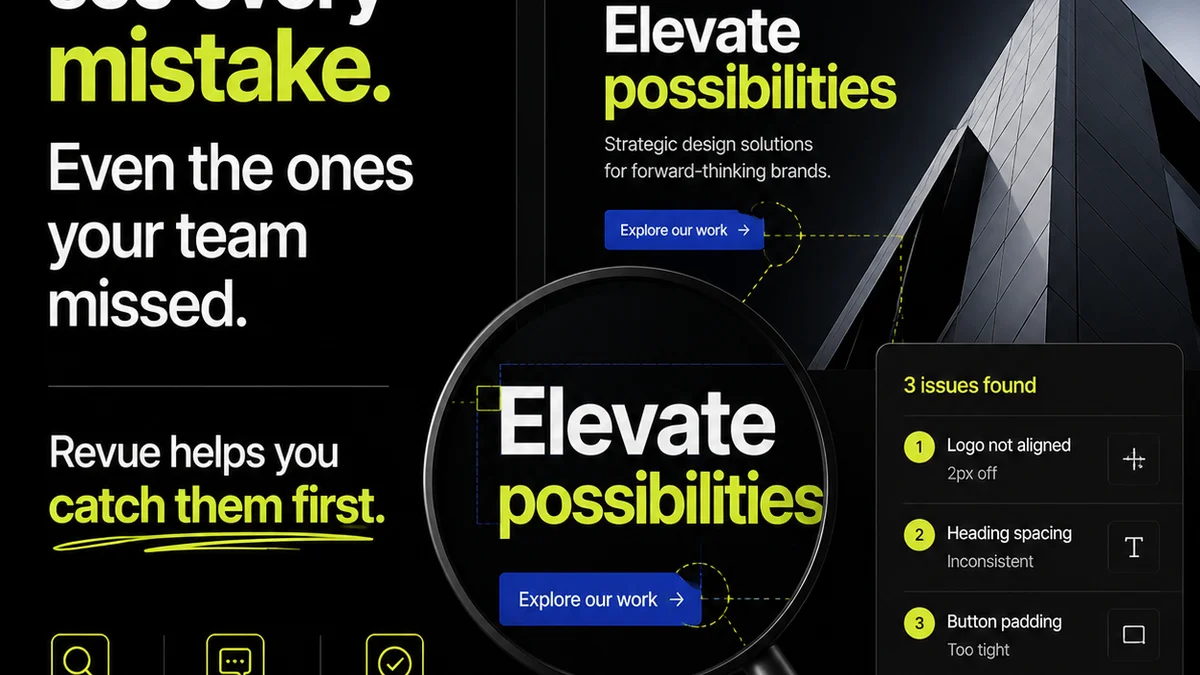
- Quality Checks: Implement structured checklists for final asset delivery. This ensures creative integrity and adherence to brand guidelines, reducing costly errors that could impact campaign performance.
By streamlining these operational aspects, Revue helps reduce the 'Cost of Investment' in your design projects, thereby increasing the potential ROI. It also provides the clarity needed to accurately attribute gains to specific design initiatives.
6. Final Thought
Marketing design isn't just about making things look good; it's about driving business results. The question isn't *if* design impacts ROI, but *how effectively* you're measuring and leveraging that impact.
Are you treating design as a cost center or a revenue generator? The answer lies in the data you choose to track.
Frequently asked questions
What are the most important KPIs for measuring marketing design ROI?
Focus on conversion rates, click-through rates, bounce rates, form completion rates, customer acquisition cost (CAC), and time-to-market for your design assets. These directly tie design efforts to business outcomes.
How can I accurately attribute business gains to specific design work?
Use UTM parameters for campaign tracking, implement A/B testing for design variations, track performance per creative asset in ad platforms, and leverage analytics tools to monitor goal completions. While perfect attribution is challenging, strive for the clearest possible link.
What costs should be included when calculating design ROI?
Include all direct and indirect costs: designer/agency fees, software licenses, asset purchases, internal team time (project management, approvals), and costs associated with testing platforms. Don't forget the opportunity cost of delays.
Is it possible to measure the ROI of brand identity design?
Measuring the ROI of brand identity is more complex and typically involves longer time horizons and different metrics, such as brand recall, market share shifts, and long-term customer loyalty, rather than immediate conversion gains. Consistent, strong design builds brand equity over time.