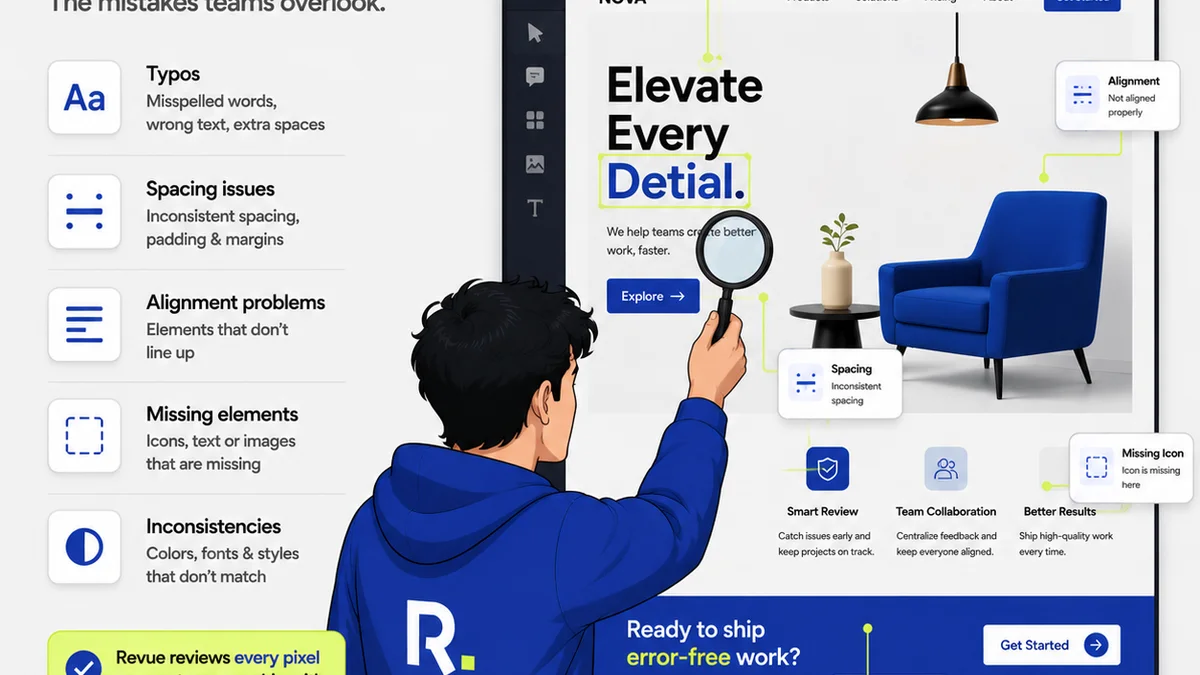
Everyone talks about the benefits of automating creative reviews: faster turnarounds, fewer errors, happier clients. These are all true.
But they’re also vague. “Happier clients” doesn’t pay the bills. Faster turnarounds don’t automatically mean more profit.
The hard truth? If you can’t measure the financial impact, you can’t truly optimize it. You’re flying blind.
Let’s cut through the noise and talk dollars and cents. We need to talk about the ROI of review automation.
1. The True Cost of Manual Reviews
Before we can measure the gains from automation, we need to understand the deep, often hidden, costs of the status quo. Manual review processes are a black hole for agency time and money.
Think about it:
- Endless email chains with feedback buried deep.
- Scattered feedback across documents, Slack messages, and verbal conversations.
- Time spent deciphering conflicting comments.
- Hours lost tracking down the latest version.
- Wasted hours on revisions based on misunderstood feedback.
- The cost of errors that slip through due to unclear feedback or missed details.
- Client frustration leading to scope creep or lost business.
These aren't just minor annoyances. They are direct drains on your profitability.
The Hidden Labor Drain
Every minute a team member spends wrangling feedback instead of creating work is a minute they aren't billable. Multiply that by your team’s hourly rate, and the numbers get scary.
Consider a designer spending 30 minutes per file, per round, just trying to collate and understand feedback. If they handle 10 files a week, that’s 5 hours of non-creative work weekly. That’s 260 hours a year, per designer. At a loaded cost of $75/hour, that’s $19,500 per designer, per year, lost to administrative overhead.
The Cost of Rework and Errors
Misinterpreted feedback leads directly to rework. Rework is non-billable time spent fixing something that should have been right the first time. It erodes margins.
Furthermore, errors that reach clients or, worse, production, can lead to significant costs. A misplaced logo, incorrect copy, or broken link can mean a client demanding free revisions, or worse, a reputational hit.
The Opportunity Cost
Perhaps the most significant cost is opportunity cost. Time spent in inefficient review cycles is time not spent on client acquisition, strategic thinking, or developing new services. It’s time your team isn't innovating or growing the business.
2. Defining Key Metrics for Automation ROI
To measure ROI, you need metrics. Not vanity metrics, but hard, quantifiable business indicators. For review automation, focus on these areas:
Time Savings
This is the most obvious benefit. Track the time your team *used* to spend on manual review tasks and compare it to the time they spend now.
Metrics to track:
- Average time spent per review cycle (before vs. after automation).
- Reduction in time spent consolidating feedback.
- Reduction in time spent tracking revisions.
- Percentage decrease in time spent clarifying feedback.
How to measure: Use time-tracking tools, conduct team surveys (asking for estimates on time spent before/after), and analyze project management data.
Rework Reduction
Automated, centralized feedback with clear version control drastically reduces misinterpretations and the need for rework.
Metrics to track:
- Percentage decrease in number of revision rounds required per project.
- Reduction in billable hours attributed to rework.
- Client satisfaction scores related to clarity of feedback and final output.
How to measure: Analyze project scope vs. actual hours billed, track the number of revisions logged in your project management system, and use client surveys.
Project Velocity and Throughput
Faster, smoother review cycles mean projects move through the pipeline more quickly. This increases your agency's capacity.
Metrics to track:
- Average project completion time.
- Number of projects completed per quarter.
- Increased billable hours capacity due to reduced bottlenecks.
How to measure: Analyze project start and end dates, track project volume, and calculate potential billable hours freed up by efficiency gains. For example, if review cycles are cut by 2 days on average, and you run 50 projects a quarter, that's 100 days of regained capacity.
Client Satisfaction and Retention
While harder to quantify directly, improved client experience is a massive ROI driver. Happy clients provide repeat business and referrals.
Metrics to track:
- Net Promoter Score (NPS) or similar client satisfaction surveys.
- Client retention rate.
- Number of client referrals.
- Reduction in client complaints related to the review process.
How to measure: Implement regular client feedback mechanisms, track client churn, and monitor referral sources.
3. Calculating the Financial ROI
Once you have your metrics, it's time to do the math. The basic ROI formula is:
ROI = (Net Profit from Investment / Cost of Investment) * 100
Let’s break down the components for review automation:
Cost of Investment
This includes:
- Software subscription fees (e.g., Revue).
- Implementation and training time (consider this a one-time cost or amortize it).
- Any integration costs with existing tools.
Be thorough. Don't forget the internal time spent setting up and learning.
Net Profit from Investment
This is where your measured benefits come in:
- Value of Time Saved: (Hours saved per team member per year) * (Loaded hourly cost per team member)
- Value of Rework Reduction: (Reduction in billable hours spent on rework per year) * (Average billable hourly rate)
- Value of Increased Throughput: (Additional projects completed per year) * (Average profit margin per project)
- Value of Improved Client Retention: (Increase in client retention rate) * (Average client lifetime value)
Sum these values to get your total gain. Then subtract the Cost of Investment to get your Net Profit.
Example Calculation (Simplified)
Let's say an agency invests $10,000 annually in review automation software.
Through measurement, they find:
- Time Saved: 500 hours saved across the team annually. At an average loaded cost of $75/hour, this is worth $37,500.
- Rework Reduction: 15% reduction in rework hours, saving $25,000 in billable time previously lost.
- Increased Throughput: The efficiency gains allow for 5 extra projects per year, with an average profit of $5,000 each, adding $25,000 in profit.
Total Gains = $37,500 + $25,000 + $25,000 = $87,500
Net Profit = $87,500 (Gains) - $10,000 (Cost) = $77,500
ROI = ($77,500 / $10,000) * 100 = 775%
This is a powerful number. It justifies the investment and shows the tangible business impact.
4. Where Revue Fits In
Review automation isn't just about software; it's about a smarter workflow. Tools like Revue are built to streamline the entire creative feedback loop, making measurement easier and the ROI clearer.
Centralized Feedback: Revue consolidates all client comments, stakeholder approvals, and internal reviews into a single source of truth. No more hunting through emails or Slack. This directly reduces the time spent consolidating feedback and clarifies who said what, when.
Revision and Approval Visibility: Track the history of changes, see who approved what, and manage multiple versions seamlessly. This transparency minimizes misunderstandings that lead to rework and speeds up the approval process.
Quality Checks: By providing a structured environment for feedback, Revue helps ensure that all required checks (e.g., brand compliance, accessibility considerations) are addressed before final delivery. This reduces costly errors.
By using a platform like Revue, you're not just automating; you're creating a measurable, efficient system. The data generated within Revue—like the number of comments resolved, approval times, and version history—can feed directly into your ROI calculations.
5. Beyond the Numbers: Qualitative Benefits
While we're focused on ROI, don't discount the qualitative wins. They often have a compounding financial effect.
- Improved Team Morale: Less frustration with clunky processes means happier, more productive teams.
- Stronger Client Relationships: A smooth, transparent review process builds trust and makes clients feel valued.
- Enhanced Brand Perception: Delivering polished work efficiently positions your agency as professional and reliable.
- Scalability: As your agency grows, an automated system scales with you, unlike manual processes which break under pressure.
These qualitative benefits are harder to put a dollar figure on, but they directly impact retention, referrals, and your agency's long-term success.
Final Thought
Are you treating creative review automation as a cost center or a profit driver? The way you measure its impact—or fail to—determines which it becomes. Stop assuming efficiency gains and start quantifying them. The numbers will tell you where to invest, what to optimize, and how to truly grow your agency's bottom line.
Frequently asked questions
What are the main costs associated with manual creative reviews?
The main costs include hidden labor drain from consolidating and deciphering feedback, significant expenses from rework and errors due to misinterpretation, and the opportunity cost of team members spending time on administrative tasks instead of billable or strategic work.
What are the key metrics to track for review automation ROI?
Key metrics include time savings (reduction in time spent per review cycle), rework reduction (fewer revision rounds, less billable rework time), project velocity (faster completion times, increased throughput), and client satisfaction (NPS, retention rates, referrals).
How is the ROI of review automation calculated?
ROI is calculated using the formula: (Net Profit from Investment / Cost of Investment) * 100. Net profit is derived from the value of time saved, rework reduction, increased throughput, and improved client retention, minus the cost of the automation software and implementation.
Can qualitative benefits of review automation be quantified?
While harder to assign a direct dollar value, qualitative benefits like improved team morale, stronger client relationships, enhanced brand perception, and scalability contribute indirectly to ROI by boosting retention, referrals, and overall agency efficiency and reputation.