Everyone’s talking about AI in design. You’ve probably heard it all: AI will automate everything, boost creativity, and slash production times by 70%. It’s the shiny new object promising to revolutionize your agency.
None of that is wrong. But it’s incomplete.
The hard truth is that simply adopting AI tools isn't a guarantee of success. Without a clear framework for measuring their impact, you risk investing time and money into tech that doesn’t move the needle. You’ll be left with more tools, more complexity, and no real proof of value.
1. Defining What 'Success' Actually Means
Before you can measure anything, you need to know what you’re measuring against. For AI in design, success isn’t a single, universal metric. It’s a spectrum, and it depends entirely on your specific goals.
Are you aiming to:
- Reduce time spent on repetitive tasks?
- Increase the volume of creative output?
- Improve the quality or consistency of deliverables?
- Free up designers for higher-level strategic work?
- Reduce costs associated with specific design processes?
- Enhance client collaboration and feedback loops?
Most agencies want a mix of these. But trying to optimize for everything at once is a recipe for confusion. Start by identifying your top 1-2 priorities for AI adoption.
The Vanity Metric Trap
The easiest metrics to track are often the least meaningful. Think about how many AI tools your team is using, or how many AI-generated assets are produced. These numbers might look impressive on a dashboard, but they don't tell you if the AI is actually *helping*.
Did using that AI image generator save you money, or did it just lead to more revisions because the output wasn't quite right? Did the AI content assistant speed up copywriting, or did it require so much editing that it slowed things down?
Focus on metrics that reflect tangible business outcomes, not just adoption rates.
2. Measuring Efficiency Gains
This is often the most immediate and tangible benefit of AI. Efficiency is about doing more with less, or doing the same with less time and effort. But it requires careful tracking.
Time Tracking is Crucial
You can’t measure time saved if you don’t know how long things took before. Implement robust time tracking for all design tasks, both before and after AI integration.
Break down projects into granular tasks:
- Initial concepting
- Asset creation (e.g., illustrations, icons, background elements)
- Image editing and manipulation
- Copywriting and headline generation
- Mood board creation
- Presentation design
- Revision rounds
When you introduce an AI tool for a specific task, compare the time taken for that task with and without AI. Don't forget to factor in the time spent prompting, refining, and integrating the AI output.
Cost Per Asset/Project
Beyond time, look at the direct costs. If an AI tool has a subscription fee, or if using certain AI models incurs per-use charges, you need to weigh this against the savings in:
- Designer hours
- Stock asset purchases
- Outsourcing costs
Calculate the effective cost per deliverable. If an AI tool increases your per-project cost, it’s not an efficiency gain, no matter how fast it seems.
Throughput: The Real Output Metric
Instead of just counting AI-generated assets, measure your team's overall throughput. How many projects or client deliverables can your team complete in a given period (week, month, quarter)?
If AI is truly improving efficiency, your team should be able to handle a higher volume of work without sacrificing quality or burning out.
3. Quantifying Quality Improvements
This is trickier. Quality is subjective, but its impact is not. Poor quality leads to client dissatisfaction, rework, and damaged reputation.
Client Satisfaction Scores
Are your clients happier with the final deliverables? Track client feedback systematically. Use surveys, post-project reviews, or even simple Net Promoter Score (NPS) questions focused on the creative output.
Look for trends. Are clients approving designs faster? Are there fewer rounds of revisions requested specifically for aesthetic or conceptual issues that AI might have helped address?
Internal Quality Assurance (QA) Metrics
Define objective quality standards for your work. These could include:
- Brand guideline adherence
- Visual consistency across assets
- Technical specifications (e.g., file formats, resolution)
- Error rates (e.g., typos, incorrect information)
If AI tools are helping designers catch errors, ensure consistency, or adhere more closely to brand standards, you should see a reduction in QA failures or a decrease in the time spent on manual QA.
Designer Satisfaction and Skill Development
Happy, engaged designers produce better work. Is the AI freeing them from tedious tasks, allowing them to focus on more creative and strategic aspects of their job? Are they learning new skills related to AI prompting and integration?
While harder to quantify directly, regular check-ins, team surveys, and observing morale can provide qualitative insights.
4. Assessing Impact on Creativity and Innovation
This is the most debated aspect. Does AI enhance or stifle creativity?
Exploration and Ideation Speed
AI can be a powerful tool for rapid ideation. Measure how quickly your team can generate a diverse range of concepts or visual directions. AI can present possibilities that designers might not have considered, sparking new avenues of thought.
Track the number of distinct concepts explored at the outset of a project. If AI helps generate more varied starting points in less time, that’s a win for innovation.
Novelty and Originality
This is the million-dollar question. Is the AI output truly novel, or is it derivative? This requires qualitative assessment by experienced creative directors and designers.
However, you can look for proxy indicators. Is the AI helping designers break out of their usual stylistic ruts? Is it enabling the creation of entirely new visual styles that weren't previously feasible?
Client Perception of Innovation
Are clients noticing a difference? Does your agency feel more cutting-edge? This ties back into client satisfaction but focuses specifically on the perceived innovation and freshness of the creative work.
5. Where Revue Fits In
Implementing AI tools effectively requires a streamlined workflow for managing the entire creative process. This is where Revue becomes indispensable.
AI tools generate content, but that content still needs to be reviewed, iterated upon, and approved by clients. Revue provides a centralized hub for all of this.
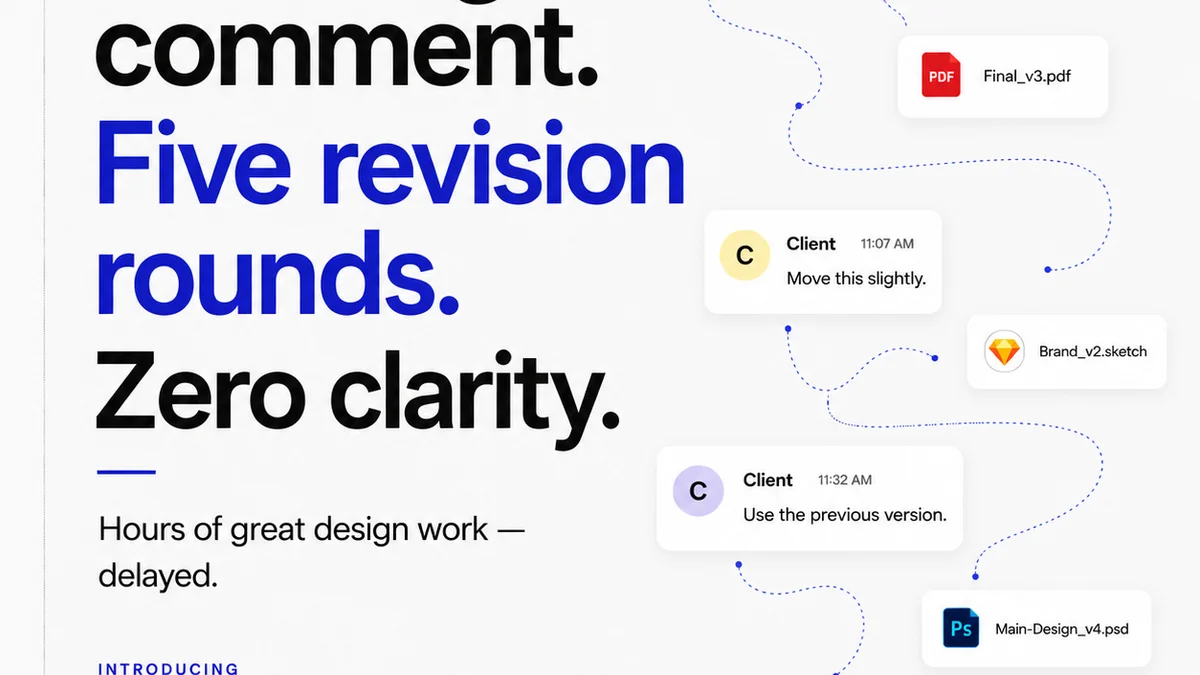
- Centralized Feedback: AI-generated assets, just like human-created ones, require feedback. Revue allows clients and stakeholders to provide precise, contextual feedback directly on the creative work, eliminating the confusion of scattered email threads or disparate chat messages.
- Revision Visibility: When AI assists in revisions, or when human designers iterate on AI outputs, Revue clearly tracks every version and every change. This transparency ensures everyone is working from the latest iteration and understands the evolution of the design.
- Streamlined Approvals: Getting sign-off on AI-assisted creative can be just as complex as traditional work. Revue simplifies the approval process, providing clear status updates and audit trails, ensuring that approved assets are ready for deployment.
- Quality Control: By providing a single source of truth for feedback and revisions, Revue helps maintain quality standards. It ensures that the final output aligns with client expectations and project briefs, mitigating the risks associated with poorly managed AI-generated content.
Revue doesn't replace AI, but it ensures that the output of AI is managed, refined, and approved efficiently, allowing you to accurately measure the *real* impact of your AI investments.
Final Thought
The AI revolution in design isn't about the tools themselves; it's about how intelligently you integrate them and rigorously you measure their contribution. Are you measuring adoption, or are you measuring impact? The difference is everything.
Frequently asked questions
What are vanity metrics for AI in design?
Vanity metrics for AI in design include tracking the sheer number of AI tools used or the volume of AI-generated assets produced. While these numbers might seem impressive, they don't necessarily indicate actual business value or efficiency gains. True success lies in measuring outcomes like time saved, cost reduction, improved quality, or increased client satisfaction.
How can I measure the time savings from AI tools?
To measure time savings, implement detailed time tracking for design tasks before and after introducing AI. Break down projects into granular steps and compare the time spent on AI-assisted tasks versus traditional methods. Crucially, include the time spent on prompting, refining, and integrating AI outputs in your calculations.
Is it possible to quantify the quality improvements from AI?
Yes, though it requires a structured approach. Quantify quality improvements by tracking client satisfaction scores, monitoring internal QA failures (like brand guideline breaches or errors), and assessing designer satisfaction. Look for a reduction in revision rounds related to subjective creative issues or an increase in adherence to defined quality standards.
How does AI impact creativity, and how can I measure it?
AI can impact creativity by speeding up ideation and exploration, presenting novel visual directions. Measure this by tracking the diversity and speed of concept generation at project initiation. While originality is subjective, observe if AI helps designers break stylistic ruts or enables entirely new visual outcomes. Client perception of innovation is also a key indicator.
How can a tool like Revue help measure AI success?
Revue helps measure AI success by providing a centralized platform to manage the entire creative process, from AI-generated drafts to final client approval. It offers clear visibility into feedback, revisions, and approvals, ensuring that the actual impact of AI on efficiency and quality can be accurately assessed within a structured workflow, rather than lost in scattered communication.