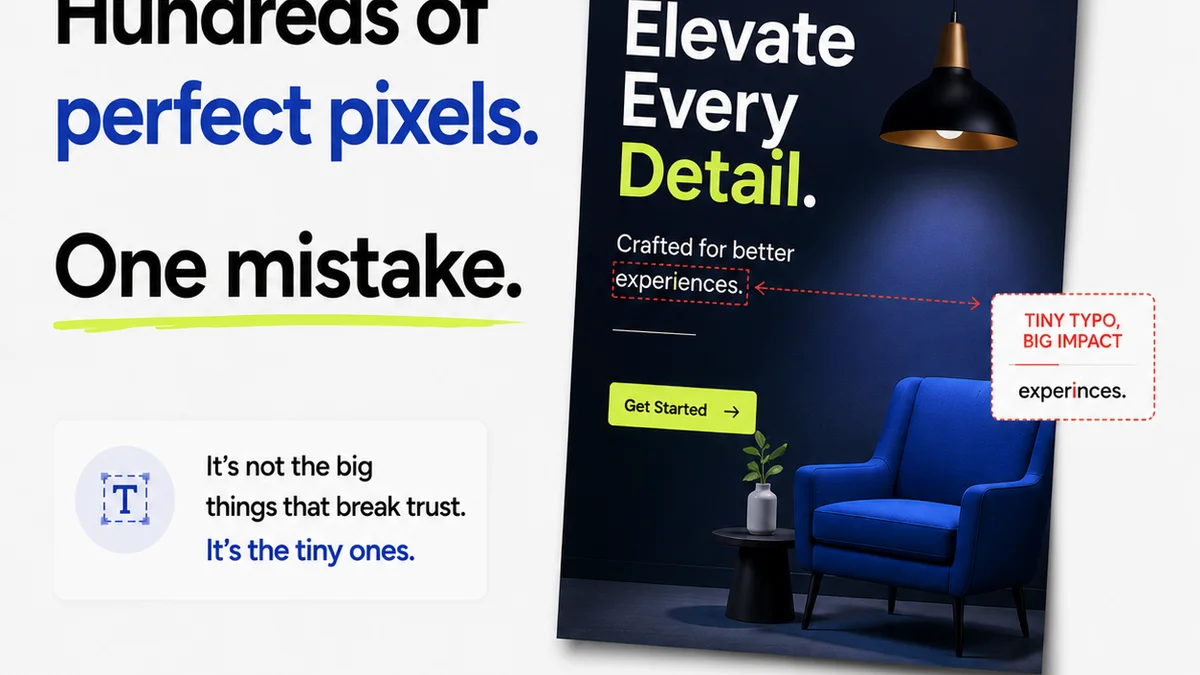
Everyone in the agency world talks about quality. We nod along, picturing polished final assets, pixel-perfect designs, and error-free copy. It’s the bedrock of client trust.
But what if I told you that most agencies are doing quality checks wrong? That the methods we’ve relied on for years are fundamentally flawed, leaving us exposed to avoidable mistakes?
The hard truth is that manual review, no matter how diligent, is prone to human error. We miss things. Especially when it comes to the fine print, the data buried in spreadsheets, or the legally mandated text on a piece of collateral.
1. The Myth of the Perfect Proofread
We assume a fresh pair of eyes, a checklist, or a dedicated QA person is enough. That a human can catch every typo, every misplaced decimal, every outdated piece of information.
This works for obvious errors.
But it fails spectacularly when the error is subtle, requires cross-referencing, or is simply lost in a sea of text. Think about a pricing table with one errant digit, a disclaimer that’s slightly out of date, or a product feature description that no longer matches the latest spec sheet.
These aren’t just typos; they’re potential liabilities.
The Cost of 'Close Enough'
- Missed deadlines due to late-stage error discovery.
- Client frustration over easily avoidable mistakes.
- Wasted agency time and resources on frantic fixes.
- Damage to your agency's reputation for meticulousness.
- Potential legal or financial repercussions from inaccurate data.
The truth is, our brains are wired to see patterns and fill in blanks, not to meticulously verify every single data point against an external source. We skim. We assume. We get tired.
2. Enter Optical Character Recognition (OCR)
OCR technology is often associated with digitizing old documents or extracting text from images. But its real power for agencies lies in its ability to *read* and *compare* text with machine precision.
Think of it as a tireless, infallible proofreader that never gets bored and never assumes.
When applied to quality checks, OCR can:
- Extract text from PDFs, images, scanned documents, and even video frames.
- Compare extracted text against a known source of truth (like a master spreadsheet or approved copy document).
- Flag discrepancies that a human might easily overlook.
This isn’t about replacing human judgment; it’s about augmenting it. It’s about automating the tedious, error-prone task of data verification so your team can focus on the creative and strategic elements.
Beyond Simple Text Extraction
Modern OCR goes beyond just pulling characters. It understands context, can identify specific data fields (like dates, prices, names), and can be trained to look for specific patterns or keywords.
This makes it incredibly powerful for checking:
- Legal disclaimers and terms & conditions.
- Product specifications and pricing.
- Contact information and addresses.
- Compliance-related text.
- Data within charts and graphs.
If it's text, OCR can help verify it.
3. Implementing OCR for Agency QA
Integrating OCR into your workflow isn't about buying a single piece of software and flipping a switch. It’s about strategic application.
Where OCR Shines Brightest
Start with the highest-risk areas:
- Financial Documents: Pricing tables, invoices, budget summaries. A single misplaced decimal can be costly.
- Legal & Compliance: Disclaimers, terms of service, regulatory text. Errors here can lead to lawsuits.
- Product Information: Specs, features, SKUs. Outdated info leads to customer confusion and returns.
- Client-Provided Data: Verifying client input against their own source documents ensures alignment.
Don't try to boil the ocean. Identify the 2-3 areas where errors cause the most pain and implement OCR-based checks there first.
The Workflow Integration
This typically involves:
- Defining the Source of Truth: Have a clean, approved document (e.g., a Google Sheet, a Word doc) that contains the correct information.
- Generating Assets: Create the design or copy asset that needs checking.
- OCR Extraction: Use an OCR tool to pull text from the generated asset.
- Comparison: Programmatically compare the extracted text against the source of truth.
- Flagging Discrepancies: Automatically highlight any differences for human review.
This process can be manual initially, but can be increasingly automated with the right tools.
4. Where Revue Fits In
Managing this entire process—from initial feedback to final approval and quality assurance—is where a platform like Revue becomes essential.
Revue centralizes client feedback, meaning all comments, markups, and discussions live in one place, tied directly to the asset. This reduces the chance of feedback getting lost or misinterpreted.
When it comes to revisions and approvals, Revue provides a clear, auditable trail. You can see exactly who approved what, and when. This visibility is critical for accountability.
And for quality checks? While Revue doesn't perform OCR itself, it acts as the central hub where you can manage the assets being checked. You can upload the final versions, run your OCR comparisons (perhaps using an integrated tool or a separate process managed via Revue's project structure), and then log the results of those checks before final client sign-off.
This ensures that the quality assurance step, including data verification powered by OCR, is a formally recognized part of your workflow, not an afterthought.
5. Final Thought
We chase perfection in creative work. But perfection isn't just about aesthetics; it's about accuracy. It’s about trust built on verifiable details.
Are you still relying on the fallible human eye for critical data verification, or are you embracing tools that can provide machine-level precision?
The future of agency QA isn't about working harder; it's about working smarter, with technology that catches what we miss.
Frequently asked questions
What is OCR and how does it apply to agency quality checks?
OCR (Optical Character Recognition) is technology that converts images of text into machine-readable text. For agencies, it means being able to extract text from PDFs, images, or scanned documents and compare it against a 'source of truth' document to automatically flag discrepancies in data, copy, or legal information that a human might miss.
Isn't manual proofreading sufficient for agency work?
Manual proofreading is essential for style, tone, and obvious errors. However, it's prone to human error, especially with large volumes of text, complex data, or when fatigue sets in. OCR provides a layer of precision for factual accuracy and data verification that manual checks often cannot reliably achieve.
What types of agency assets are best suited for OCR quality checks?
OCR is most valuable for assets containing critical data that needs to be exact. This includes pricing tables, financial reports, legal disclaimers, product specifications, contact information, and any text that must precisely match a master document or database.
Do I need expensive software to implement OCR quality checks?
While enterprise-level OCR solutions exist, many agencies can start with existing tools or more affordable options. The key is integrating OCR into your workflow to compare extracted text against a validated source document, which can often be achieved with scripting or specialized QA platforms.
How does a platform like Revue help with OCR-based quality checks?
Revue centralizes feedback, streamlines approvals, and provides an audit trail for your projects. While Revue itself doesn't perform OCR, it manages the assets and workflow. You can use Revue to store the final assets, manage the process of running OCR comparisons against them, and log the QA results before final sign-off, ensuring the check is part of an auditable process.