Everyone thinks great packaging design is about a killer concept and beautiful visuals. And sure, that’s part of it.
But that’s the easy part.
The hard truth? The real challenge in packaging design lies in the operational details that most creatives overlook. It’s about translating that stunning visual into a physical product that can be manufactured, shipped, sold, and experienced without a hitch.
1. The Brief: Beyond Pretty Pictures
Your client brief is the foundation. But often, it’s too focused on the 'what it looks like' and not enough on the 'how it works'.
Information Architecture for the Brief
- Brand Guidelines: Not just the logo and colors. What are the do’s and don’ts for typography, tone of voice, and imagery?
- Product Specifications: Dimensions, materials, weight, fragility. This is non-negotiable.
- Manufacturing Constraints: What printing processes are available? What are the minimum/maximum order quantities (MOQs)? Any die-line limitations?
- Supply Chain Realities: How will it be stored? Shipped (individually, in cases)? What are the environmental factors it will face?
- Retail Environment: Will it be on a shelf, hanging, stacked? What are the competitor’s packages like?
- Target Audience & Purchase Occasion: Who is buying this and why? Is it a gift? A daily essential?
- Legal & Regulatory Requirements: Ingredients, warnings, certifications, country-specific labeling.
Dig deep here. If the brief is vague, push back. A beautiful package that can’t be made or doesn’t comply is a failure, no matter how good it looks on mood boards.
2. Structural Integrity: The Unsung Hero
This is where beauty meets brute force. A package has to protect its contents. Period.
Key Structural Considerations
- Material Selection: Cardboard, plastic, glass, metal? Each has pros, cons, costs, and environmental impacts.
- Durability Testing: Can it withstand drops, stacking, moisture? Simulate real-world stress.
- Ease of Opening: Is it a fight to get into? Frustration kills the customer experience.
- Ease of Re-closure (if applicable): For food, cosmetics, etc., can the customer put it away easily?
- Tamper Evidence: Is security a concern? How is this integrated without looking clunky?
- Sustainability: Recyclable, compostable, made from recycled materials? Increasingly crucial.
Don’t let the structural engineer have all the fun. Understand the basics. A great design can be ruined by a flimsy box or a lid that won’t seal.
3. Print Production: The Devil in the Details
You’ve got the artwork. Now, how does it get onto the package? This is a minefield of potential errors.
Print Production Checklist
- Color Management: CMYK vs. Pantone. Understand the difference and when to use each. Ensure color profiles are correctly set.
- Die Lines & Bleeds: Are they accurate? Are bleeds sufficient to avoid white edges after cutting?
- Finishes & Effects: Matte vs. gloss varnish, spot UV, foil stamping, embossing, debossing. Understand the cost and application implications.
- Typography Legibility: Is that tiny legal text actually readable at size? Test it.
- Barcode Placement & Clarity: Will the barcode scan easily? Is it obstructed by design elements?
- Print Method Compatibility: Flexography, offset, digital. Each has limitations and strengths.
- Vendor Capabilities: Know what your chosen printer can actually do.
This isn't just about hitting the right Pantone color. It’s about ensuring the entire printed surface serves its purpose without looking cheap or being unreadable.
4. Logistics & Fulfillment: The Supply Chain Gauntlet
The package leaves the printer. Now what? It needs to survive the journey to the consumer.
Logistics & Fulfillment Points
- Shipping Case Pack Design: How many units per case? What are the dimensions and weight of the case?
- Palletization: How will cases be stacked on pallets for efficient shipping?
- Warehouse Storage: Will it withstand typical warehouse conditions (temperature, humidity, stacking)?
- Retail Shelf Presentation: Does it stand up properly? Can it be easily stocked by store staff?
- E-commerce Unboxing Experience: If shipped directly, is the *outer* packaging sufficient protection and part of the experience?
A beautiful product package might be fine on its own, but if it can’t be efficiently packed, shipped, and stocked, the entire operation grinds to a halt. Costs skyrocket.
5. User Experience (UX): The Moment of Truth
This is the payoff. The moment the customer interacts with the package.
UX Considerations
- First Impression: Does it look and feel premium, appropriate, exciting?
- Information Hierarchy: Is key information (product name, benefits, usage) easy to find?
- Ease of Use: Does it open, dispense, or function as expected?
- Sustainability Perception: Does the packaging communicate responsible choices?
- Disposal: Is it easy to recycle or dispose of properly?
This is where your design work connects directly with the end-user. Every detail, from the tactile feel of the material to the clarity of the instructions, matters.
Where Revue Fits In
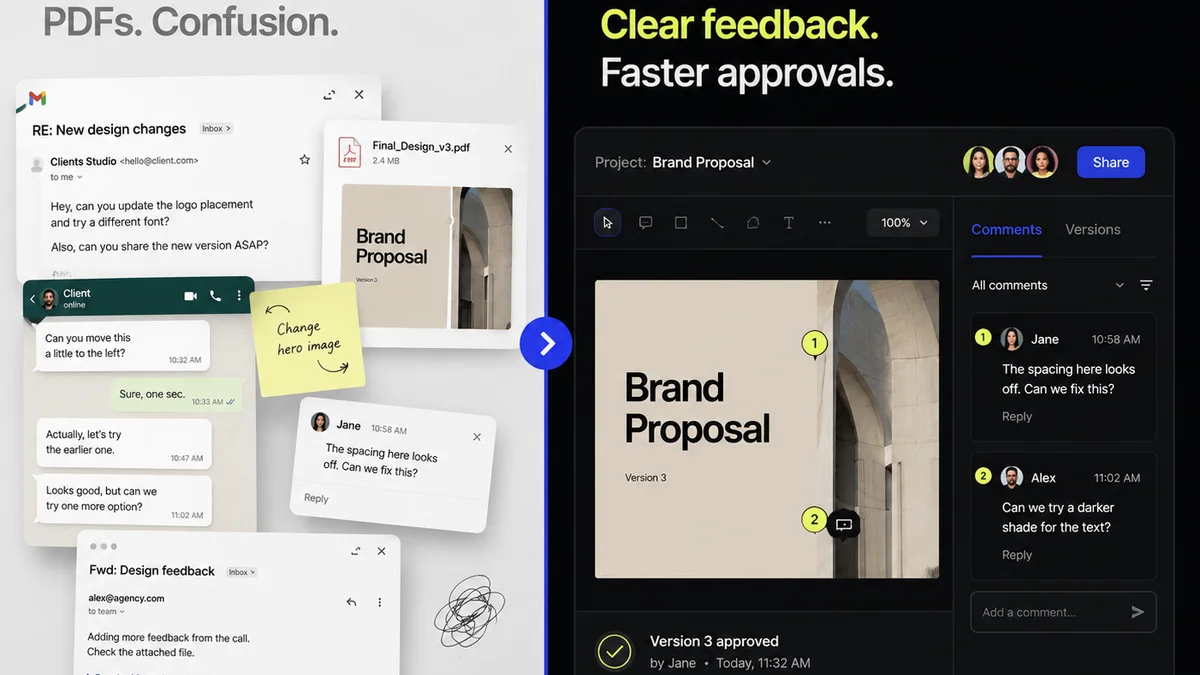
Managing a packaging project involves countless moving parts, stakeholders, and feedback loops. It’s easy for crucial details to get lost in translation.
Revue is built for this complexity.
- Centralized Feedback: Upload design mockups, structural drafts, and print proofs. All stakeholders comment in one place, with clear version history. No more hunting through email chains.
- Revision & Approval Tracking: See exactly who has reviewed what, their comments, and their approval status. Get clear sign-offs before moving to costly production.
- Quality Assurance Checks: Use checklists within Revue to ensure all critical elements—legal copy, barcodes, color targets, structural specs—are verified before final approval.
By streamlining communication and centralizing approvals, Revue helps ensure that the brilliant design you created actually makes it to market, flawlessly.
Final Thought
Packaging design isn’t just art. It’s engineering, logistics, and user experience rolled into one tangible object.
Are you designing for the screen, or for the shelf? For the client’s approval, or for the customer’s hands?
The best designs succeed on all fronts.
Frequently asked questions
What are the most common mistakes in packaging design briefs?
Common mistakes include a lack of detail on product specifications, manufacturing constraints, supply chain realities, and legal requirements. Briefs often focus too much on aesthetics and not enough on the functional and operational aspects needed for production and distribution.
How important is structural integrity in packaging design?
Structural integrity is paramount. The package must protect the product during transit and storage, be durable enough for its intended environment, and be easy for the consumer to open and use. A failure in structure can lead to damaged goods, poor customer experience, and increased costs.
What is the difference between CMYK and Pantone colors in printing?
CMYK (Cyan, Magenta, Yellow, Key/Black) is a subtractive color model used for full-color printing, mixing inks to create a spectrum of colors. Pantone is a proprietary color-matching system that uses a standardized set of colors (spot colors), ensuring consistent color reproduction across different printing processes and materials. Pantone is often used for specific brand colors that need to be exact.
How can feedback be managed effectively during a packaging design project?
Effective feedback management involves using a centralized platform like Revue to consolidate all comments, revisions, and approvals. This prevents confusion, ensures all stakeholders see the latest versions, and maintains a clear audit trail, reducing the risk of errors slipping through before production.