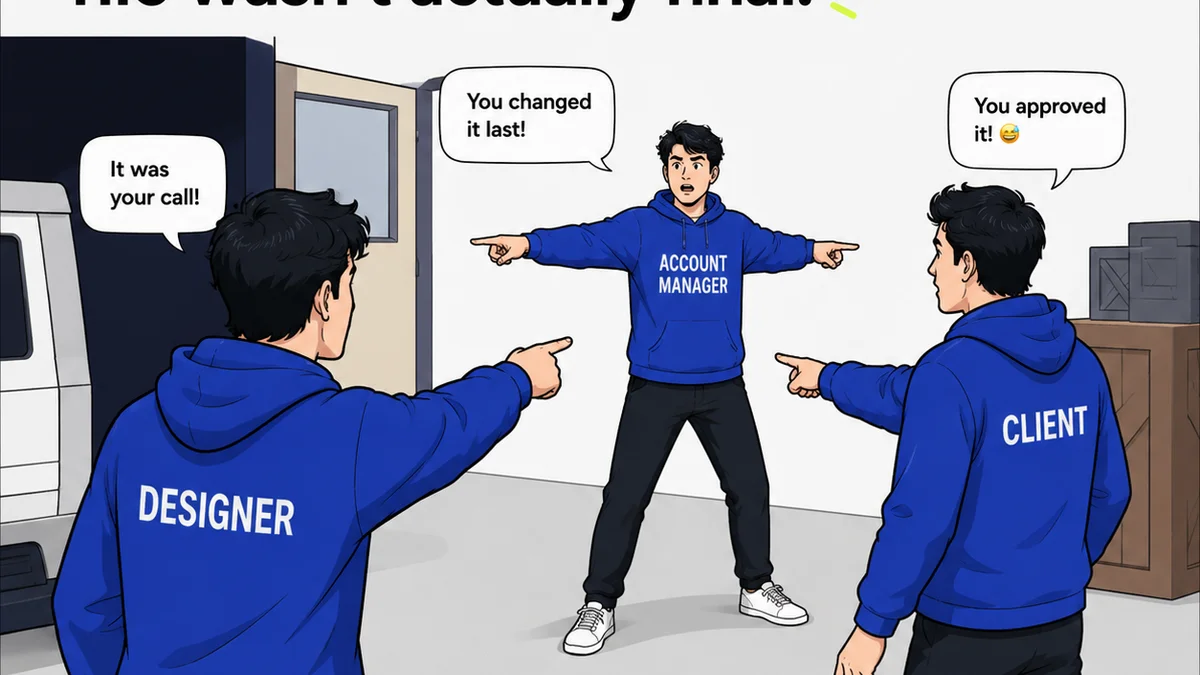
You think the biggest mistakes in print and publishing are typos and bad kerning. That designers miss deadlines. That clients don’t know what they want.
None of that is wrong. But it’s incomplete.
The real, costly errors in print and publishing—the ones that tank projects and burn through budgets—don't happen in the final proofread. They’re baked in much earlier, in how teams communicate, how feedback is managed, and how approvals are tracked.
It’s about operational friction, not just aesthetic slip-ups.
1. The Myth of the Single Source of Truth
The assumption: Everyone has access to the latest file. The latest brief. The latest client notes.
The hard truth: In most agencies, this is a fantasy. Files live in scattered folders, feedback is buried in email chains, and version control is a prayer.
This chaos leads to:
- Redundant work: Revisions made on outdated versions.
- Missed feedback: Critical notes lost in an inbox abyss.
- Scope creep disguised as clarification: “Oh, I thought you meant…”
- Endless back-and-forths: Chasing down the right information.
Consider a print ad campaign. The designer is working off V3. The copywriter is referencing V2. The client’s latest email about color palette changes is sitting unread in a junior account manager’s inbox. The printer is waiting for final specs that keep changing.
This isn’t a minor inconvenience. It’s a project killer.
The Fix: Centralized Workflow Hubs
You need a single place where all project assets, communication, and approvals live. Not just for the final handoff, but for the entire lifecycle of the project.
This means:
- All design files, copy, and supporting documents in one accessible location.
- All client and internal feedback logged directly against the specific asset or version.
- Clear version history, so you always know what’s current.
This isn’t about fancy software; it’s about a disciplined approach to information management.
2. The Approval Black Hole
The assumption: An approval is an approval. Once signed off, it’s done.
The hard truth: Unstructured approvals are fragile. They can be vague, conditional, or simply misunderstood, leading to a painful “callback” later.
Think about a complex brochure. The client approves the design layout. Then they approve the copy. Then they approve the color proofs. But somewhere along the line, a crucial detail about paper stock or finishing was overlooked.
Who is accountable? Where is the record of that specific approval point?
This can manifest as:
Frequently asked questions
What’s the most common operational mistake in print production?
Lack of a centralized system for feedback and approvals. This leads to confusion, outdated files, and missed revisions, often discovered too late in the process.
How can agencies prevent scope creep related to print projects?
By establishing clear communication channels and using a system that tracks all feedback and approvals against specific project versions. This makes it obvious when new requests fall outside the original scope.
Is version control really that important for print projects?
Absolutely. Without clear version control, teams can work on outdated files, leading to wasted effort, incorrect output, and significant delays. A single source of truth for all project assets is crucial.
How does managing feedback digitally help with print and publishing?
Digital tools centralize feedback, link it directly to assets, and create an auditable trail. This reduces misinterpretations, ensures all stakeholders see the same information, and streamlines the revision process, minimizing errors.