Everyone knows print collateral needs a final proofread. It’s the last step before hitting the presses. Seems simple enough.
None of that is wrong. But it’s incomplete.
For insurance marketing teams, print Quality Assurance (QA) is more than just catching typos. It’s a complex operational discipline with direct ties to regulatory compliance, brand consistency, and even sales effectiveness. Treating it as a mere final check misses the forest for the trees.
The Hard Truth About Print QA in Insurance
The real challenge with print QA in insurance isn't spotting a misplaced comma. It's managing the sheer volume, complexity, and regulatory scrutiny inherent in financial services marketing. Every flyer, brochure, and direct mail piece is a potential compliance minefield. Errors aren't just embarrassing; they can be costly and legally damaging.
This means your print QA process needs to be robust, repeatable, and deeply integrated into your workflow, not an afterthought.
1. The Compliance Gauntlet: More Than Just Legal Review
Insurance marketing is heavily regulated. Every claim, offer, disclaimer, and rate needs to be accurate and compliant with state and federal laws. Your print QA process must bake this in from the start.
Beyond a Single Legal Pass
A single pass by legal or compliance isn't enough. They review for adherence to regulations, but they aren't proofreaders. They also may not catch subtle brand misalignments or outdated product information.
- Regulatory Accuracy: Does the ad clearly state all required disclosures? Are rates presented correctly?
- Product Alignment: Does the collateral accurately reflect current policy offerings and terms?
- Brand Voice & Tone: Does the language align with the company's established brand identity?
- Target Audience Appropriateness: Is the messaging suitable and clear for the intended policyholder?
This requires a multi-layered QA approach, not a single gatekeeper.
2. Brand Consistency: The Unseen Risk
Think about your brand. It’s more than a logo and a color palette. It’s the promise you make to your customers. In insurance, trust is paramount, and brand consistency is a huge part of that.
Inconsistent branding across print materials erodes that trust. It makes your agency look sloppy and unprofessional. This is especially true for distributed teams where local agents might be creating their own materials.
What to Watch For
- Visual Identity: Are logos, fonts, and brand colors used correctly and consistently?
- Messaging Alignment: Is the core value proposition communicated uniformly across all touchpoints?
- Tone of Voice: Does the language feel like it's coming from the same, trusted source?
- Imagery: Are the images used on-brand and appropriate for the target audience?
Every piece of print collateral is a brand ambassador. Make sure it’s a good one.
3. Workflow Bottlenecks: The Enemy of Efficiency
A clunky, manual print QA process creates bottlenecks. This delays campaigns, frustrates teams, and increases costs.
Imagine waiting days for a single revision cycle on a print ad. That’s time your sales team could be using to reach customers. It’s also an invitation for errors to creep in as files are passed around.
Common Bottlenecks Include:
- Manual Feedback: Relying on email chains, scattered notes, or verbal feedback is inefficient and error-prone.
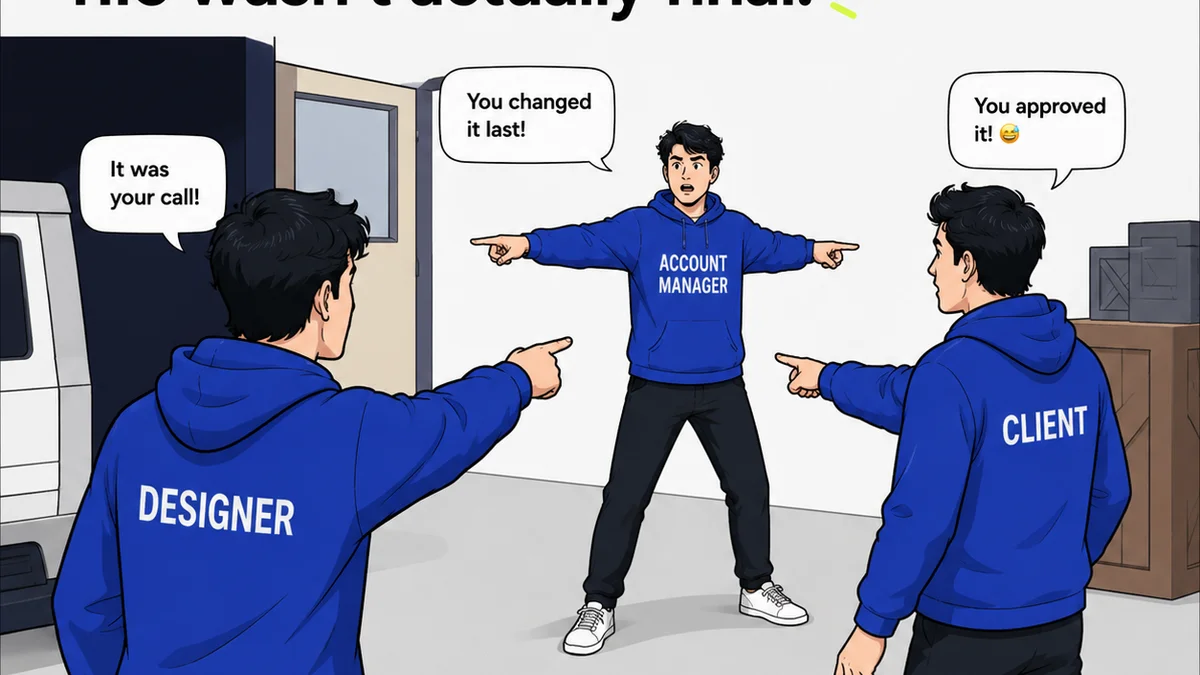
- Version Control Chaos: Knowing which version is the latest and greatest can be a nightmare.
- Lack of Centralization: Teams working in silos leads to duplicated effort and missed communication.
- Delayed Approvals: Stakeholders not having a clear, streamlined way to approve or reject content.
These aren't just minor inconveniences; they directly impact your marketing team's ability to execute effectively.
4. The Cost of Errors: Beyond the Printing Bill
The cost of a print error goes far beyond the expense of reprinting. Consider the downstream effects:
- Regulatory Fines: Non-compliance can lead to significant penalties.
- Reputational Damage: A public error can severely harm customer trust.
- Lost Sales Opportunities: Delayed campaigns mean missed market windows.
- Wasted Resources: Time and money spent correcting errors could be used for revenue-generating activities.
Each mistake is a drain on your resources and a risk to your business.
Where Revue Fits In
This is where a dedicated platform for creative review and approval becomes essential. Revue provides a centralized hub for managing all your creative assets, including print collateral.
Instead of relying on scattered emails and endless spreadsheets, you can manage the entire print QA process within a single, organized system.
- Centralized Feedback: All stakeholders provide feedback directly on the design files within Revue. No more hunting through email threads.
- Clear Revision History: Track every change, comment, and approval. This ensures transparency and accountability.
- Streamlined Approvals: Set up clear approval workflows. Know exactly who needs to sign off and when.
- Version Control: Always work with the latest version. Reduce errors from outdated files.
- Integrated Quality Checks: Ensure all necessary compliance and brand checks are performed before final sign-off.
Revue helps transform print QA from a chaotic, manual chore into a controlled, efficient operational process. It ensures accuracy, consistency, and compliance, allowing your marketing team to focus on strategy, not just proofreading.
Final Thought
Print collateral is still a vital part of the insurance marketing mix. But its effectiveness hinges on a rigorous, integrated QA process. Are you treating print QA as a mere formality, or as the critical operational control point it truly is?
Frequently asked questions
What is the primary difference between standard proofreading and print QA for insurance marketing?
Standard proofreading focuses on text-based errors like typos and grammar. Print QA for insurance marketing is a broader process that includes regulatory compliance checks, brand consistency verification, accuracy of product details, and ensuring all required disclosures are present and correct, in addition to proofreading.
How can print QA help maintain brand consistency in insurance marketing?
Print QA ensures that logos, fonts, color palettes, imagery, and tone of voice are used consistently across all print materials. This reinforces brand identity and builds customer trust, which is crucial in the insurance industry.
What are the biggest risks of inadequate print QA in insurance?
The biggest risks include regulatory fines due to non-compliance, significant damage to brand reputation, lost sales opportunities from delayed campaigns, and wasted financial and human resources on correcting errors.
How does a platform like Revue improve the print QA process?
Revue centralizes feedback and approvals, provides clear version control, tracks revision history, and streamlines workflows. This reduces errors, speeds up the process, and ensures all stakeholders can contribute efficiently and transparently, making QA more robust and less prone to bottlenecks.