Everyone talks about agency scalability. The common wisdom? Hire more talent. Bring in more clients. That’s the path to growth, right?
None of that is wrong. But it’s incomplete. Dangerously so.
The hard truth is that raw talent and client volume are accelerators, not the engine itself. If your agency is a car without a well-maintained transmission, you’re going to grind gears, burn out your clutch, and eventually seize the engine. You can add a bigger engine (more hires), but it won’t fix the fundamental problem.
The real engine of scalable growth? Documented process. And I don’t mean a dusty binder on a shelf. I mean living, breathing, embedded workflows that make your agency predictable, repeatable, and yes, scalable.
1. The Myth of the 'Tribal Knowledge' Agency
Many agencies pride themselves on their “culture” and “creativity.” They operate on the assumption that the magic happens in spontaneous bursts of genius, fueled by a handful of brilliant individuals.
This often translates to a reliance on “tribal knowledge.” Key processes, client nuances, and best practices live only in the heads of senior staff. It’s efficient, in a way. For them.
But what happens when that person leaves?
- Projects stall.
- Clients get confused.
- New hires struggle to get up to speed.
- Quality dips.
- Your agency’s capacity is capped by individual capacity.
This isn’t a culture; it’s a bottleneck disguised as expertise.
The Cost of Unwritten Rules
The cost of tribal knowledge is hidden but immense. It’s the time spent on repeated questions. It’s the onboarding delays. It’s the errors that stem from inconsistent execution. It’s the missed opportunities because no one has a clear, documented playbook for pursuing them.
Scalability requires consistency. Consistency requires documented processes.
2. Building a Predictable Machine, Not a Star System
Your goal isn’t to build an agency of lone geniuses. It’s to build a high-performing team that can deliver exceptional work, consistently, regardless of who is assigned to the project.
This is where process documentation transforms your agency from a precarious star system into a well-oiled machine.
What Process Documentation Actually Is
It’s not about stifling creativity. It’s about creating guardrails and repeatable steps so that creative energy is focused on the *problem*, not on figuring out the *how*.
Process documentation covers:
- Onboarding new clients: From initial brief to kickoff meeting checklist.
- Project kickoff: Standard agenda, required information, stakeholder identification.
- Creative brief development: Standard template, key questions to ask, approval steps.
- Design and development workflows: File naming conventions, version control, approval stages, QA checklists.
- Client feedback loops: How to solicit, consolidate, and action feedback.
- Revision management: Number of rounds, sign-off procedures, scope creep protocols.
- Project closeout: Final delivery, debriefing, asset archiving.
- Internal communication standards: Meeting cadences, reporting structures, tool usage.
Each of these is a mini-system that, when documented and followed, reduces friction.
The Ripple Effect of Clarity
When processes are clear, everyone knows their role and what’s expected. This:
- Reduces ambiguity.
- Minimizes errors and rework.
- Speeds up project timelines.
- Improves client satisfaction through predictable delivery.
- Empowers junior team members to perform at a higher level.
- Frees up senior talent for strategic work.
This isn’t about bureaucracy. It’s about removing obstacles to great work.
3. The Onboarding Accelerator
Think about your current onboarding process for new hires. How long does it take for a junior designer or a new account manager to become fully productive?
If it’s weeks or months, you have a problem. A problem directly solvable by process documentation.
From Chaos to Competence
A well-documented agency has a clear path for new team members:
- Welcome Packet: Agency values, mission, org chart.
- Tool Setup Guide: Step-by-step instructions for accessing and using essential software.
- Workflow Manuals: Detailed guides for common tasks and project phases.
- Client Case Studies: Examples of successful projects and how they were executed.
- Glossary of Terms: Agency-specific jargon and industry acronyms.
- Mentorship Program Guidelines: How senior staff support junior hires.
New hires can hit the ground running. They can find answers to their questions independently. They feel empowered and integrated faster.
This drastically cuts down ramp-up time and gets valuable people contributing sooner.
4. De-Risking Your Client Relationships
Clients hire agencies for expertise and reliability. They don’t want to feel like they’re part of an unpredictable experiment. They want assurance that their project will be handled professionally, on time, and on budget.
Documented processes are your best defense against client dissatisfaction and scope creep.
Standardizing Client Interactions
When you have documented processes for:
- Briefing: Ensuring you capture all necessary information upfront.
- Feedback collection: Establishing clear channels and expectations for client input.
- Revision rounds: Defining the scope and number of revisions allowed.
- Approvals: Creating formal sign-off points.
- Communication: Setting expectations for response times and meeting cadences.
You create a framework that benefits both sides.
Clients understand the workflow. They know when to expect updates and deliverables. They have clear points to provide input. This transparency builds trust.
It also provides a solid basis for addressing scope creep. If a client asks for something outside the documented process, you have a clear reference point to discuss it.
5. Where Revue Fits In
You might be thinking, “This sounds like a lot of work. How do I even manage it all?”
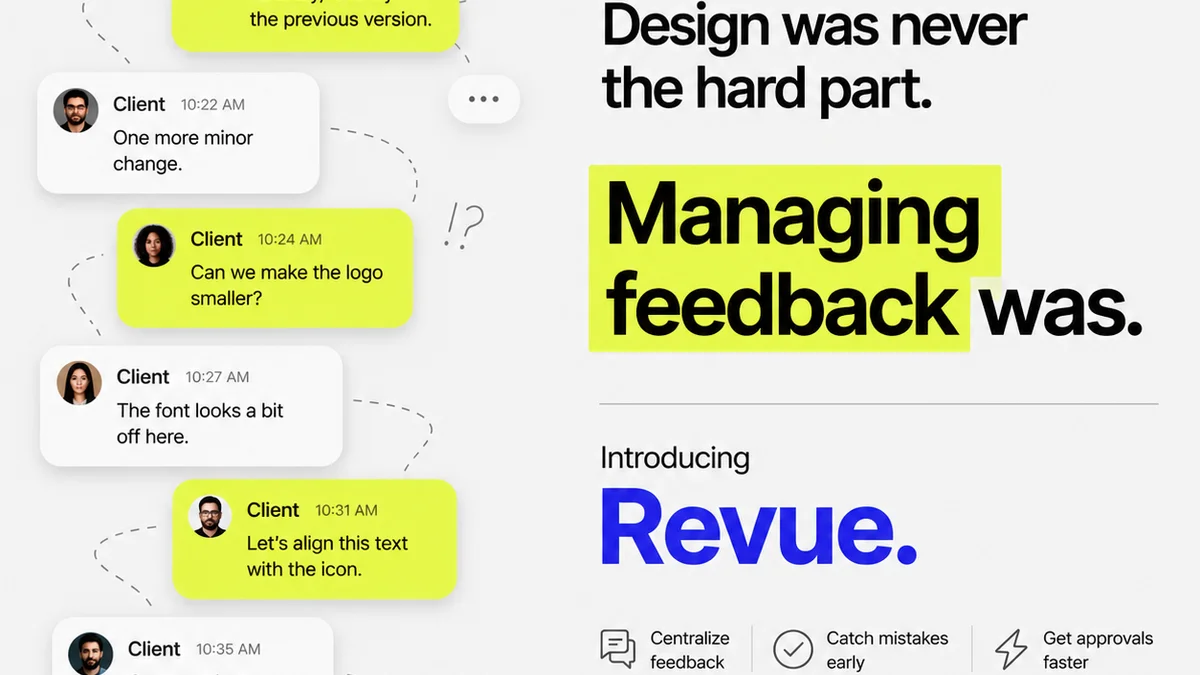
That’s where tools designed for creative workflows become invaluable. A platform like Revue isn't just about collecting feedback; it's about embedding process into your daily operations.
Centralizing Feedback and Revisions
Revue allows you to:
- Centralize all client feedback: No more hunting through emails or Slack threads. All comments, annotations, and approvals live in one place, attached to the specific creative asset.
- Visualize the revision process: See exactly where a project stands, who needs to provide input, and what feedback has been actioned. This transparency is key to keeping projects on track.
- Streamline approvals: Formal sign-offs within the platform provide a clear audit trail, reducing disputes and clarifying project status.
- Maintain version control: Easily track revisions and ensure everyone is working from the latest approved version.
- Perform quality checks: Use the platform to ensure all deliverables meet the agreed-upon standards before final delivery.
By digitizing and standardizing these critical touchpoints, Revue helps make your documented processes actionable and efficient. It turns your process documentation from static guidelines into a dynamic, living part of your agency’s workflow.
6. The True Measure of Scalability
Scalability isn't just about revenue. It's about capacity. It's about your agency's ability to take on more work, serve more clients, and tackle bigger projects without a proportional increase in chaos or a decrease in quality.
It’s about predictability.
When you have documented processes, you’re not just hiring people; you’re multiplying your agency’s capability. You’re building a system that can absorb growth without breaking.
The Long Game
Investing time in documenting your workflows is not a bureaucratic chore. It’s a strategic investment in your agency’s future.
It’s the difference between an agency that grows haphazardly and one that grows intentionally.
It’s the difference between an agency that’s constantly putting out fires and one that’s building something lasting.
Final Thought
What if the next big hire you need isn’t a person, but a process? What if the bottleneck isn’t talent, but the lack of a clear, documented path for that talent to follow?
Consider this: If your agency’s success hinges on any single person, you’re not scalable. You’re vulnerable.
Frequently asked questions
What is 'tribal knowledge' in an agency, and why is it a problem for scalability?
Tribal knowledge refers to critical information, processes, and best practices that exist only in the minds of a few key individuals within an agency. While it can seem efficient for those individuals, it creates significant bottlenecks for scalability. If that person leaves or is unavailable, the agency loses vital expertise, projects can stall, and consistency suffers. Documenting these processes makes them accessible to everyone, reducing reliance on individuals and enabling smoother growth.
How does process documentation actually help with creativity, rather than stifle it?
Process documentation provides clear guardrails and repeatable steps, allowing creative energy to be focused on solving the client's problem rather than on figuring out the operational 'how-to.' By standardizing mundane tasks, approvals, and feedback loops, creative professionals are freed up to innovate and explore solutions within a structured framework, leading to more effective and efficient creative output.
What are the key areas an agency should focus on when documenting its processes?
Key areas include client onboarding, project kickoff, creative brief development, design and development workflows (including file naming and version control), client feedback loops, revision management, project closeout procedures, and internal communication standards. Essentially, any recurring task or interaction that impacts project delivery and client satisfaction is a candidate for documentation.
How can tools like Revue help in implementing and managing process documentation?
Tools like Revue help by digitizing and centralizing critical workflow steps. They provide a clear, visual platform for managing client feedback, tracking revisions, and formalizing approvals, embedding process directly into daily operations. This makes documented workflows actionable and reduces the friction associated with manual tracking and communication, turning static documents into dynamic, efficient systems.